
2026 Small Bathroom Remodel at a Glance
A small bathroom is one of the hardest-working rooms in your home — and one of the smallest line items in your floor plan. At 40 square feet or less, it doesn't look like a complicated project. But once you start pricing out tile, plumbing, a new vanity, and labor, the numbers add up fast. We've helped thousands of homeowners plan and budget small bathroom remodels across Northern Virginia, Maryland, and beyond, and the single most common regret we hear is "I wish I'd understood the real costs before I started."
This guide is built to fix that. We break down every cost — by size, by component, by budget tier — using 2026 pricing that reflects this year's tariff impacts, labor shortages, and material trends. Refreshing a tired powder room for $2,000 and gutting a 5×8 bathroom for $15,000 are very different projects — but both require the same clarity on costs. You'll find the numbers, the trade-offs, and the strategies to spend wisely on every type of small bathroom remodel in the sections below.
How Much Does a Small Bathroom Remodel Cost in 2026?
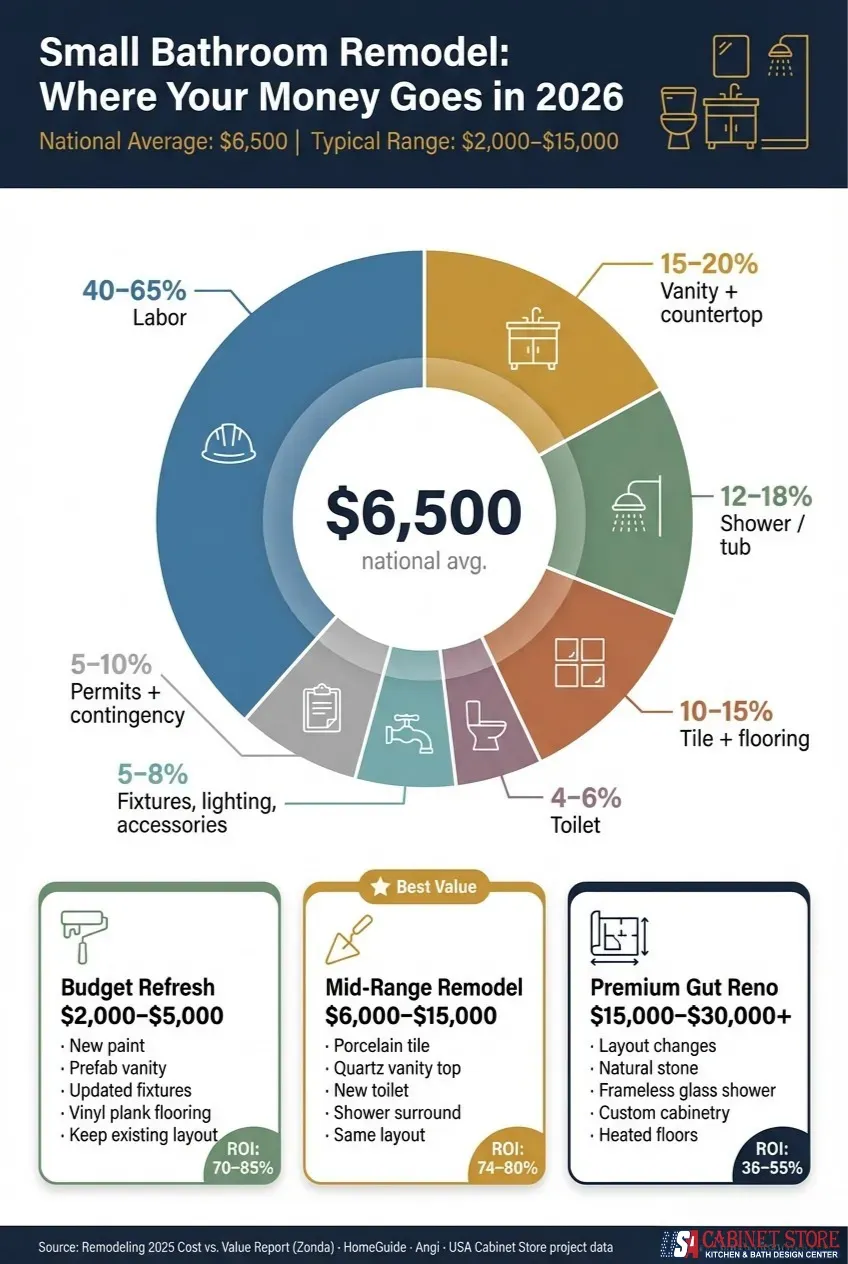
The question we hear most often — usually in the first five minutes of a consultation — is "what's this going to cost me?" The honest answer: about $6,500 for a typical small bathroom remodel in 2026, though the real range runs from $2,000 for a basic refresh to $15,000+ for a full gut renovation.
Small bathrooms are usually 40 square feet or less — those familiar 5×7 or 5×8 spaces found in most American homes. They look simple. They are not. Every major trade shows up in a bathroom — plumbing, electrical, tile, carpentry — which is why costs per square foot run higher than in larger rooms.
Costs have climbed 4–6% compared to 2025, driven by two forces: skilled-labor shortages and new import tariffs on cabinetry and fixtures. At the per-square-foot level, expect $80–$120 for a budget refresh, $180–$280 for mid-range work, and $300–$500+ for premium finishes (sources: HomeGuide, This Old House, our own national pricing data).
Small Bathroom Remodel Cost by Size
Dimensions drive material quantities — tile, flooring, paint — and labor hours. A 3×5 powder room and a 5×10 bathroom are completely different jobs even if you pick the same finishes.
| Bathroom Size | Sq. Ft. | Budget Refresh | Mid-Range Remodel | Full Gut Renovation |
|---|---|---|---|---|
| 3×5 (powder room) | 15 | $2,000–$3,500 | $3,500–$5,500 | $5,500–$8,500 |
| 5×5 | 25 | $2,500–$4,000 | $4,500–$7,000 | $7,000–$10,000 |
| 5×7 | 35 | $2,800–$4,500 | $5,500–$9,000 | $9,000–$13,000 |
| 5×8 | 40 | $3,200–$4,800 | $7,200–$11,200 | $11,200–$15,000 |
| 5×10 | 50 | $4,000–$6,000 | $9,000–$14,000 | $14,000–$18,000 |
Cost-per-square-foot drops as bathrooms get larger because fixed costs — a toilet, a vanity, a shower — spread across more area. A 3×5 powder room can hit $200+ per square foot. A 5×10 bath might average $140–$180 for the same quality level.

For layout strategies in tight spaces, see our 21 bathroom remodeling ideas.
Cost by Bathroom Type
The type of bathroom matters as much as its square footage. A half bath with a toilet and sink is a fundamentally different project from a small primary bath with a shower, tub, and upgraded finishes.
| Bathroom Type | What It Includes | 2026 Cost Range |
|---|---|---|
| Half bath / powder room | Toilet, sink, vanity, mirror | $5,000–$8,500 |
| Small full bathroom | Toilet, sink, vanity, tub/shower combo | $5,500–$10,000 |
| Small primary bathroom | Full bath with upgraded finishes, better fixtures | $8,000–$15,000 |
| Half-to-full conversion | Adding a shower or tub to an existing half bath | $7,000–$15,000 |
| Tub-to-shower conversion | Removing tub, installing walk-in shower | $2,500–$8,000 |
Half-to-full conversions carry the highest per-square-foot costs. New plumbing rough-in — drain lines, supply pipes, waterproofing — adds thousands before you even pick a tile. For tub-to-shower conversions, see our shower remodeling cost breakdown and shower-to-bathtub conversion guide.
Complete Cost Breakdown by Component
Where does the money actually go? We hear that question constantly. The table below shows installed costs per component for a small bathroom in 2026, drawn from Angi, HomeGuide, HomeAdvisor, and our own project data.
| Component | Budget Range | Mid-Range | Premium |
|---|---|---|---|
| Vanity (with sink & faucet) | $525–$1,200 | $1,200–$2,940 | $3,000–$5,000+ |
| Toilet | $105–$630 | $630–$1,200 | $1,500–$5,000 |
| Bathtub replacement | $400–$1,500 | $2,000–$4,500 | $5,000–$9,400 |
| Shower (walk-in, custom tile) | $210–$2,000 | $4,000–$7,000 | $7,875–$15,000+ |
| Floor tile (installed) | $525–$1,200 | $1,200–$2,500 | $2,500–$3,700 |
| Wall tile / tub surround | $200–$800 | $1,000–$3,000 | $3,000–$8,000 |
| Countertop (vanity top) | $100–$300 | $400–$900 | $900–$2,000 |
| Lighting (per fixture) | $32–$150 | $150–$400 | $400–$800+ |
| Faucets & showerhead | $50–$200 | $200–$500 | $500–$1,200 |
| Mirror / medicine cabinet | $50–$150 | $150–$500 | $500–$2,000 |
| Painting | $70–$250 | $150–$350 | $350–$600 |
| Exhaust fan | $50–$150 | $150–$300 | $300–$500 |
| Accessories (towel bars, etc.) | $50–$150 | $150–$400 | $400–$800 |
Two items dominate: the vanity and the shower or tub. Together they often account for 40–50% of material costs. For vanity pricing details, see our bathroom cabinet cost guide.
How to Choose the Right Vanity for a Small Bathroom
We sell vanities and cabinets every day, and the mistake we see most often in small bathrooms is picking one that's either too big for the room or too cheap for the house. The vanity sets the tone. Get it right and the entire bathroom looks intentional.
Vanity Sizes for Small Bathrooms
In bathrooms under 40 square feet, the most popular widths are 24, 30, and 36 inches. A floating (wall-mounted) vanity opens up visual floor space and makes the room feel bigger — it's also one of the top design trends in 2026. For a 5×7 layout, a 30-inch floating vanity hits the sweet spot between counter space and clearance.
Stock vs. Semi-Custom vs. Custom
| Vanity Type | Unit Cost | Installed Cost | Best For |
|---|---|---|---|
| Stock / prefabricated | $525–$2,940 | $630–$3,200 | Budget and mid-range projects; fastest delivery |
| Semi-custom | $800–$3,200 | $1,500–$3,800 | Specific size needs; modified finishes and hardware |
| Custom-built | $1,000–$3,500+ | $1,500–$4,500+ | Unusual dimensions; luxury finishes; complex layouts |
A 50% tariff on imported bathroom vanities took effect October 1, 2025, pushing vanity costs up by an estimated 20–28% compared to 2024. If your project timeline allows, purchasing early — before further increases — can save $400 to $2,000 on this single component. Domestically produced and assembled vanities, like the brands we carry at USA Cabinet Store, help offset some of this pressure.
We carryFabuwood, Wolf Classic, Showplace, and Ultracraft, all of which offer sizes suited for small bathrooms. Browse our bathroom vanity types guide for detailed comparisons, or see our bathroom cabinet collection directly.
Labor Costs
Labor is the single biggest line item in most bathroom remodels. It's not unusual for it to account for 40–65% of the total. And in 2026, skilled trades are harder to book than ever — plumber and electrician rates have climbed noticeably year over year, according to data from the National Association of Home Builders (NAHB).
| Trade | 2026 Rate | YoY Change |
|---|---|---|
| General contractor | $300–$500/day | +4–6% |
| Plumber | $85–$175/hr | +8–10% |
| Electrician | $60–$145/hr | +6–8% |
| Tile installer | $12–$22/sq ft | +10–15% |
| Painter | $30–$60/hr | +3–5% |
Metro-area contractors charge $50–$100+ per hour. Smaller cities and rural areas run $30–$70. The bigger challenge right now is availability — many contractors are booking 8–12 weeks out. If you have a target completion date, start reaching out to contractors early.
Additional Costs to Plan For
These are the expenses that catch homeowners off guard. We see it on almost every project — the budget was built around fixtures and tile, and nobody planned for demo, permits, or the water damage hiding behind the old tub surround.
| Item | Typical Cost | Notes |
|---|---|---|
| Demolition & removal | $390–$2,100 | Dumpster rental ($160–$630/day) often extra |
| Permits | $200–$1,000 | Required for plumbing, electrical, structural work |
| Water damage repair | $3.75–$7/sq ft | Found in ~30% of bathroom remodels |
| Design consultation | $200–$400 | Prevents costly mid-project changes |
| Contingency | 15–20% of total | Industry standard — do not skip this |
Water damage is the wild card. According to Angi, roughly 30% of bathroom remodels uncover damage behind walls or under flooring once demo starts. That's exactly why a 15–20% contingency isn't optional. It's a safety net you will probably need.
Budget vs. Mid-Range vs. Premium
Not every project needs to be a gut renovation. The right tier depends on your goals — selling soon, staying long-term, or just fixing something that's genuinely worn out.
Budget Refresh: $2,000–$5,000
Fresh paint, new fixtures (faucet, showerhead, lighting), a prefabricated vanity, and budget flooring like luxury vinyl plank. The existing layout, tub, and plumbing all stay put. Refinishing the tub ($300–$600) instead of replacing it is the hallmark of this tier. ROI at resale: 70–85%.
Mid-Range Remodel: $6,000–$15,000
New vanity with a quartz or solid-surface countertop. Porcelain tile on the floor and in the shower surround. New toilet. Updated fixtures and lighting throughout. Fresh paint. Same layout. This is the sweet spot — dramatic transformation, no plumbing relocation. ROI: approximately 74–80%, the strongest return for this project type since 2007 according to the Remodeling 2025 Cost vs. Value Report (costvsvalue.com).
Premium / Upscale: $15,000–$30,000+
Layout changes, custom tile with natural stone, frameless glass walk-in shower, custom cabinetry, heated floors, smart technology, designer hardware. Spa-level results. But the ROI drops to 36–55% at resale. Best justified if you plan to stay in the home long-term and will enjoy it daily.
2026 Cost Trends and Market Factors
Normal inflation would push costs up 2–3% per year. In 2026, we're seeing 4–6%. Two factors are responsible.
Tariffs on imported fixtures and cabinetry. A 50% tariff on imported bathroom vanities hit in late 2025. Broader tariffs on Chinese-manufactured goods — porcelain tile, plumbing fixtures, lighting components, hardware — are adding 20–30% to certain material categories. This is one reason we emphasize American-assembled products in our bathroom cabinet collection. They're not immune to cost increases, but they avoid the steepest tariff impacts.
Labor market tightness. Plumber rates have jumped 8–10% year-over-year. Electricians are up 6–8%. The shortage is most acute in the mid-Atlantic and West Coast. It's extending project timelines by 1–2 weeks in many markets and pushing hourly rates higher.
Materials themselves have stabilized compared to the 2021–2023 chaos. Most non-tariffed categories are up a modest 2–3% annually. The exceptions — vanities, imported tile, certain plumbing fixtures — are where the pain is concentrated.
Contractor availability fluctuates seasonally, and rates can vary by 10–15% depending on demand in your market. Ask local contractors when their slower periods fall — scheduling during those windows often means shorter lead times and more competitive bids. Planning 2–3 months ahead is essential regardless of season.
For Northern Virginia–specific pricing, see our Fairfax County bathroom remodeling cost guide or try the NOVA remodeling cost calculator.
Regional Cost Comparison
Where you live changes the math more than almost any design decision. Labor rates vary 2–3× between the most and least expensive markets, and that difference flows through the entire project.
| Region / Market | Small Bath Typical Range | vs. National Avg |
|---|---|---|
| San Francisco Bay Area | $10,000–$22,000 | +50–100% |
| New York City | $9,000–$20,000+ | +40–80% |
| Northern Virginia / DC Metro | $8,000–$16,000 | +25–35% |
| Seattle | $8,500–$15,000 | +25–40% |
| Chicago | $6,500–$13,000 | +5–15% |
| National Average | $6,500 | Baseline |
| Texas (major metros) | $5,000–$10,000 | −10–20% |
| Florida | $5,000–$10,000 | −5–15% |
| Ohio / Midwest | $4,500–$9,000 | −15–25% |
| Arkansas / Rural South | $3,500–$7,500 | −20–35% |
These ranges assume comparable scope. The primary driver is labor cost — a plumber in San Francisco charges twice what a plumber in Little Rock does for the same work (sources: HomeAdvisor, Badeloft USA).
ROI and Home Value Impact
Bathrooms remain one of the most reliable places to put renovation dollars. The Remodeling 2025 Cost vs. Value Report (published by Zonda, available at costvsvalue.com) puts a mid-range bathroom remodel at roughly 74–80% ROI — meaning for every $10,000 spent, you add $7,400 to $8,000 in resale value. That's the strongest return for this project type since 2007.
| Remodel Tier | Typical ROI | Source |
|---|---|---|
| Budget / cosmetic refresh | 70–85% | Industry estimates, Fixr |
| Mid-range full remodel | 74–80% | Remodeling 2025 Cost vs. Value Report (Zonda) |
| Universal / accessible remodel | ~61% | Remodeling 2025 Cost vs. Value Report |
| Upscale / luxury remodel | 36–55% | This Old House, Today's Homeowner |
The National Kitchen & Bath Association (NKBA) recommends spending 5–10% of your home's value on a primary bathroom remodel and 3–5% on a secondary. For a $400,000 home, that's $12,000–$20,000 for the primary bath — squarely in the mid-range tier for a small bathroom.
The highest-performing states for bathroom ROI include South Dakota (93.5%), Arkansas, Nevada, California, and Oregon, per state-level analysis from Fixr. For more on resale value, see why small bathroom remodeling is a valuable investment.
2026 Design Trends Affecting Cost
Design choices have real budget consequences. Some of the hottest trends this year happen to be affordable. Others will test your contingency fund.
Warm earth tones are replacing stark whites. Clay, olive, sage, taupe, terracotta — these colors are showing up in tile and paint selections everywhere (sources: Re-Bath, Kitchen Concepts Plus). Good news: this is mostly a color choice. The tile costs the same in sage as it does in white. The exception is handmade or artisanal tile (zellige, for example), which can add $5–$15 per square foot over standard options.
Walk-in showers keep gaining ground over tubs. In small bathrooms, removing a bulky tub and replacing it with a frameless glass walk-in shower makes the room feel twice its size. But custom walk-in showers start at $7,875, so this is a commitment. A simpler tub-to-shower conversion with a prefab unit runs $2,500–$8,000.
Floating vanities are everywhere — and for good reason. They open up floor space visually and make cleaning easier. Wall-mounted installation needs solid blocking in the framing, which adds $100–$300 to the install. Worth it.
Large-format tiles keep growing in popularity. Fewer grout lines create a cleaner, more open look. The tiles themselves cost about the same as standard sizes, but installation runs slightly higher because the precision required is greater.
Mixed metals — brushed brass paired with matte black, or polished nickel with warm gold — have replaced the all-black-everything look of 2023–2024. Most fixture manufacturers now offer multi-finish collections, so this trend adds visual depth without significant cost impact.
For full inspiration, browse our 21 bathroom remodeling ideas and 11 eye-catching bathroom tile styles.
Smart Bathroom Technology and Costs
Smart bathroom features used to be a luxury curiosity. Not anymore. According to NKBA research, a majority of kitchen and bath designers now report growing client demand for smart toilets and heated flooring. We're seeing the same shift in our own consultations — clients who would never have asked about a smart toilet two years ago are bringing it up themselves.
| Smart Feature | Installed Cost | Why Clients Want It |
|---|---|---|
| Smart toilet | $1,500–$5,000 | Heated seat, bidet, auto-flush, self-cleaning |
| Heated floor (radiant, small bath) | $300–$600 | Even warmth underfoot, energy-efficient, works under tile |
| Digital shower system | $800–$3,500 | Preset temperatures, app or voice control |
| Smart mirror | $500–$2,000 | LED lighting, defogging, Bluetooth speakers |
| Touchless faucet | $200–$800 | Hygiene, water conservation |
| Smart ventilation fan | $150–$400 | Humidity-sensing, automatic, Bluetooth |
| Heated towel rack | $150–$500 | Timed operation, surprisingly energy-efficient |
| Smart lighting | $200–$800 | Dimmable, motion-activated, circadian rhythm modes |
| Leak detector | $50–$200 | Catches water damage before it costs thousands |
Best bang for the buck? Heated flooring ($300–$600), a smart vent fan ($150–$400), and a leak detector ($50–$200). Under $1,200 total. You'll notice the heated floor every cold morning, the vent fan prevents mold, and the leak detector could save you $5,000 in water damage down the road.
How to Save Money on a Small Bathroom Remodel
A well-planned remodel doesn't need to be the most expensive one. These strategies can cut your costs by 20–40% without sacrificing quality.
Keep the existing plumbing layout. This is the single biggest money-saver. Moving a toilet, shower, or sink to a new location means rerouting drain lines and supply pipes. That plumbing work alone costs $3,000–$10,000. If the current layout works, put your budget into better finishes instead.
Refinish, don't replace. Reglazing a bathtub costs $300–$600. Replacing one costs $2,000–$9,400. Repainting a solid-wood vanity costs under $200 in materials and transforms the look entirely.
Pick mid-range materials. Porcelain tile that mimics natural stone costs $6–$15 per square foot. Actual marble or travertine runs $20–$50+. Modern porcelain is extremely durable, nearly indistinguishable from stone to most eyes, and delivers far better ROI (70–80% vs. 36–55% for luxury materials).
Do the safe stuff yourself. Painting saves $70–$250. Careful demolition saves $500–$1,000. Hardware installation, accessory mounting — all fair game for capable homeowners. Leave plumbing, electrical, waterproofing, and anything involving permits to licensed pros.
Get three written quotes. Minimum. Pricing varies dramatically between contractors. Comparing bids line by line routinely saves 10–20% on labor. Ask each bidder to separate materials from labor so you can make direct comparisons.
Shop sales and buy early. Holiday weekends (Memorial Day, Black Friday, President's Day) bring real fixture and material discounts. Given the tariff environment in 2026, purchasing your vanity and imported tile sooner rather than later hedges against further price increases.
Common Mistakes That Blow Your Budget
We've seen every one of these — some of them more than once in the same week.
Skipping the contingency. About 30% of bathroom remodels uncover hidden water damage, outdated wiring, or rotting subfloor behind the walls. Without a 15–20% contingency, a single surprise can derail the whole project. Build it in from day one.
Changing the plan mid-project. Deciding to relocate the toilet after plumbing is roughed in? Switching tile after it's ordered? Both create expensive rework and delays. Every detail — from grout color to towel bar placement — should be locked before your contractor starts swinging a hammer.
Ignoring ventilation. A $150–$400 humidity-sensing exhaust fan prevents thousands in future mold and moisture damage. Code requires a minimum 50 CFM fan vented to the exterior. Upgrading to a quality unit is one of the smartest, cheapest investments in any bathroom.
Going with the cheapest bid. Unusually low bids usually mean corners are being cut somewhere — waterproofing, material quality, or change orders that haven't appeared yet. Proper shower waterproofing (Schluter-Kerdi or equivalent) runs $1,400–$2,000 installed. It's not optional. It protects a $6,000–$15,000 investment from catastrophic water damage.
Over-improving for the neighborhood. A $25,000 luxury remodel in a $250,000 home won't recoup its cost. The NKBA guideline of 5–10% of home value keeps your investment proportional and your ROI realistic.
Forgetting storage. Every inch matters in a small bathroom. Building in recessed niches, medicine cabinets, or above-toilet shelving during the remodel is far cheaper than retrofitting storage later. Our article on bathroom cabinet ideas for storage covers this in depth.
For more pitfalls, see our guide on avoiding mistakes in budgeting for bathroom projects.
Step-by-Step Planning Guide
Good remodels follow a predictable sequence. Skipping steps — or doing them out of order — is where most of the pain comes from.
Phase 1 — Planning (2–4 weeks before construction). Set the budget. Define what's non-negotiable. Browse designs. If the layout is complicated, spend $200–$400 on a design consultation — it pays for itself by preventing mid-project changes. Select all materials, fixtures, and finishes before any work begins. Get 3+ contractor quotes. Check references, licenses, insurance.
Phase 2 — Demolition (1–2 days). Out with the old. Fixtures, tile, flooring, drywall — whatever's going. This is when hidden surprises (water damage, old wiring) surface. Your contingency budget matters most right here.
Phase 3 — Rough-in (2–4 days). Plumbing rough-in for any relocated or new fixtures. Electrical updates — GFCI outlets (required on every bathroom receptacle), dedicated 20-amp circuit, new lighting wiring. Structural work or framing. Subfloor repair if needed.
Phase 4 — Walls and waterproofing (2–3 days). Cement board or waterproof membrane in wet areas. Drywall on non-wet walls. Do not rush this step. Proper waterproofing prevents the most expensive long-term damage a bathroom can suffer.
Phase 5 — Tile and flooring (2–4 days). Shower and tub surround tile first. Then floor tile. Grout. Seal. Allow 24–48 hours of cure time before walking on floors.
Phase 6 — Fixtures and finishing (2–3 days). Vanity, countertop, sink. Toilet. Shower door or curtain rod. Lighting, exhaust fan, mirrors. Paint. Hardware and accessories.
Phase 7 — Final walkthrough (1 day). Go through every fixture, door, drawer, and drain with your contractor. Note touch-ups. Confirm permits are closed and inspections passed.
Total timeline for a typical mid-range small bathroom remodel: 2–4 weeks of active construction, plus 2–4 weeks of planning and material procurement. For a detailed checklist, see our 9 steps to a successful bath remodeling and our bathroom remodel planning guide.
Frequently Asked Questions
How much does a small bathroom remodel cost in 2026?
The national average is about $6,500, with most projects falling between $2,000 and $15,000. A cosmetic refresh runs $2,000–$5,000. A full gut renovation of a small bathroom can reach $15,000 or more depending on materials and whether the layout changes.
Can you remodel a small bathroom for $5,000?
Yes — but you'll need to be strategic. That budget covers fresh paint, a new prefabricated vanity, updated fixtures (faucet, showerhead, lighting), and new flooring like luxury vinyl plank. Keep the existing plumbing layout and handle painting yourself.
What is the most expensive part of a small bathroom remodel?
Labor. It accounts for 40–65% of total costs. Among material costs, the shower or bathtub installation is typically the biggest single item — $2,000 to $9,400 for a standard replacement, $7,875+ for a custom walk-in shower.
How long does a small bathroom remodel take?
Plan for 1–3 weeks for a cosmetic update, 3–5 weeks for a full gut renovation. Add 2–4 weeks of planning and material selection before construction starts. Labor shortages in 2026 may extend timelines by 1–2 weeks in some markets.
What is the ROI of a small bathroom remodel?
A mid-range remodel returns roughly 74–80% at resale, per the Remodeling 2025 Cost vs. Value Report — the strongest return since 2007. Budget-focused updates deliver 70–85%. Luxury renovations return only 36–55%.
Do I need a permit for a small bathroom remodel?
If your project involves plumbing changes, electrical work, structural modifications, or fixture relocation — yes. Cosmetic updates (paint, hardware, same-location vanity swap) generally don't require permits. Permit costs range from $200 to $1,000 depending on jurisdiction.
Should I replace the bathtub or convert to a walk-in shower?
Tub-to-shower conversions average $2,500–$8,000 depending on the scope and are one of the most popular small bathroom upgrades in 2026. Walk-in showers make compact bathrooms feel more spacious. One caveat: keep at least one tub in the home if you plan to sell. Families with young children still consider it essential.
How can I save money on a small bathroom remodel?
The single biggest savings: keep the existing plumbing layout ($3,000–$10,000 saved). After that, refinish rather than replace the tub ($300–$600 vs. $2,000+), paint and do demo yourself, choose prefab vanities, and get multiple quotes to compare.
How much does it cost to remodel a 5×8 bathroom?
A 5×8 bathroom (40 sq ft) — one of the most common small bathroom sizes in American homes — costs $3,200–$4,800 for a budget refresh, $7,200–$11,200 for mid-range, and $11,200–$15,000+ for a full gut renovation.
What size vanity fits in a small bathroom?
24-inch and 30-inch vanities are the go-to for bathrooms under 40 square feet. Floating vanities open up visual floor space. In a 5×8 layout, a 36-inch vanity can work if clearance requirements are met. See our vanity types guide for sizing recommendations.
We offer free design consultations, competitive vanity and cabinet pricing, and guidance for projects of every size. See our bathroom remodeling services or schedule a free consultation.