
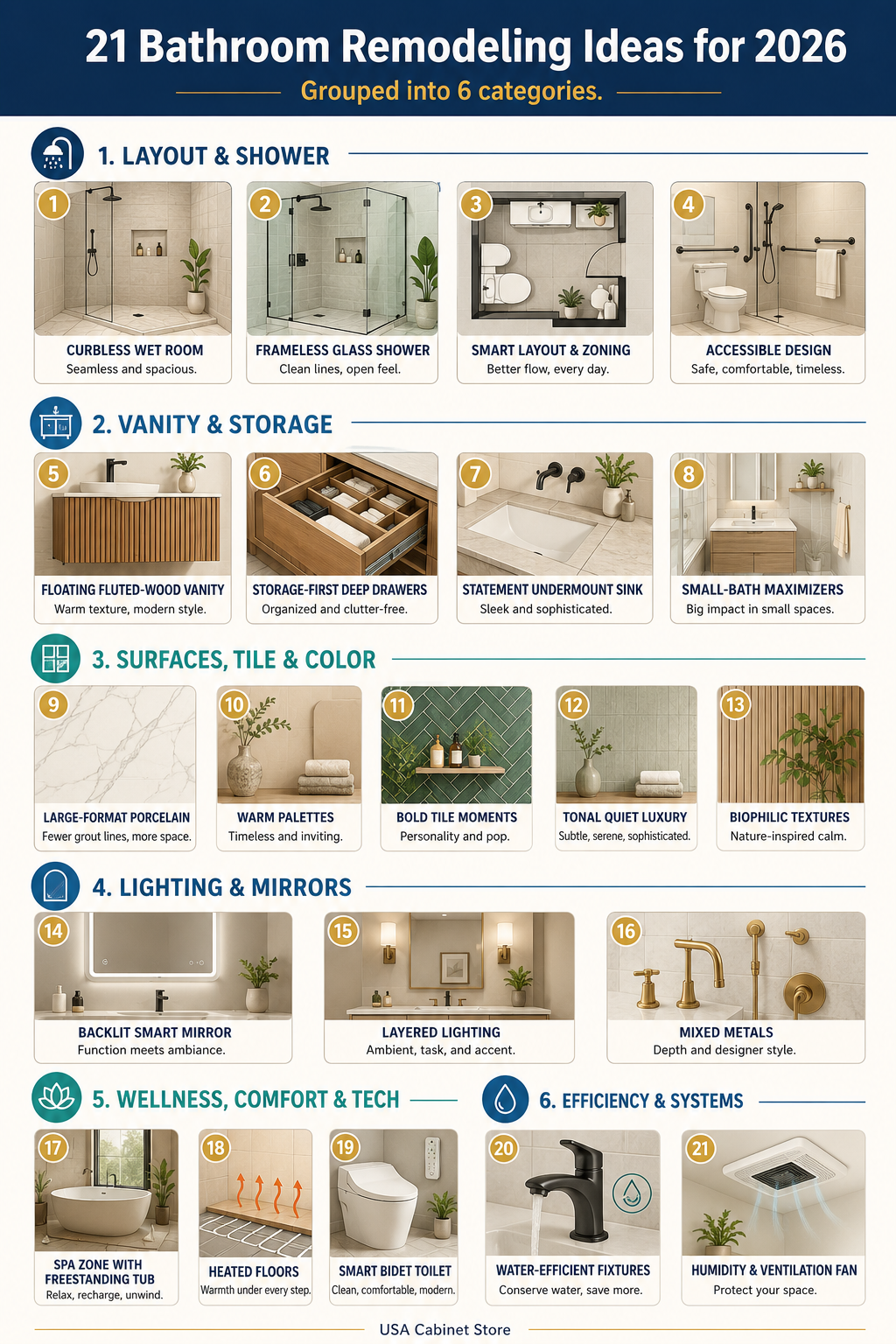
The all-white, cool-gray bathroom is over. In 2026, homeowners are turning the bathroom into the most personal room in the house, a warm, spa-like space built around wellness, better storage, and finishes that feel intentional. But good bathroom remodeling ideas are not just about looks. The smart ones pay you back. A mid-range bathroom remodel now returns up to about 80 percent of its cost at resale, among the strongest returns for this project since 2007, according to the Remodeling Cost vs. Value Report.
So we built this guide differently. Below are 21 bathroom remodeling ideas for 2026, grouped by what they do and tagged with real costs, real ROI, and who each one is right for. Start with the money picture, skim the best-return upgrades, then pick the ideas that fit your budget and your goals.
We also pulled in what real homeowners say on Reddit, the upgrades they never regret, the ones they wish they could undo, and the mistakes that wreck budgets. You will find that honesty woven through the ideas below, plus two sections near the end on what people keep versus regret and the pain points to plan around before the first tile goes down.
Why trust this guide: USA Cabinet Store has designed and installed kitchens and baths since 2011, that is 15 years and counting, across 14 showrooms in seven states. We are an NKBA member, 2026 award winner and a Best of Houzz Service award winner every year from 2016 through 2026, licensed as a Virginia Class A Contractor (#2705182026) and in Maryland (#98655). Everything below reflects what our designers and installers actually see work, and fail, in real bathrooms every week. Reviewed by Emin Halac, Design Director, USA Cabinet Store.
2026 Bathroom Remodel: The Numbers That Matter
What a bathroom remodel costs in 2026
The national average for a full bathroom remodel sits around $16,500, and across the projects we price, most homeowners spend between roughly $8,000 and $45,000, depending on size, materials, and where you live. Prices rose about 4 to 6 percent this year, driven by a skilled-trade labor shortage and new tariffs: a 25 percent federal tariff on imported cabinets and vanities took effect in October 2025, and a scheduled increase to 50 percent has been delayed to 2027. Plan for it. Here is the quick version, with a deeper breakdown on our 2026 bathroom remodeling cost guide.
| Project tier | Typical 2026 cost | What you get | ROI at resale |
|---|---|---|---|
| Cosmetic refresh | $2,000–$10,000 | Paint, fixtures, lighting, refinish, vanity swap, keep layout | 70–85% |
| Mid-range full bath | $16,000–$28,000 | New vanity + countertop, porcelain tile, fixtures, flooring | 70–80% |
| High-end primary bath | $29,000–$50,000 | Custom cabinetry, natural stone, frameless glass, layout changes | 55–65% |
| Luxury spa retreat | $60,000–$120,000+ | Steam, heated floors, smart systems, designer finishes | 45–55% |
Sources: USA Cabinet Store 2026 cost data, Angi, This Old House, NKBA. Labor and materials make up roughly 80 percent of a typical bathroom budget. About 1 in 3 remodels uncovers hidden water damage once demo starts, so the 15 to 20 percent contingency is not optional.
Where your budget actually goes
Two line items, the vanity and the shower or tub, usually eat 40 to 50 percent of your material budget. Here is a typical 2026 breakdown so you know where the money lands before you spend it. Full detail lives on our 2026 cost guide.
| Element | Typical installed cost (2026) | Notes |
|---|---|---|
| Vanity + countertop | $600–$4,000+ | Stock to semi-custom; one of the two biggest line items |
| Shower (tile, valve, waterproofing) | $3,000–$15,000 | The other big one; custom pushes higher |
| Frameless glass enclosure | $1,200–$3,500 | By glass thickness and hardware |
| Tile + installation | $7–$30 / sq ft | Ceramic at the low end, natural stone at the high end |
| Tub or tub replacement | $2,000–$9,400 | Skip it if you convert to a walk-in shower |
| Plumbing | $800–$8,000 | Higher if you relocate fixtures; moving a toilet runs $1,000–$3,500 |
| Electrical + lighting | $800–$2,500 | More for smart features and layered lighting |
| Toilet | $375–$5,000 | Standard model to full smart toilet |
Labor is the single biggest driver at 40 to 65 percent of the total, and a general contractor adds another 15 to 20 percent. Optional luxury add-ons price separately, for example heated floors at $12 to $25 per square foot installed. Sources: USA Cabinet Store cost guide, Angi, NAHB.
Not sure where your budget lands?
Our designers will price your ideas against your space and goals, free, at any of our 14 showrooms.
The 5 ideas with the best payback
If resale is on your radar, spend here first. These upgrades consistently return the most because they have broad buyer appeal and they fix the things buyers actually notice: a dated shower, a tired vanity, bad lighting. The pattern holds every year. Strategic mid-range moves beat luxury splurges on return.
| Upgrade | Estimated ROI | Why it pays |
|---|---|---|
| Walk-in shower conversion (from tub) | 75–85% | Reads as modern and accessible at once |
| New vanity + countertop | 70–80% | The visual centerpiece buyers judge first |
| Updated lighting | 70–80% | Cheap to do, changes the whole room |
| Fresh tile + flooring | 65–75% | Signals a clean, low-maintenance space |
| Modern toilet + faucets | 65–75% | Small spend, fixes the “old bathroom” feeling |
By contrast, heated floors (40 to 50 percent), custom stonework (35 to 45 percent), and high-end smart toilets (40 to 50 percent) return less. That does not make them bad ideas. It just means they are upgrades you buy because you will enjoy them, not because they will pay for themselves. Now, the ideas.
Layout & shower ideas (the big-impact moves)
Change the footprint and you change everything. These four ideas drive the biggest visual and functional payoff.
1. Curbless walk-in wet rooms
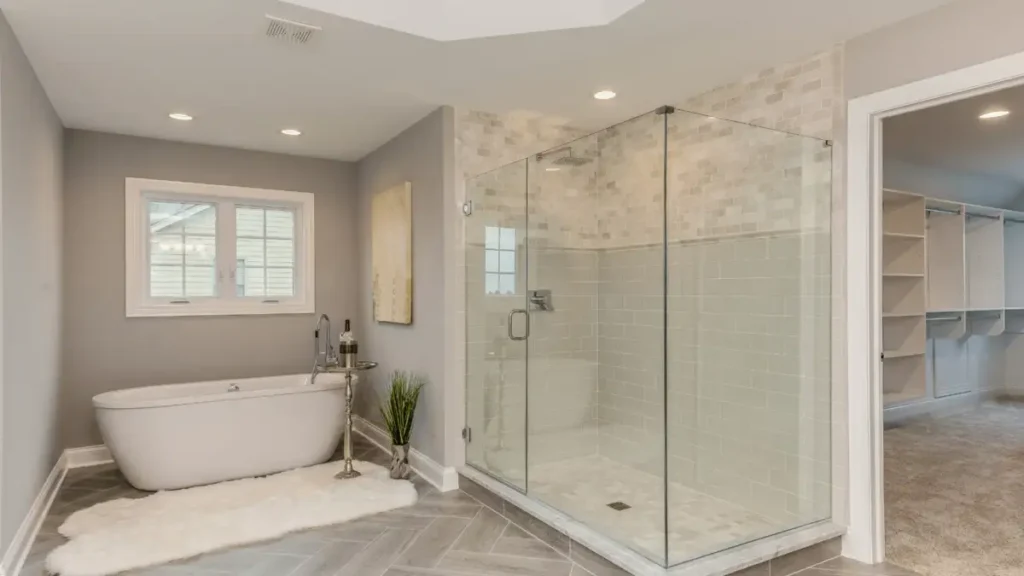
This is the benchmark layout of 2026. Recess the subfloor, add a linear drain, and tile runs uninterrupted from the dry area straight into the shower with no curb to step over. The look is open and continuous. The practical wins are just as real: easier cleaning, no lip to trip on, and a space that feels larger than its square footage. Pair it with a quality thermostatic valve and serious waterproofing (Schluter-Kerdi or RedGard) since this layout asks more of the membrane. A few hard-won tips from people who have built one: put the controls within reach of the entry so you are not stepping into a cold blast to turn it on, mount the shower head high enough for tall users, pair any rain head with a handheld (a rain head alone makes rinsing shampoo a chore), and go bigger than feels right in the showroom. A 3-by-3 stall that looks fine on display feels cramped every single day.
Best for: primary baths and aging-in-place. | Cost signal: mid to high-end. | ROI: high, especially as a tub-to-shower conversion. See more walk-in shower ideas.
2. Frameless glass shower enclosures
Few upgrades read “custom” faster than frameless glass. With no bulky metal frame, the eye travels straight through to your tile, so the room looks bigger and the tilework you paid for actually shows. Expect roughly $1,200 to $3,500 installed depending on glass thickness and hardware. If you are weighing framed against semi-frameless against fully frameless, our shower remodeling ideas guide breaks down the trade-offs. One honest caveat homeowners raise: frameless glass only looks its best if you squeegee it after each shower, so if low-maintenance matters more than the look, weigh that in.
Best for: almost any remodel. | Cost signal: mid. | ROI: strong, pairs with the high-return shower conversion.
3. Smart layout optimization and zoning
Before you pick a single finish, get the floor plan right. The cheapest way to improve a bathroom is to keep the plumbing where it is. Moving a toilet or shower drain runs $500 to $3,500 per fixture, and on a slab it means breaking concrete. So if the bones work, leave them. If they do not, zone the room: separate the wet area from the vanity, give a shared bath his-and-her stations, and put a pocket door on the toilet. A well-zoned bathroom feels calmer and works harder, and our remodel planning guide walks through writing a proper scope of work.
Best for: awkward or shared bathrooms. | Cost signal: varies. | Tip: not moving plumbing saves $1,500 to $10,000.
4. Accessible and aging-in-place design
Accessibility used to look clinical. It does not anymore. A curbless shower, comfort-height toilet, slip-resistant large-format tile, a built-in bench, and discreet grab bars (now sold in finishes that match your fixtures) all read as good design first and safety second. Build to ADA clearances if anyone in the home needs them, and you future-proof the space for everyone. This is one of the few upgrades that adds buyer appeal across every age group.
Best for: multi-generation homes, long-term stays. | Cost signal: low to mid. | ROI: broad appeal.
Vanity & storage ideas
Storage upgrades show up in more 2026 remodels than any single finish swap. Clear counters make a bathroom feel finished.
5. Floating, furniture-style vanities with fluted wood
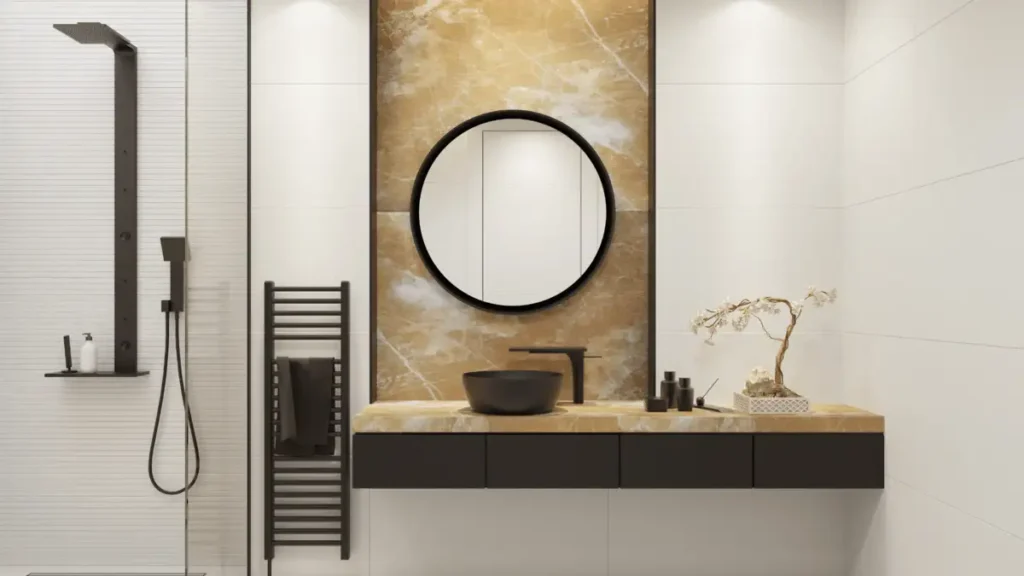
In 2026, the vanity reads more like furniture than a fixture. Floating (wall-mounted) designs are the dominant modern look. They open up visual floor space, make cleaning underneath effortless, and take an LED strip beneath beautifully. Warm wood tones and fluted, vertical-grooved fronts are everywhere, and the NKBA reports wood-faced vanities at 62 percent of projects. Designers are reaching for white oak and walnut with reeded fronts, undermount sinks, and quartzite or quartz tops, with a mix of shallow and deep soft-close drawers for real organization. Houzz found that when homeowners pick one element to do in wood rather than white, it is the vanity, because it warms up a room full of cold, hard surfaces. Reddit is blunt about the storage side: deep drawers beat open shelving and drawerless floating vanities every time, and if you have the wall, a double vanity with 10-plus feet of drawer storage is the upgrade people are happiest with years later. Mount to studs with 2×6 or 2×8 blocking. Our complete 2026 vanity guide covers every type, and we carry furniture-grade lines like James Martin alongside our own bathroom cabinets.
Best for: modern and transitional baths. | Cost signal: mid to high-end. | ROI: 70–80%.
From our showrooms: with the 25 percent federal tariff on imported cabinets and vanities in effect since October 2025 (and a 50 percent rate now slated for 2027), we steer most clients toward the domestically built lines we carry (Fabuwood, Wolf Classic, Showplace, UltraCraft, and James Martin), which sidestep the import duty. In our Florida and Texas showrooms we also spec moisture-rated cabinet boxes, because MDF vanities swell and fail fast in 80-plus percent humidity. Fifteen years of installs teaches you where corners come back to bite.
6. Storage-first design (deep drawers, niches, hidden outlets)
Here is the thing most inspiration photos skip: a beautiful bathroom only stays beautiful if there is somewhere to put the clutter. That is why storage now drives vanity specs. In the Houzz study, 78 percent of homeowners chose soft-close drawers and 29 percent added built-in outlets inside the vanity so hair tools charge out of sight. Add a recessed shower niche, a medicine cabinet that sits flush in the wall, and drawer dividers, and the counters stay clear for good. Two cheap moves homeowners swear they would never skip again: run a bidet-ready outlet behind the toilet now, since adding one mid-remodel costs almost nothing but retrofitting later is painful, and add more GFCI outlets than you think you need, including one inside a drawer for charging toothbrushes and razors. People who spent a little extra on a custom-sized recessed medicine cabinet also rate it far above the flimsy big-box units. Tight on counter space? A narrow storage tower flanking the mirror hides daily clutter without crowding the vanity top.
Best for: family and primary baths. | Cost signal: low to mid. | ROI: high, function buyers notice.
7. Statement and stone-basin sinks
A sculptural sink turns a vanity into a focal point. Full stone basins carved from a single block are having a moment in higher-end baths, balancing clean lines with a bit of natural drama. On a tighter budget, a vessel sink in matte stone or fired ceramic gets you most of the look. One caution worth knowing: vessel sinks are a common homeowner regret, since they splash, are fiddly to clean around, and eat usable counter space. If daily practicality matters more than the statement, a low-profile or undermount basin is the safer call. Just match the faucet height to the basin and confirm your sink drain placement before the countertop is cut.
Best for: powder rooms, design-forward primary baths. | Cost signal: mid to high-end.
8. Small-bathroom space maximizers
Tight footprint? Work the verticals and the sightlines. A wall-mounted sink or toilet frees floor space, a large mirror bounces light, and a single large walk-in shower (instead of a cramped tub-shower combo) makes the whole room read bigger. Keep tile tonal and continuous so the eye does not stop at busy grout lines. A small bath rewards restraint, and the math is friendlier too: most run $6,000 to $15,000. See our small bathroom remodel cost guide for the full breakdown.
Best for: powder rooms, condos, guest baths. | Cost signal: low to mid.
See these ideas in real homes
Browse finished USA Cabinet Store bathrooms, or talk through your own with a designer who builds them every week.
Surfaces, tile & color ideas
The biggest aesthetic shift of 2026 happens on the walls and floors: warmer, more tactile, fewer grout lines.
9. Large-format porcelain with fewer grout lines
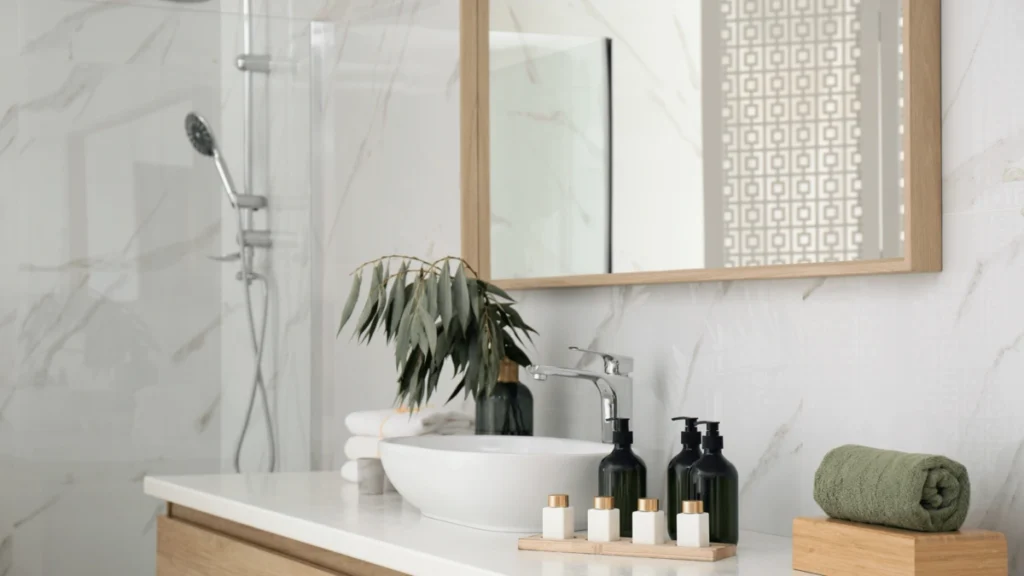
This is where design and durability agree. Large-format porcelain (think 24×48 panels) means fewer grout joints, which looks cleaner and resists water and mildew better, a real advantage in humid baths. The trade momentum is overwhelming: 89 percent of pros told the NKBA they see demand for smaller or no grout lines, and 80 percent expect large-format flooring to dominate over the next three years. The tile itself costs about the same as standard sizes; precise installation runs a little higher. Worth it. Two field-tested tips from homeowners: keep big rectangular tiles (12×24) on the floor, where they shine, rather than the walls, where they can break up awkwardly, and pair white or light tile with a darker grout to sidestep the endless white-grout staining battle. Browse tile options to compare.
Best for: showers, floors, tub surrounds. | Cost signal: mid. | ROI: 65–75%.
10. Warm, earthy color palettes
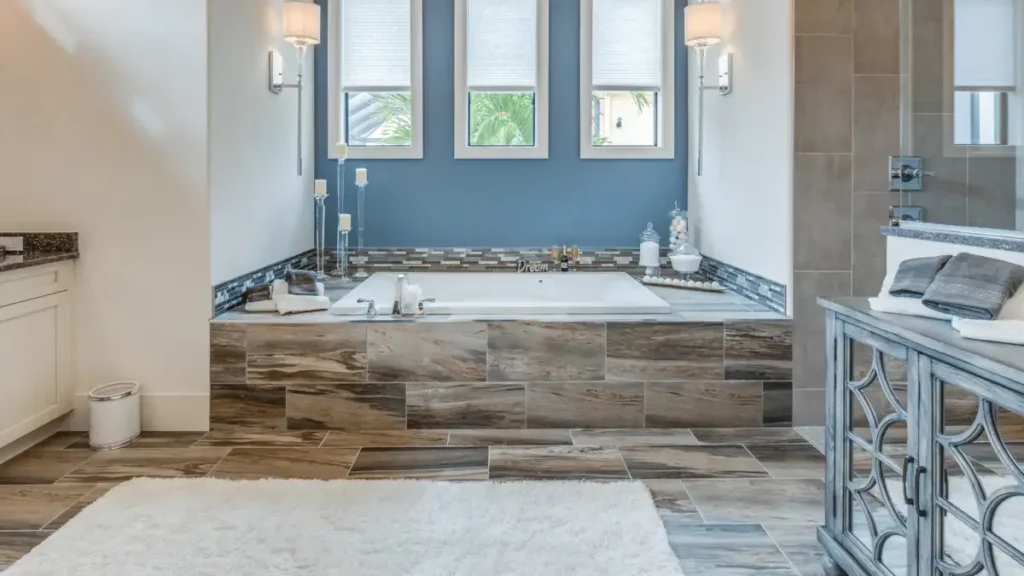
Cool gray is out, and homeowners now call gray-everything one of the fastest ways to date a bathroom. Warm neutrals are in: greige, taupe, soft beige, warm white, with sage and forest green, clay, terracotta, and a softer “butter yellow” as accents (Sherwin-Williams even named the warm mid-tone Universal Khaki its color of the year). The reason is partly mood (these tones feel calmer) and partly resale (warm neutrals appeal to the widest set of buyers). You do not need a full renovation to use this. Repaint with a moisture-resistant bathroom finish, swap the textiles, and the whole room warms up. For a bolder, designer-led move, “tile drenching” runs a single hue across the floor, walls, and even the ceiling for an enveloping, spa-like effect. If you want one hit of color instead, an ocean-inspired blue still tests well with buyers.
Best for: every budget, including refreshes. | Cost signal: low.
11. Bold tile patterns and textures
If warm neutrals are the base, pattern is the personality. Zellige (the hand-glazed Moroccan tile with subtle color variation), horizontally stacked tile, and tactile textured stone are leading the look. One feature wall lands harder than tiling everything: stacked shower wall tile already appears in 18 percent of projects per Houzz. A powder room can take a stronger swing than a primary bath, since the impact lands fast and you are not in there for an hour every morning. One thing to weigh: penny tile and tiny intricate mosaics look stunning but are brutal to keep clean across big surfaces, a regret that comes up again and again. Save them for a small accent.
Best for: feature walls, powder rooms. | Cost signal: low to mid.
12. Tonal “quiet luxury” schemes
The monochromatic bathroom grew up. Instead of one flat color, 2026’s version layers a single warm tone across different textures: a honed-stone counter, a matte tile, a fluted wood vanity, a linen Roman shade, all in the same family. The effect is rich without being loud, and it ages slowly, which is the whole point of quiet luxury. Designers also call this soft minimalism, and its close cousin Japandi (Japanese-Scandinavian) leans on the same calm, natural, low-clutter palette. Durability is part of the look here. Buy finishes you will not want to replace in three years.
Best for: primary baths, long-term homes. | Cost signal: mid to high-end.
13. Nature-inspired and biophilic elements
Biophilic design answers our screen-heavy lives by pulling the natural world in. In practice that means maximizing daylight with a larger window or a skylight, adding live plants that thrive in humidity, and choosing organic materials: reclaimed wood, bamboo accents, natural stone, recycled-glass tile. A teak shower bench or a stone vessel sink does the work of a dozen accessories. The room ends up feeling like a retreat instead of a utility space.
Best for: spa-style and wellness-focused baths. | Cost signal: low to mid.
Lighting & mirror ideas
Lighting is the highest-leverage, lowest-cost upgrade in the room. Get it right and everything else looks better.
14. Backlit and smart LED mirrors
A backlit mirror does two jobs at once: it throws soft, even light for grooming and it adds a quiet glow that makes the whole room feel custom. Smart versions add anti-fog heating, dimming, and even weather or calendar displays. Prices have dropped fast, with smart mirrors now running roughly $500 to $2,000. For a single, high-impact change on a small budget, this is hard to beat.
Best for: any vanity. | Cost signal: low to mid. | ROI: 70–80% as part of a lighting update.
15. Layered, creative lighting
One overhead fixture is the mark of a builder-grade bathroom. A designed one uses three layers: ambient (recessed or a central fixture), task (sconces flanking the mirror at eye level, not above it), and accent (LED under a floating vanity, in a niche, or behind the mirror). Put them on separate switches or dimmers so the room can go from bright-morning to soft-soak. Layered light is what separates a remodel from a refresh.
Best for: every remodel. | Cost signal: low to mid. | ROI: 70–80%.
16. Mixed-metal finishes
All-black everything had its run in 2023 and 2024. The 2026 move is mixed metals: brushed brass paired with matte black, or warm gold with polished nickel. The trick is to pick one finish as the lead (usually the faucet and shower trim) and use the second as an accent (hardware, lighting, the mirror frame). Most manufacturers now sell multi-finish collections, so you get depth without a cost penalty. A practical note from daily use: matte black shows every water spot and limescale mark, so it works best as an accent rather than on the faucets and handles you touch constantly. Plenty of homeowners still call chrome, nickel, and real brass the timeless picks that never look dated.
Best for: adding warmth and depth. | Cost signal: low.
Wellness, comfort & tech ideas
The defining theme of 2026: the bathroom as a personal wellness retreat. About 36 percent of remodeled baths now build in dedicated wellness features.
17. Spa and wellness zones
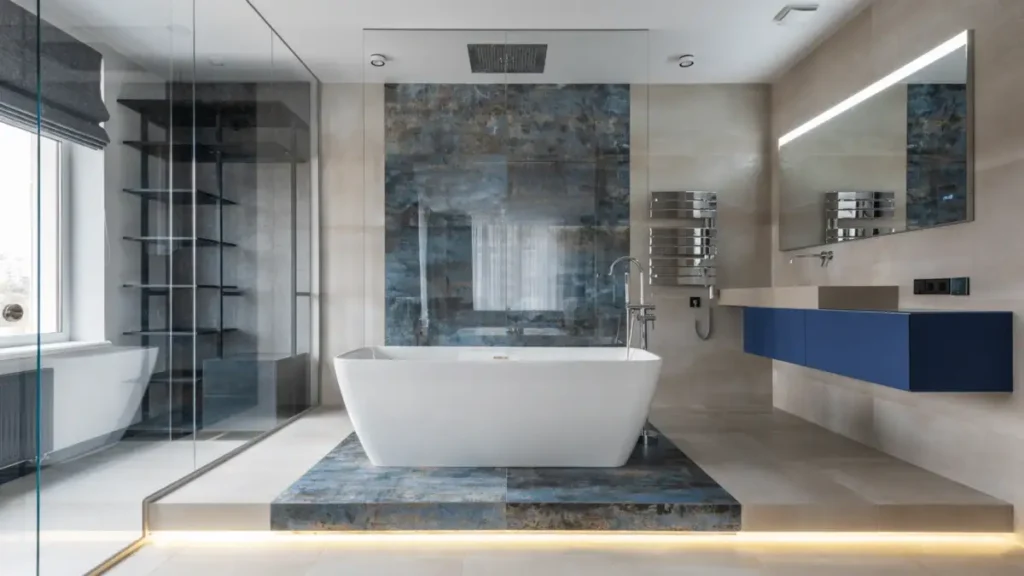
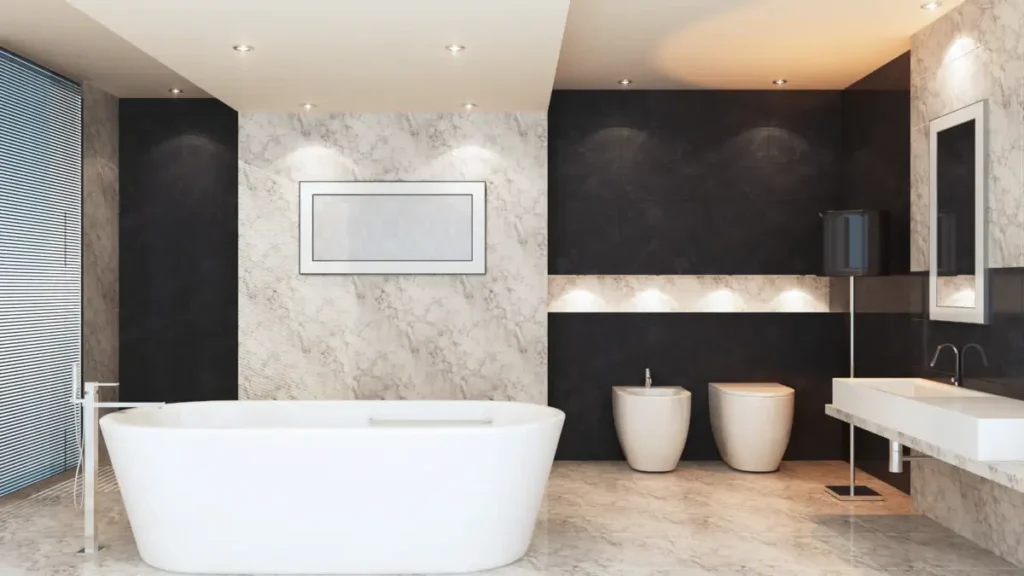
Wellness is no longer a single feature. It is a zone. Homeowners are designing around how they actually use the room: a quarter use the bathroom mainly to rest and recharge, another quarter for beauty and pampering. That is driving steam showers with aromatherapy, enclosed wet rooms with heated benches, and at the high end, saunas and cold plunges integrated into hybrid layouts. A freestanding soaking tub under a window remains the classic centerpiece. Anchor the zone around the one ritual you do most.
Best for: primary baths, long-term homes. | Cost signal: high-end to luxury.
18. Heated floors and towel warmers
Radiant heated flooring is the single most-requested luxury upgrade in 2026, and it earns its spot for a reason beyond comfort: it speeds up moisture evaporation, which helps protect your tile and grout. A warm floor on a winter morning sells itself, and it is the single most-named “wish I had done it sooner” upgrade among homeowners who finished a remodel. Add a towel warmer, not just a plain towel bar, for the version that actually delivers, and the spa effect is complete. Just know the math going in. Heated floors return only about 40 to 50 percent at resale, so this is a buy-it-for-yourself upgrade, best when you plan to stay.
Best for: cold climates, long-term stays. | Cost signal: mid to high-end. | ROI: 40–50%.
19. Smart bathroom technology
Smart tech got cheaper and more useful at the same time. Digital shower systems ($800 to $3,500) let you preset temperature and flow. Smart toilets and bidet seats ($1,500 to $5,000, with names like TOTO Washlet and Kohler leading the market) add a bidet, heated seat, and self-cleaning, and they are one of the upgrades homeowners say they love most years later. Voice-activated lighting runs as little as $200 to $800. The advice here is restraint: add the one or two features you will use daily, skip the rest. A digital shower you touch every morning earns its keep. A novelty gadget gathers dust. Even if you are not ready for a smart toilet today, run a bidet-ready outlet by the toilet during the remodel. It is nearly free now and expensive to add later.
Best for: tech-forward households. | Cost signal: mid to high-end.
Efficiency & systems ideas (the smart-money upgrades)
The least glamorous ideas protect everything else. In 2026, 61 percent of homeowners upgrade core systems during a bathroom remodel.
20. Water-efficient fixtures and rebates
Low-flow does not mean low-pressure anymore. EPA WaterSense toilets, faucets, and showerheads cut water use without the weak trickle of older models, and they lower the water bill every month, which buyers notice. Better still, many utilities offer rebates: WaterSense toilets can earn up to $100 back. Pick efficient fixtures and you score on three fronts: lower bills, possible rebates, and a greener footprint.
Best for: every remodel. | Cost signal: low. | Bonus: utility rebates.
21. Humidity management and ventilation
This is the idea nobody photographs and everybody should plan for. The wet-room era puts more moisture in the air, and a standard fan cannot keep up. A high-quality, humidity-sensing exhaust fan that adjusts its own speed is the upgrade homeowners call non-negotiable, since a cheap fan is the fast road to mold and warped finishes. Pair it with a tankless water heater if you are adding rain heads or steam, since those demand endless hot water. Note that some jurisdictions now require upgraded ventilation and waterproofing, which can add $500 to $1,500 in code compliance. Spend it. As one homeowner put it, spend the money behind the walls before you spend it on luxury fixtures. The waterproofing and ventilation protect your home for decades after the tile stops getting compliments.
Best for: wet rooms, steam showers, humid climates. | Cost signal: low to mid. | Why: protects everything else.
What homeowners keep, and what they regret?
Inspiration photos sell a look. Real remodelers, the ones posting on Reddit after living with their choices, tell you what survives daily use. Here is the consensus, and it lines up closely with the ideas above.
Worth every penny
- Heated floors (the top “should have done it sooner”)
- A real towel warmer, not just a towel bar
- Curbless walk-in shower
- Bidet or smart toilet
- Deep vanity drawers and double sinks
- Custom recessed medicine cabinet
- Backlit mirror
- Bidet-ready outlet and plenty of GFCI outlets
- Stylish (not clinical) grab bars, added early
- Large-format tile on floors
Wish they hadn’t
- Matte black fixtures (water spots, limescale)
- Vessel sinks (splashing, lost counter space)
- Penny and tiny intricate tile (brutal to clean)
- Open shelving (dust and clutter)
- A rain head with no handheld
- A small 3×3 shower stall
- Gray-everything and trend-chasing colors
- Floating wood floors (use tile in a bath)
- Tiling every wall (impossible to match for repairs)
- Cheap online fixtures that fail quickly
The community has a motto worth borrowing: buy once, cry once. Spend on the things that are hard to change later (tile, plumbing, waterproofing, the shower valve) and save on the things you can swap in an afternoon (mirrors, towel bars, paint, hardware).
The pain points to plan around
Most remodel horror stories are not about design. They are about planning. These are the issues homeowners run into most, and how to get ahead of them.
| The problem | How to get ahead of it |
|---|---|
| Contractor no-shows and silence | Hire on written scope and references, not the lowest bid. Insist on weekly updates and a payment schedule tied to milestones. |
| Hidden water damage behind walls | About 1 in 3 remodels finds rot, mold, or failed waterproofing at demo. Hold a 15 to 20 percent contingency, not the old 10 percent. |
| The “while we’re at it” spiral | Decide upfront which discovered issues are must-fix versus nice-to-have, so surprises do not quietly double the budget. |
| Material lead times | Order vanities and glass before demo starts. Get everything on site so tile delays do not stall the whole job. |
| Undertone clashes | Tile, grout, paint, and wood all carry warm or cool undertones. Mixing them makes a room feel “off.” Sample together, in the actual light. |
| Decisions made for you mid-tile | Lock shower-head height, valve placement, and niche position in writing before tiling begins. |
| Grout looks lighter dry | Store samples can mislead. Test your grout color on a board and let it cure before you commit. |
| No bathroom during the build | If it is your only full bath, line up a backup before demo. Plan for five to eight weeks. |
One more habit that saves future headaches: photograph the open walls before drywall goes back up, so you always know where the pipes and wiring run. This is exactly the kind of detail a seasoned remodeler handles by default, and where working with USA Cabinet Store takes the guesswork off your plate.
How to choose ideas for your budget
You do not need all 21. The right mix depends on your goal: selling soon, staying long-term, or just fixing something worn out. Here is how to stack the ideas by budget.
| If your budget is… | Prioritize these ideas | Goal |
|---|---|---|
| $2K–$10K (refresh) | Warm paint (#10), layered lighting (#15), backlit mirror (#14), water-efficient fixtures (#20), mixed metals (#16) | Maximum change, no plumbing moves |
| $16K–$28K (mid-range) | Floating vanity (#5), large-format tile (#9), frameless glass (#2), storage-first design (#6), better ventilation (#21) | Best ROI, full transformation |
| $29K–$50K (high-end) | Curbless wet room (#1), tonal quiet-luxury scheme (#12), stone-basin sink (#7), smart tech (#19), zoned layout (#3) | Custom primary bath |
| $60K+ (luxury) | Spa/wellness zone (#17), heated floors (#18), biophilic design (#13), everything above | A retreat you keep for years |
One rule of thumb worth remembering: spend about 5 to 10 percent of your home’s value on a primary bathroom for the best resale return. Going much higher than your neighborhood supports rarely pays back.
Your 2026 planning checklist
Before you fall for a single finish, work through these. They are the questions that keep a remodel on time and on budget.
- Am I staying or selling? Staying favors comfort upgrades; selling favors the high-ROI five.
- Can I keep the plumbing where it is? Not moving it saves $1,500 to $10,000.
- Have I set aside 15 to 20 percent for surprises? About 1 in 3 remodels finds hidden water damage.
- Did I budget for the invisible work? Waterproofing, the shower valve, and ventilation are not the place to cut.
- What is my one non-negotiable? Fund it first, then build the rest of the budget around it.
- Do I need a permit? Layout or plumbing changes almost always do. Cosmetic refreshes usually do not.
- When am I starting? January and February often run 10 to 20 percent cheaper on labor.
What homeowners ask for, by market
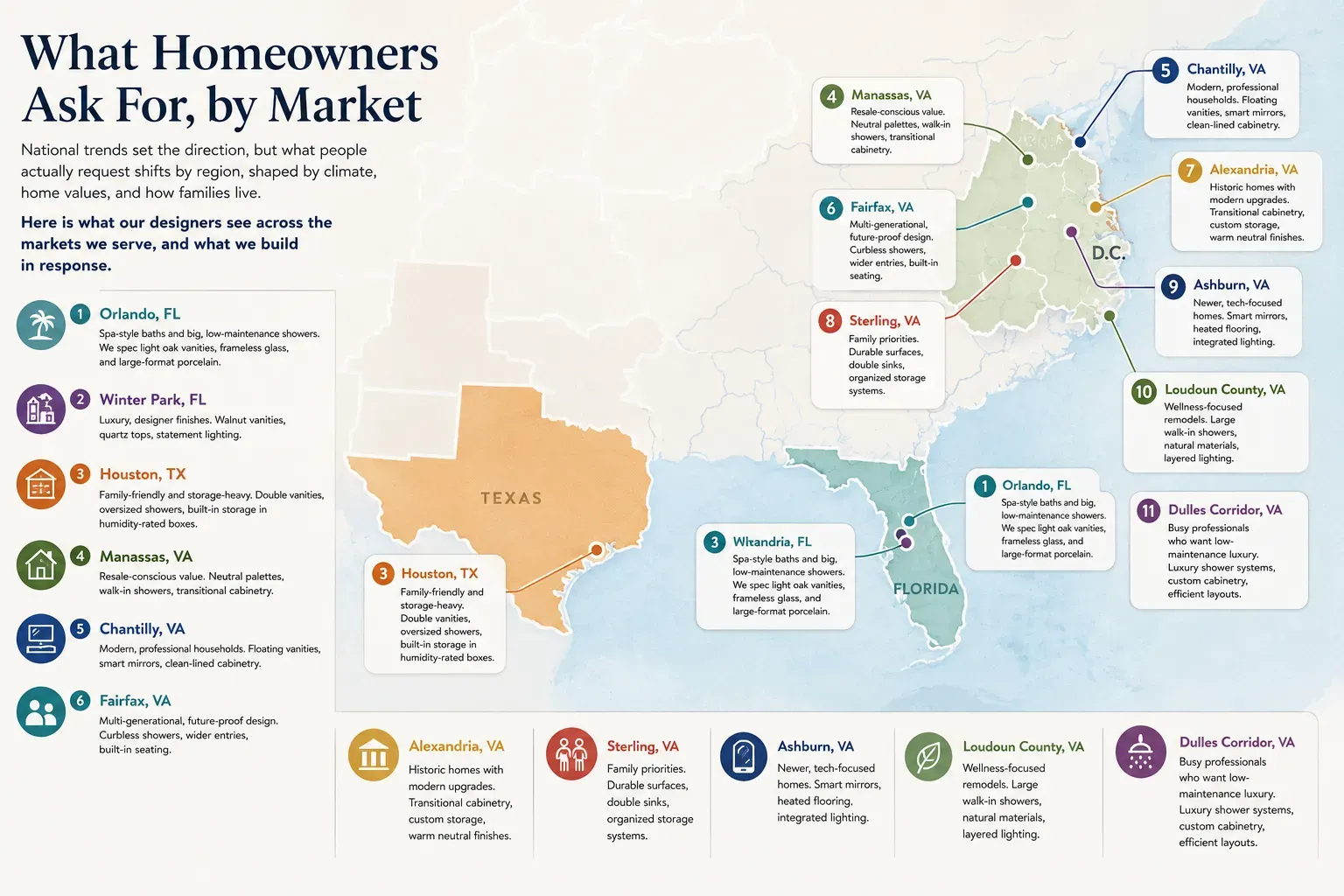
National trends set the direction, but what people actually request shifts by region, shaped by climate, home values, and how families live. Here is what our designers see across the markets we serve, and what we build in response.
| Market | What homeowners request, and what we build |
|---|---|
| Orlando, FL | Spa-style baths and big, low-maintenance showers. We spec light oak vanities, frameless glass, and large-format porcelain. |
| Winter Park, FL | Luxury, designer finishes. Walnut vanities, quartz tops, statement lighting. |
| Houston, TX | Family-friendly and storage-heavy. Double vanities, oversized showers, built-in storage in humidity-rated boxes. |
| Manassas, VA | Resale-conscious value. Neutral palettes, walk-in showers, transitional cabinetry. |
| Chantilly, VA | Modern, professional households. Floating vanities, smart mirrors, clean-lined cabinetry. |
| Fairfax, VA | Multi-generational, future-proof design. Curbless showers, wider entries, built-in seating. |
| Alexandria, VA | Historic homes with modern upgrades. Transitional cabinetry, custom storage, warm neutral finishes. |
| Sterling, VA | Family priorities. Durable surfaces, double sinks, organized storage systems. |
| Ashburn, VA | Newer, tech-focused homes. Smart mirrors, heated flooring, integrated lighting. |
| Loudoun County, VA | Wellness-focused remodels. Large walk-in showers, natural materials, layered lighting. |
| Dulles Corridor, VA | Busy professionals who want low-maintenance luxury. Luxury shower systems, custom cabinetry, efficient layouts. |
What’s most requested in every market in 2026
Regional taste varies, but six priorities show up everywhere we work: larger walk-in showers replacing oversized tubs, better storage (organized drawers, linen space, niches, clear counters), low-maintenance materials like large-format tile and quartz, spa-inspired features such as rainfall heads, heated floors, and layered lighting, aging-in-place design with curbless entries and built-in seating, and smart technology like anti-fog mirrors and touchless faucets. The throughline: homeowners want bathrooms that are easier to maintain, more comfortable, and built for the long term, not just a cosmetic refresh.
What this looks like in real homes
Trends are easy to list. Building them well is the hard part, and it is where 15 years of installs shows. Here is a sample of what our team has actually delivered, pulled from our before-and-after gallery.
The big bath that felt cramped
A bathroom with plenty of square footage still felt tight. The fix was a frameless glass shower enclosure, large-format marble-look tile, soft gray cabinetry, and gold fixtures matched to the mirror frames under a designed lighting plan. The room finally reads as big as its footprint.
The tiny, dated bathroom
An old, small bathroom with worn flooring became a walk-in shower with built-in niches and tall glass doors. Opening up the shower made the whole space read larger and brighter, no square footage added.
The 1990s time capsule
A dark, dated bathroom was reborn with a floating vanity, a bright white palette, and a lighted-frame statement mirror. Modern, airy, and far easier to keep clean than what it replaced.
See more on our YouTube channel and in the bathroom project gallery.
What clients say
Susan Parsons came to us for a master bathroom vanity transformation and singled out the precision of the cabinet delivery and install, everything arrived exactly when promised. Farisa Dastvar worked with our team member Hamit on a full home renovation before move-in and recommends him for juggling many moving parts at once. And Mrs. Naffa praised our attention to detail and overall project overview.
Backed by real guarantees: fixed-price contracts with line-item pricing, milestone payments (never more than 10 percent upfront), and 3 to 5 week cabinet delivery against an 8 to 12 week industry norm. An independent 2026 analysis ranked USA Cabinet Store among the top remodeling contractors in Northern Virginia.
Ready to build your 2026 bathroom?
USA Cabinet Store has designed and installed kitchens and baths since 2011, with 14 showrooms across VA, MD, NC, NJ, FL, TX, and TN. Bring your ideas. We will price them, plan them, and build them.
Bathroom remodeling FAQs for Bathroom Remodeling Ideas
What is a realistic budget for a bathroom remodel in 2026?
The national average is about $16,500, with most full remodels landing between $8,000 and $45,000. A cosmetic refresh runs $2,000 to $10,000, a mid-range full bath $16,000 to $28,000, and a high-end primary bath $29,000 to $50,000. Set aside another 15 to 20 percent for surprises. See our full 2026 cost guide for a detailed breakdown.
Which bathroom remodel has the best return on investment?
A tub-to-walk-in-shower conversion leads at 75 to 85 percent, followed by a new vanity and countertop (70 to 80 percent) and updated lighting (70 to 80 percent). Mid-range remodels overall return about 65 to 80 percent, among the best since 2007. Luxury upgrades like heated floors return less (40 to 50 percent), so buy those for your own enjoyment.
What is the most expensive part of a bathroom renovation?
Labor and the wet work. Plumbing relocation and tile installation top most budgets, and labor plus materials make up roughly 80 percent of the total. Moving a shower drain costs $500 to $1,500, relocating a toilet $1,000 to $3,500 depending on distance and whether it sits on a slab. The cheapest remodels keep the existing layout.
How long does a bathroom remodel take?
A shower remodel takes two to four weeks with a professional. A full bathroom renovation runs five to eight weeks. Backordered materials and contractor availability are the most common causes of delay, so book two to three months ahead, longer for peak summer season.
What is out of style for bathrooms in 2026?
The all-white, cool-gray, high-contrast “house-flip” bathroom is on the way out, along with all-black-everything fixtures and busy small-tile walls with lots of grout. In their place: warm earthy palettes, mixed metals, large-format tile, and curbless walk-in showers.
What are the best ideas for a small bathroom?
A wall-mounted or floating vanity, a single large walk-in shower instead of a tub-shower combo, large-format tonal tile, a big mirror, and good layered lighting. The goal is fewer visual interruptions so the room reads larger. Our small bathroom cost guide covers the budget side.
Do I need a permit to remodel my bathroom?
If you change the layout, move plumbing, or alter electrical, almost always yes. A cosmetic refresh (paint, fixtures, a like-for-like vanity swap) usually does not. A licensed remodeler pulls and manages the permits for you, and a good scope of work spells out exactly what is included.
Is a curbless walk-in shower worth it?
For most people, yes. It is the 2026 benchmark layout and one of the upgrades homeowners are happiest with long term: easier to clean, no lip to trip over, and it makes the room feel larger. It also reads as both modern and accessible, which helps at resale. The one requirement is serious waterproofing and a proper floor slope, so it is worth hiring a pro who has built them before.
Are heated floors worth the money?
For comfort, they are the single most-loved upgrade homeowners name after the fact. For pure resale math, they return only about 40 to 50 percent. So heat the floor if you plan to stay and enjoy it daily. If you are remodeling mainly to sell, put that money into a walk-in shower or a new vanity instead.
How do I prevent mold in a new bathroom?
Spend on the parts you cannot see. A high-quality, humidity-sensing exhaust fan vented to the outside, professional waterproofing behind the tile, a correct shower slope, and mold-resistant materials do more for long-term health than any fixture. Large-format tile with fewer grout lines and a darker grout also cut down on the spots where mold takes hold.
Walk-in shower or bathtub, which is better for resale?
A tub-to-walk-in-shower conversion is one of the highest-ROI moves at 75 to 85 percent, and buyers increasingly prefer a large shower. The usual advice: keep at least one bathtub somewhere in the home for families with young children or for buyers who want one, then make the primary bath a generous walk-in shower.
Should I install a bidet?
Bidets and smart toilets rank among the upgrades people love most years later, for comfort, hygiene, and less paper waste. Even if you are not ready for a full smart toilet, the smart move during a remodel is to add a bidet-ready outlet behind the toilet. It costs almost nothing now and is a hassle to add later.
How do I get started with USA Cabinet Store?
Book a complimentary consultation, in person at one of our 14 showrooms or by phone and email. A designer helps you choose the ideas, materials, and layout that fit your space and budget, then we handle the build from first drawing to final tile.
Data sources: National Kitchen & Bath Association (NKBA) 2026 Bath Trends Report, 2025 U.S. Houzz Bathroom Trends Study, Angi 2026 cost data, This Old House 2026 survey, Remodeling Cost vs. Value Report, EPA WaterSense, plus real-world feedback synthesized from homeowner discussions on Reddit (r/BathroomRemodeling, r/HomeImprovement, r/bathrooms). Cost figures align with USA Cabinet Store’s 2026 bathroom remodeling cost guide and reflect national averages; your local pricing may vary.