Single or Double sink? Pedestal or vessel?
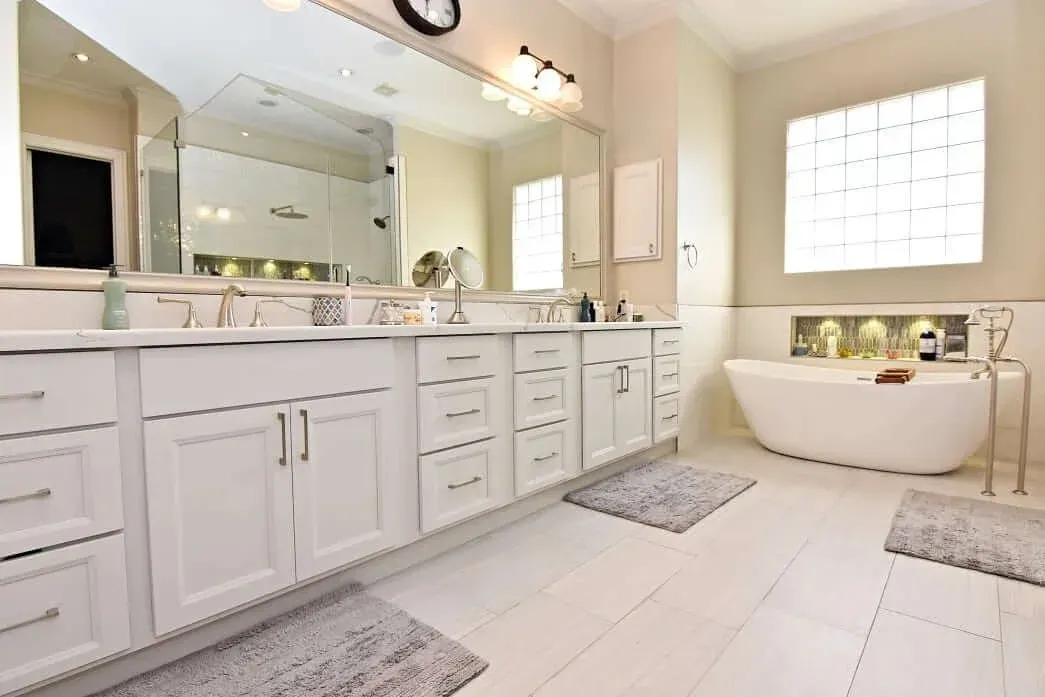
Whether you go with a simple traditional style or custom-designed vanity, before you start, be sure you have enough space for the look you want.
Your bathroom vanity serves as the functional centerpiece of your bathroom—combining sink, countertop, and storage into one essential fixture. With the global bathroom furniture market exceeding $47 billion and projected to approach $95 billion by 2035, homeowners have never had more options.
The 2026 design landscape has shifted away from sterile, all-white bathrooms toward warm, personality-driven spaces. This comprehensive guide covers every vanity type, materials, trends, and practical considerations to help you make the right choice for your home.
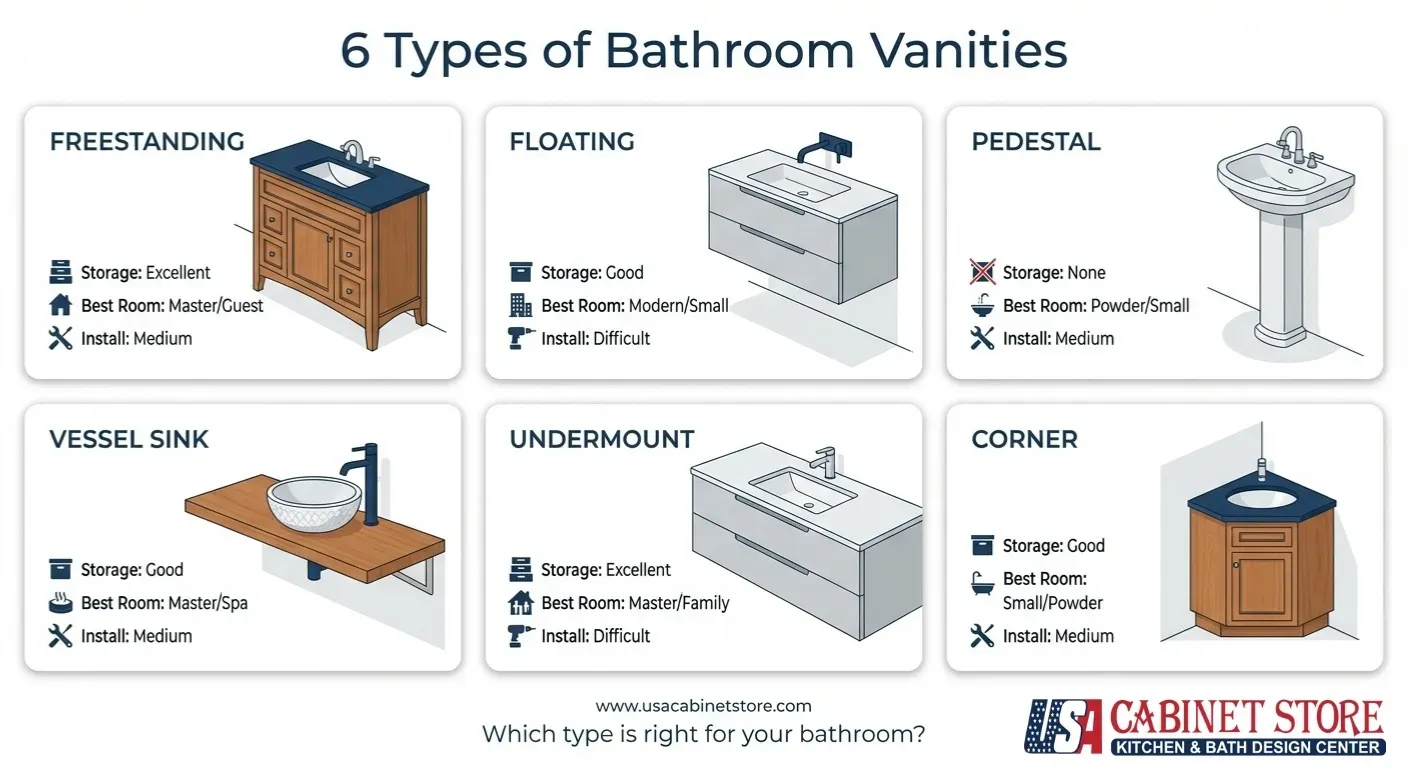
Key Takeaways at a Glance for Bathroom Vanity Types The Complete 2026 Guide
QUICK REFERENCE: BATHROOM VANITY ESSENTIALS
- 6 Main Types: Freestanding, Floating, Pedestal, Vessel, Undermount, Corner
- 2026 Trending: Floating vanities with warm wood (modern); furniture-style freestanding (transitional)
- Standard Sizes: Single 24-48″ | Double 60-72″
- Comfort Height: 34-36″ (modern standard that reduces back strain)
- Best Materials: Plywood cabinet boxes; quartz or quartzite countertops
- Price Range: $100-$2,600 (prefabricated) to $1,000-$4,000+ (custom)
ROI: 80% national average (up to 91% in Pacific states)
Your bathroom vanity usually includes a sink, a countertop, a place to store toiletries and linens, and a mirror.
Vanities come in six basic types: pedestal, free-standing, floating, vessel, under-mounted sink and cabinet.
Bathroom Vanity Types Comparison
| Type | Best For | Key Advantage | Storage | Install |
|---|---|---|---|---|
| Freestanding | Primary baths, traditional | Maximum storage | Excellent | DIY |
| Floating | Small baths, modern | Space illusion, easy cleaning | Good | Professional |
| Pedestal | Powder rooms, half-baths | Minimal footprint | None | Moderate |
| Vessel Sink | Spa baths, statement designs | Dramatic focal point | Good | DIY |
| Undermount | Modern, easy maintenance | Seamless surface | Good | Professional |
| Corner | Tiny or awkward layouts | Uses dead space efficiently | Limited | Moderate |
Detailed Guide to Each Vanity Type
Freestanding Vanities
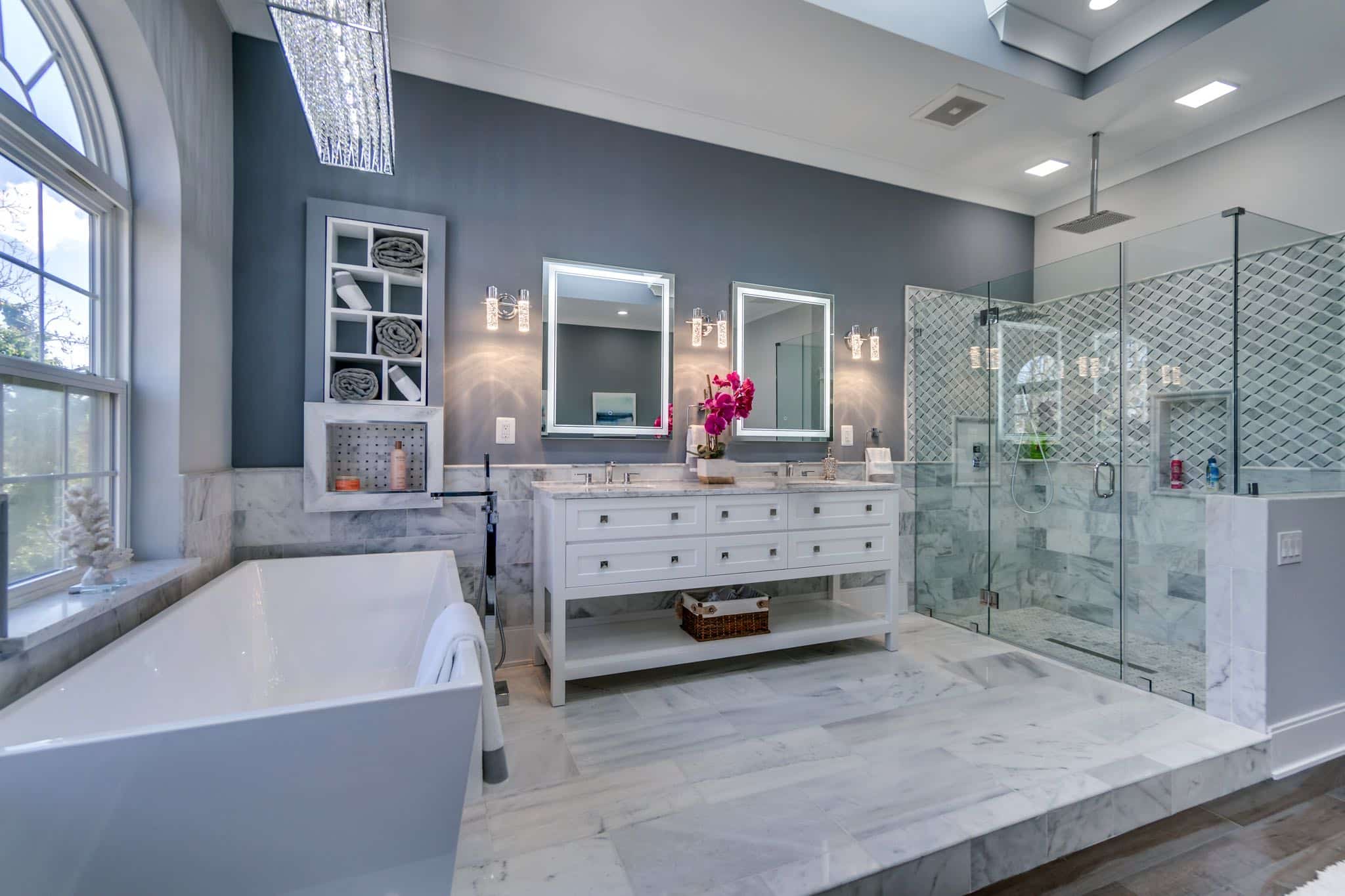
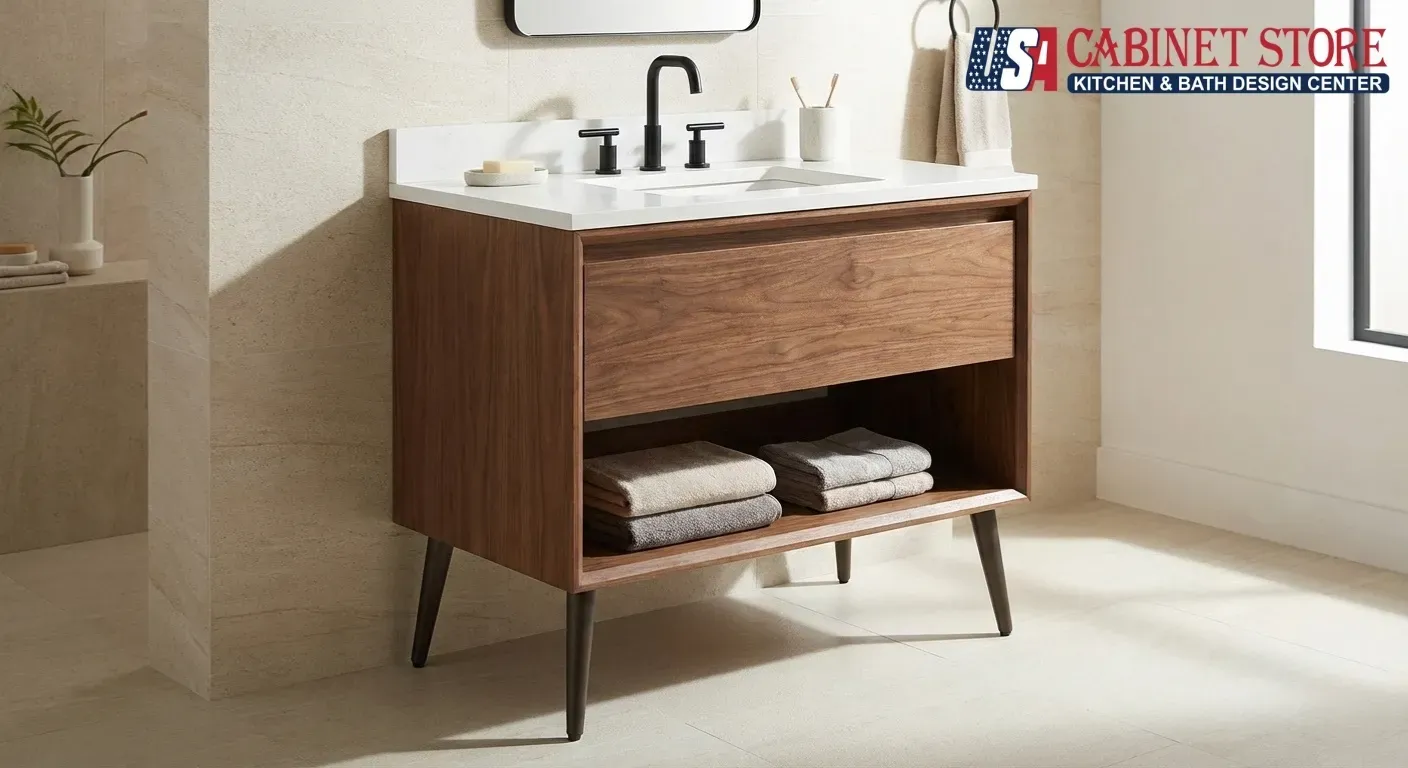
The traditional floor-standing cabinet remains the most popular choice for primary and guest bathrooms. In 2026, freestanding vanities trend toward a “furniture” aesthetic—pieces with decorative legs and heirloom profiles that feel collected rather than built-in.
- Width: 24-72″ (single sinks typically 24-48″)
- Depth: 20-24″ standard; 16-18″ for narrow spaces
- Height: 30-36″ (comfort height 34-36″ recommended)
- Installation: DIY-friendly with basic wall securing
- USA Cabinet Store Advantage: Fabuwood all-plywood construction with Blum soft-close hardware
Floating (Wall-Mounted) Vanities
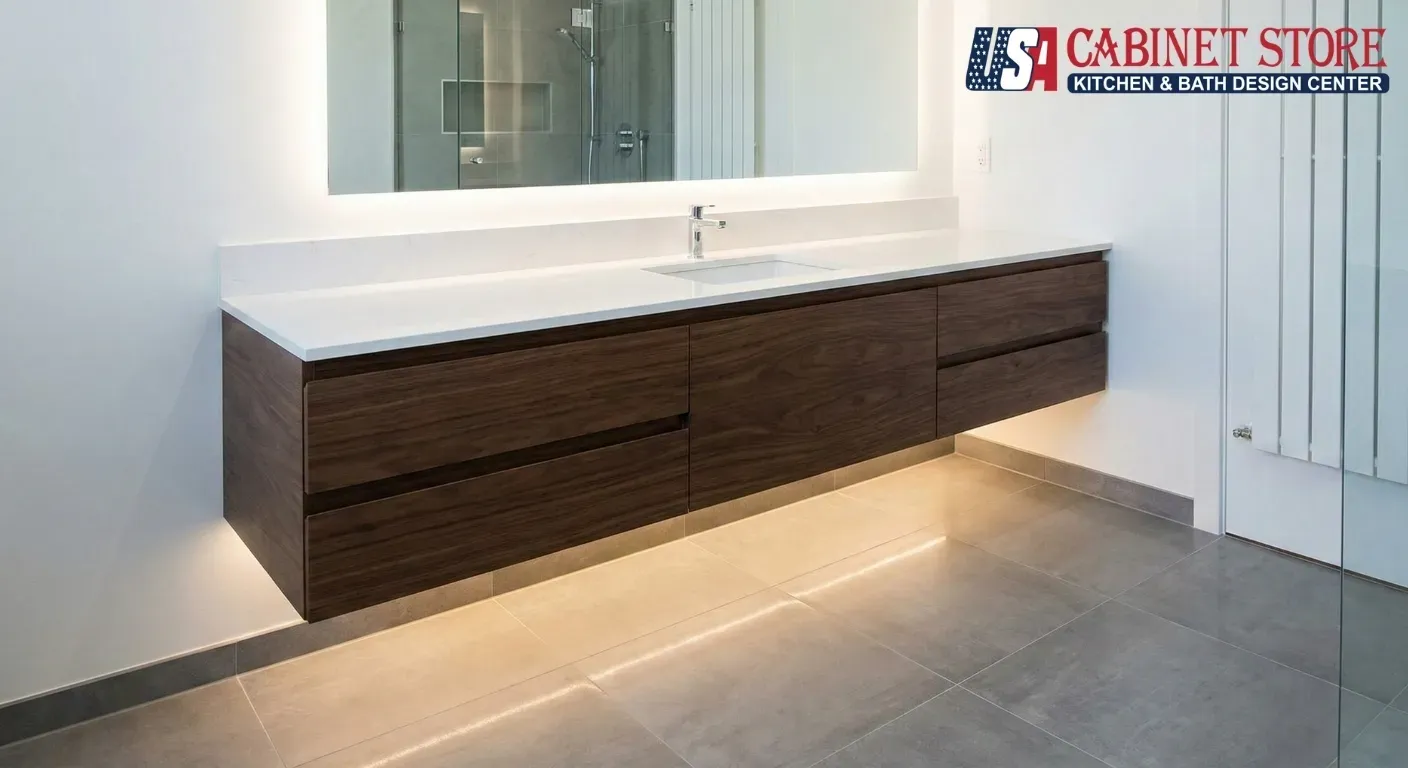
The dominant modern style for 2026. Mounts directly to wall with no floor contact, creating an open, airy appearance and making floor cleaning effortless. Many homeowners add LED strip lighting beneath for a dramatic ambient glow.
- Mounting height: 32-36″ from floor (fully customizable)
- Weight capacity: Up to 220 lbs with proper blocking
- Wall requirement: Must anchor to studs; 2×6 or 2×8 blocking recommended
- Installation: Professional recommended for proper support
- USA Cabinet Store Advantage: Free design consultation to ensure proper wall preparation
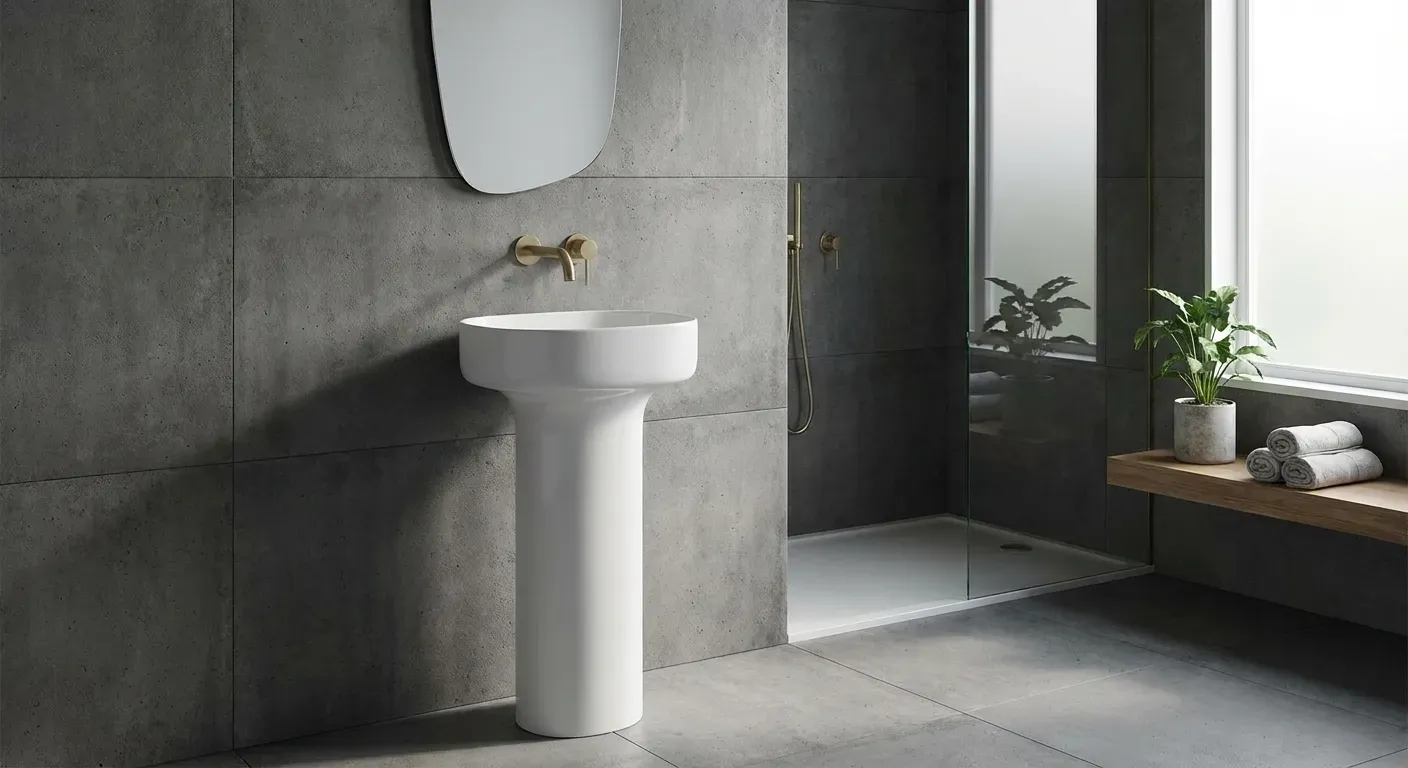
Pedestal Sinks
A basin mounted on a decorative column—the ultimate space-saver for powder rooms. Zero storage but delivers a timeless aesthetic that works with any design style from traditional to contemporary.
- Width: 18-27″ typical
- Storage: None—requires wall shelving or nearby linen closet
- Best for: Powder rooms, half-baths, historic home renovations
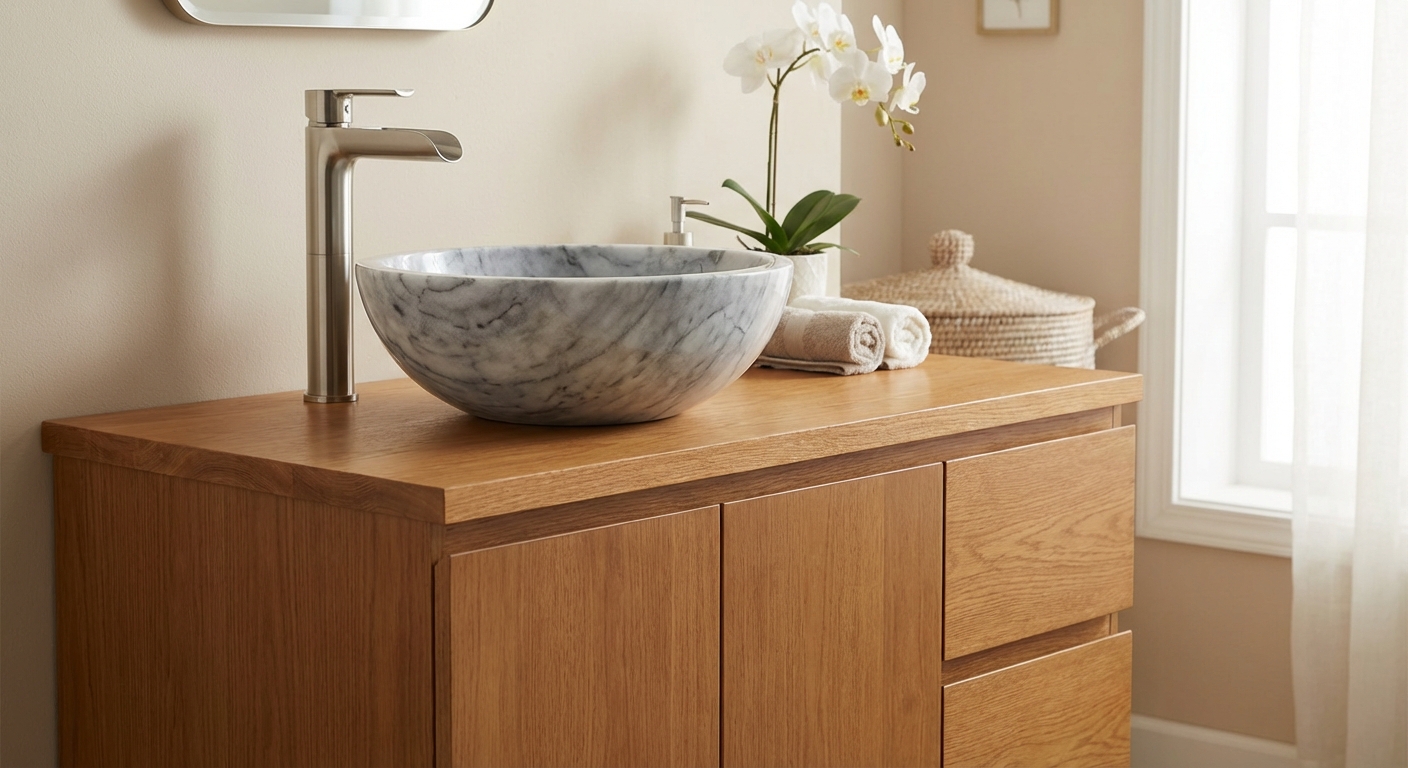
Vessel Sink Vanities
A decorative bowl that sits above the countertop, creating a dramatic focal point. Available in glass, ceramic, natural stone, and copper. Currently represents approximately 23% of the specialty sink market.
- Bowl sizes: 12-32″ diameter
- Height consideration: Vanity cabinet should be 6-8″ lower to compensate for bowl height
- Faucet requirement: Tall vessel faucet or wall-mounted required
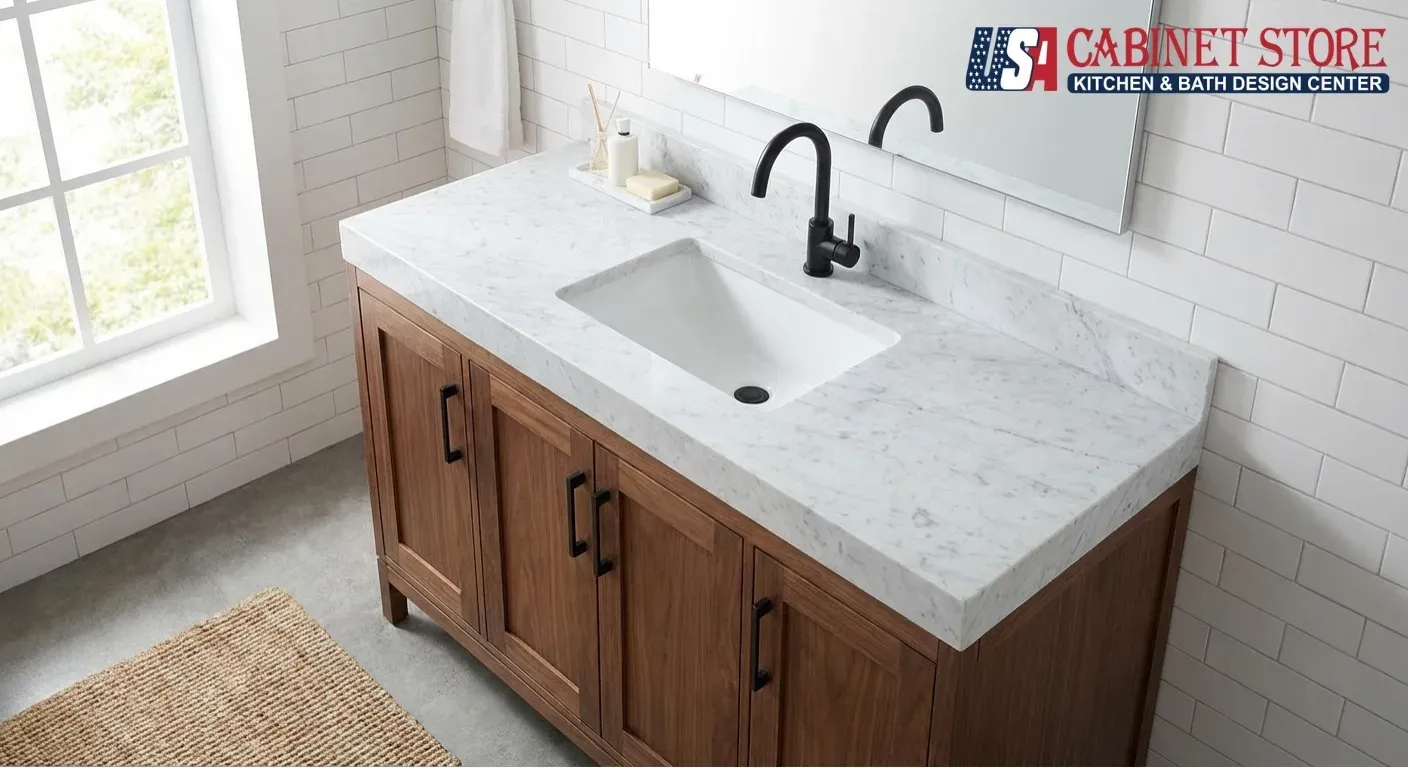
Undermount Sink Vanities
The sink mounts beneath the countertop for a seamless, uninterrupted surface—the easiest style to clean. Most common in modern bathroom designs. Compatible with quartz, granite, and marble countertops (not laminate).

Corner Vanities
Triangular or L-shaped designs built for 90-degree corners. These space-saving solutions reclaim dead space in tiny or awkwardly shaped bathrooms. Typical sizes range from 18-30″ per wall.
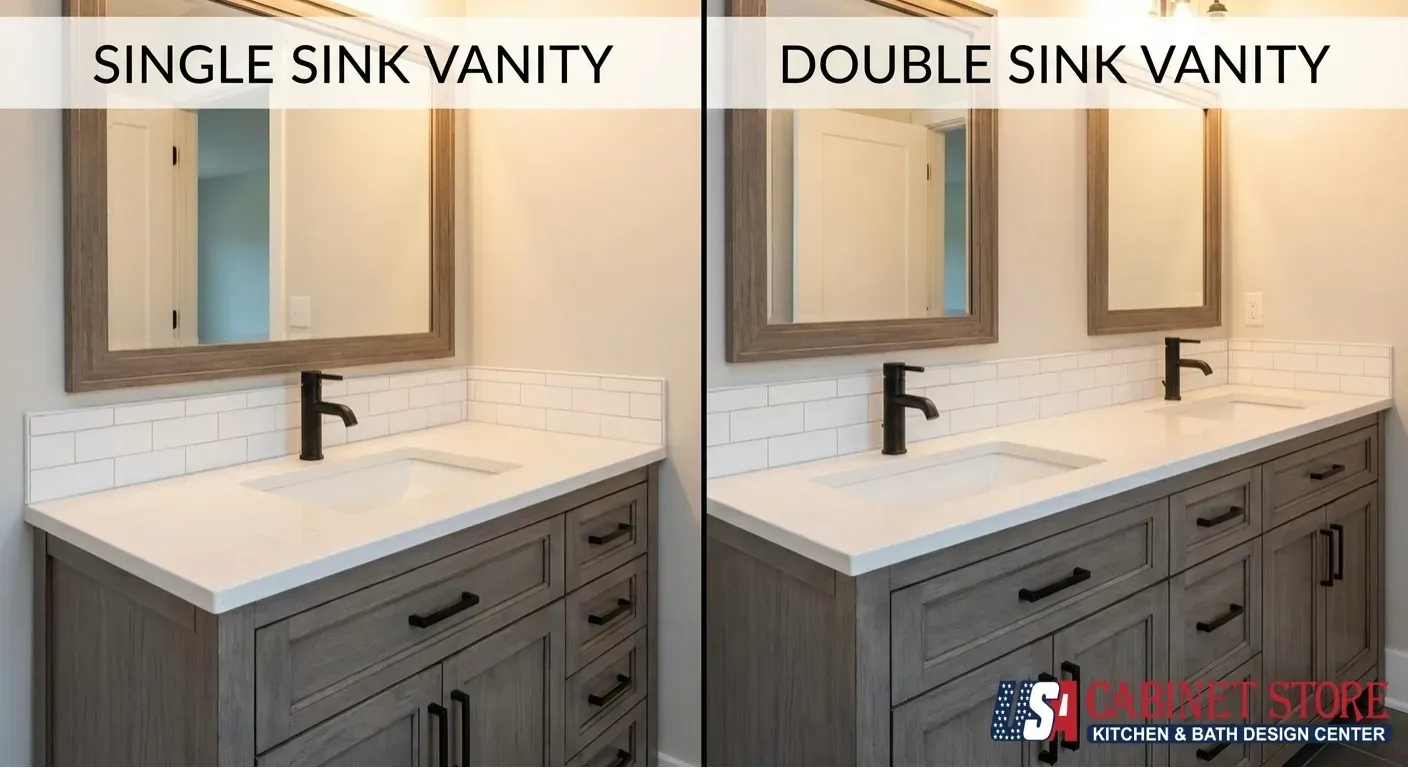
Single Sink vs. Double Sink Vanities
| Single Sink (24–48″) | Double Sink (60–72″) |
|---|---|
| • More counter space per sink • Lower cost, simpler plumbing • More uninterrupted storageBest for: Guest baths, single users |
• Two users simultaneously • Personal zones for each user • Increased resale valueBest for: Master baths, couples |
Cabinet Construction Materials
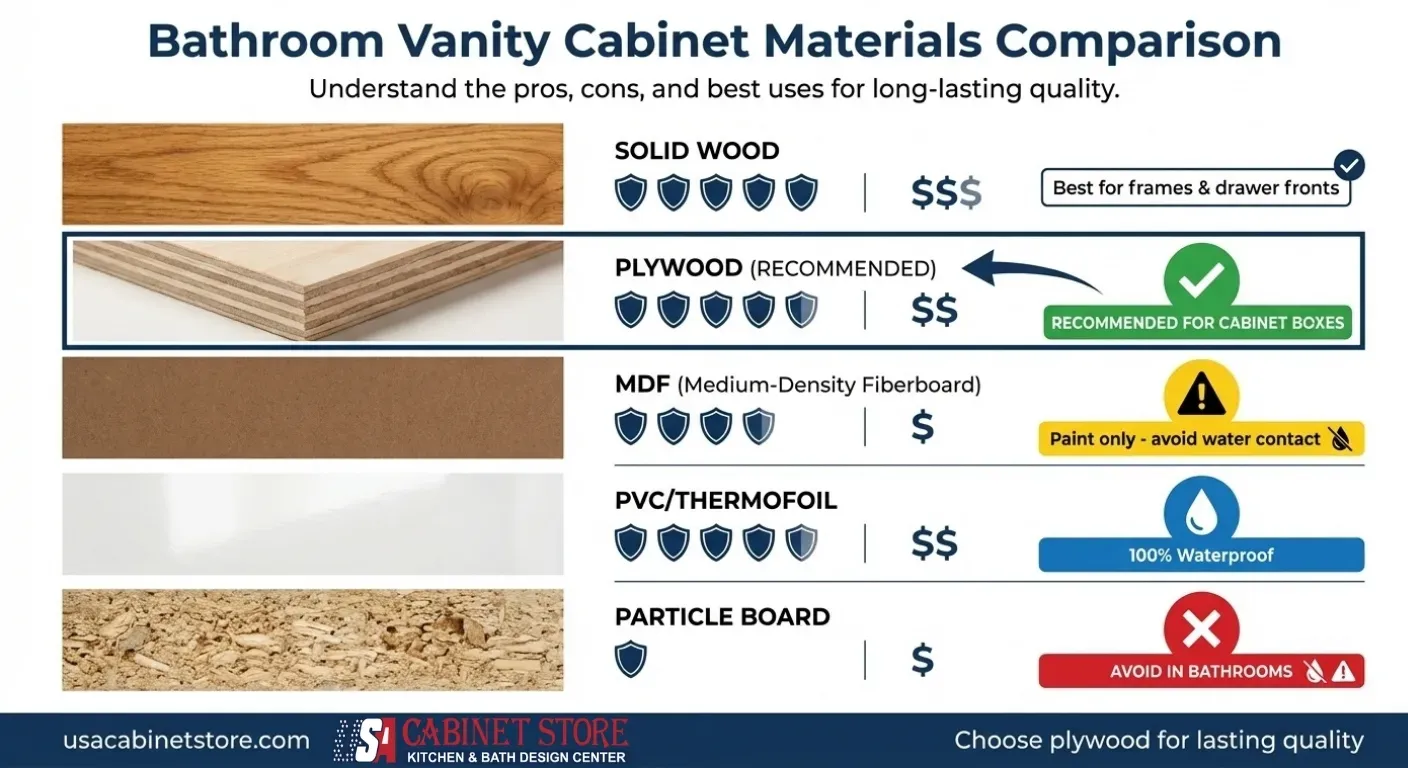
The cabinet box material determines your vanity’s longevity in a high-moisture environment. Here’s how they compare:
| Material | Pros | Cons | Best Use |
|---|---|---|---|
| Solid Wood | Strongest, refinishable, longest lifespan | Most expensive, can warp | Frames, legs, drawer fronts |
| Plywood | Moisture resistant, stable, strong | Mid-range cost | Cabinet boxes (BEST) |
| MDF | Smooth for painting, affordable | Swells if water penetrates | Painted fronts only |
| PVC / Thermofoil | 100% waterproof, immune to humidity | Limited styles, can peel | Modern floating vanities, kids’ baths |
| Particle Board | Cheapest option available | Crumbles with moisture exposure | AVOID IN BATHROOMS |
Countertop Materials Comparison
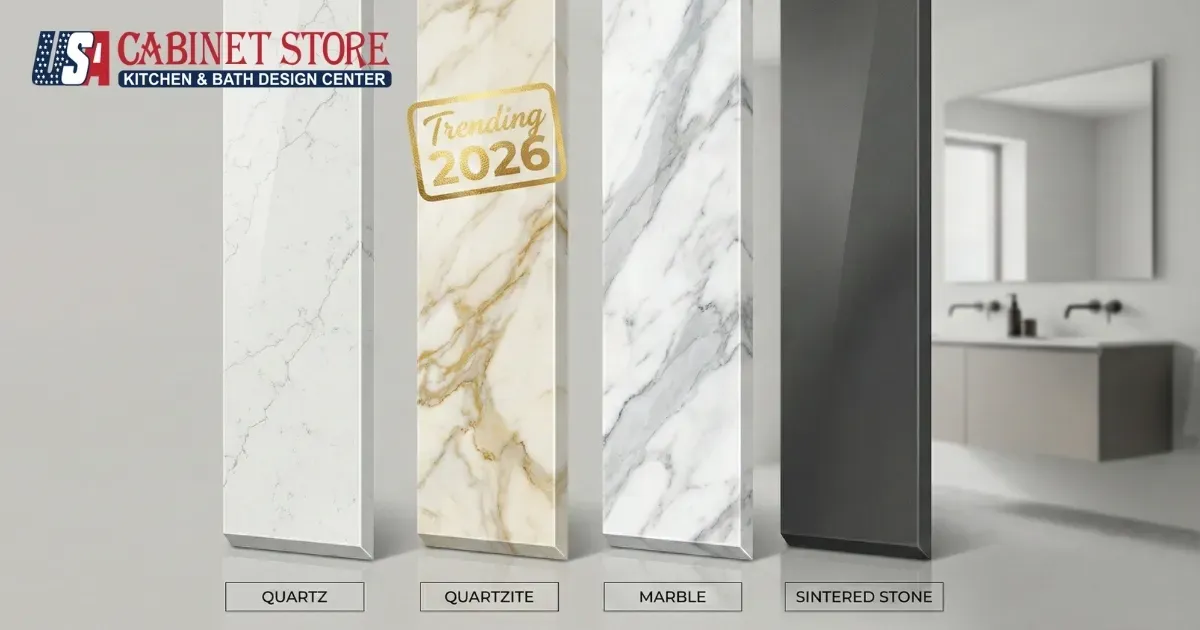
| Material | Porous | Sealing | Heat | 2026 Status |
|---|---|---|---|---|
| Quartz | None | Never | Moderate | Market leader; bolder veining trending |
| Quartzite | Low | Annual | High | 2026 “IT” material – natural beauty |
| Marble | High | Regular | High | Timeless luxury; requires maintenance |
| Sintered Stone | None | Never | Extreme | Ultra-compact; emerging premium choice |
2026 Bathroom Vanity Trends: What’s In vs. What’s Out
| Category | OUT | IN |
|---|---|---|
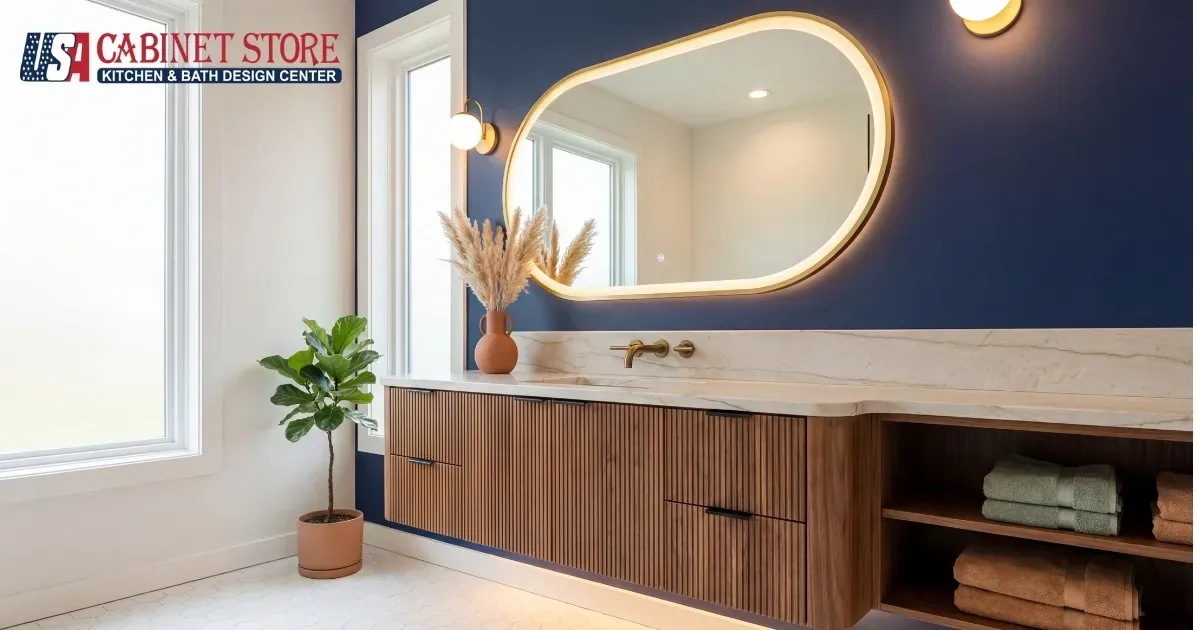
| Colors | All-white bathrooms; cool grays; high-gloss | Navy, sage, terracotta; warm wood tones; matte finishes |
| Structure | Boxy toe-kick cabinets | Floating vanities; furniture legs; soft curves |
| Surfaces | Flat slab doors | Fluted / reeded textures; ribbed drawer fronts |
| Hardware | Matching polished chrome throughout | Mixed metals; unlacquered brass; matte black |
| Technology | Visible screens and cords | Hidden outlets; smart mirrors; under-cabinet LED |
 Vanity Sizing Guide
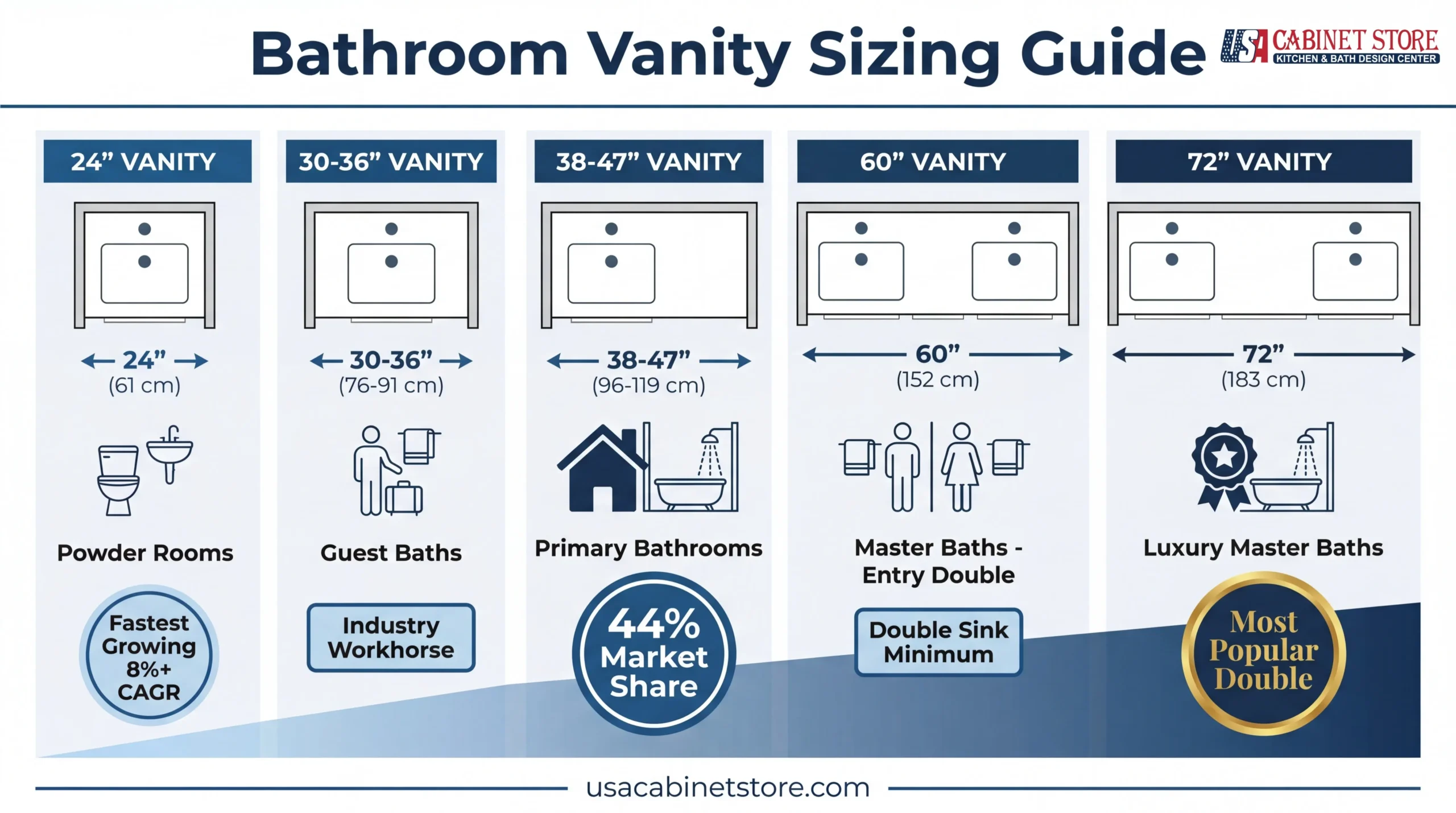
| Width | Application | Configuration | Market Note |
|---|---|---|---|
| 24″ | Powder rooms, small half-baths | Single, compact | 8%+ CAGR growth |
| 30–36″ | Guest baths, standard bathrooms | Single with good storage | Industry workhorses |
| 38–47″ | Standard primary bathrooms | Single with generous counter | ~44% market share |
| 60″ | Master bathrooms | Double sink minimum | Entry double size |
| 72″ | Master & luxury bathrooms | Ideal double (30–36″ per person) | Most popular double |
Height Standards & Clearances
- Comfort Height: 34-36″ (modern standard that reduces back strain)
- Traditional Height: 30-32″ (better for kids baths or vessel sinks)
- Standard Depth: 20-24″ (narrow options: 16-18″)
- Front Clearance: 21″ minimum required (30″ recommended for comfort)
- Toilet Clearance: 15″ from centerline minimum (18″ recommended)
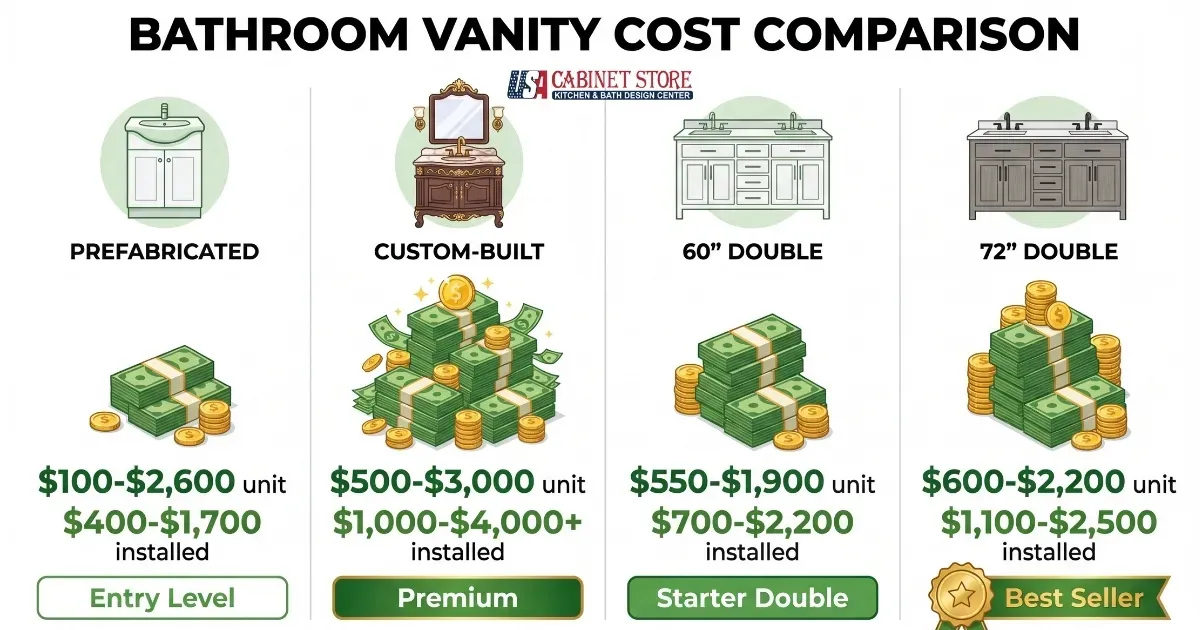
Bathroom Vanity Pricing Guide
| Configuration | Unit Cost | Installed Cost |
|---|---|---|
| Prefabricated Vanity | $100 – $2,600 | $400 – $1,700 |
| Custom-Built Vanity | $500 – $3,000 | $1,000 – $4,000+ |
| 60″ Double Sink | $550 – $1,900 | $700 – $2,200 |
| 72″ Double Sink | $600 – $2,200 | $1,100 – $2,500 |

Bathroom Remodel Return on Investment
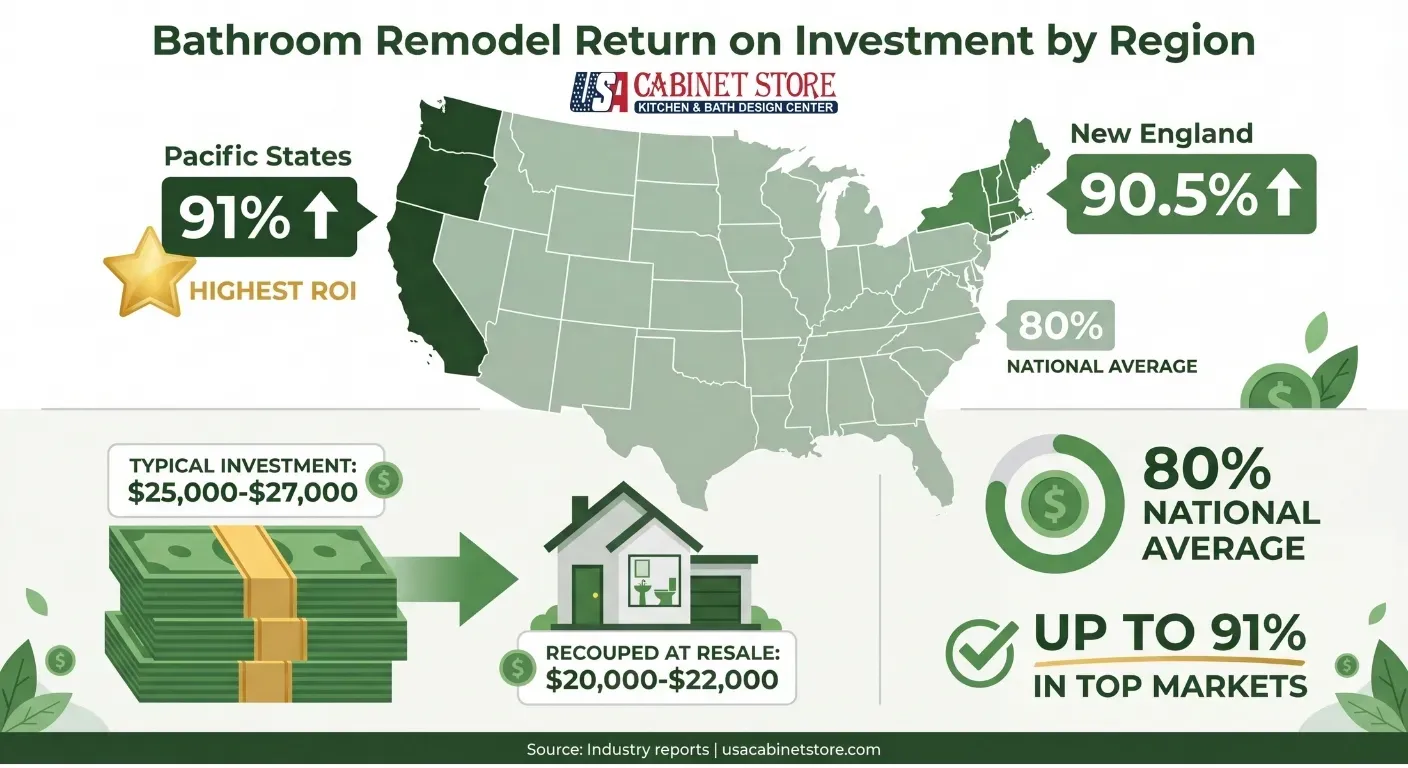
BATHROOM REMODEL ROI BY REGION
• National Average: ~80% cost recovery
• Pacific States (CA, WA, OR): Up to 91%
• New England: Up to 90.5%
• Typical Investment: $25,000-$27,000 spent / $20,000-$22,000 recouped at resale
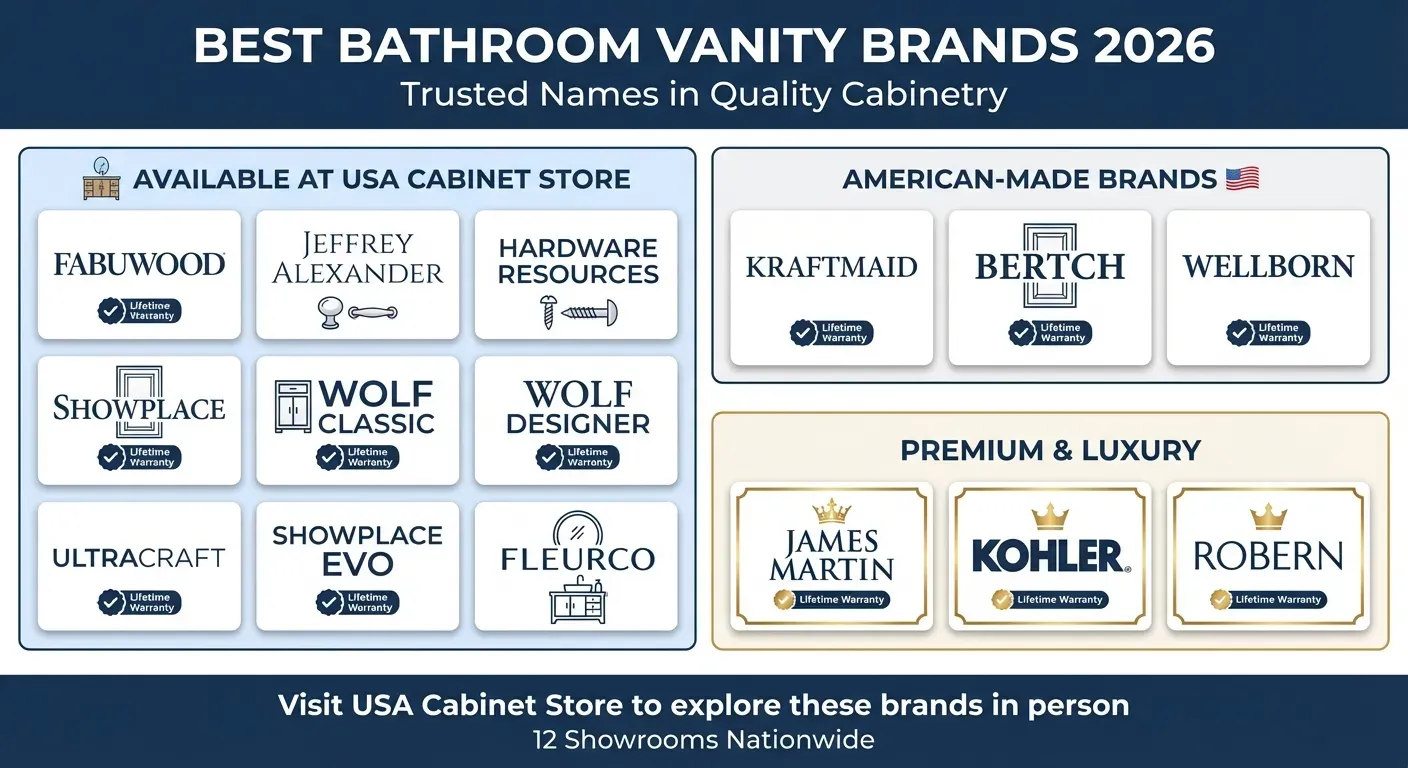
Best Bathroom Vanity Brands for 2025-2026
Choosing the right vanity brand is just as important as selecting the right style. Here’s our guide to the top brands available, including those we carry at USA Cabinet Store.
Brands Available at USA Cabinet Store
| Brand | Origin | Known For | Warranty |
|---|---|---|---|
| Fabuwood | USA-based | All-plywood construction, Blum soft-close, excellent value | Limited Lifetime |
| Jeffrey Alexander | USA | Designer vanities, quality hardware, multiple finishes | Limited Lifetime |
| Hardware Resources | USA | Premium cabinet hardware, functional storage accessories | Varies by product |
| Showplace | USA 🇺🇸 | Employee-owned, American-made, exceptional craftsmanship | Limited Lifetime |
| ShowplaceEVO | USA 🇺🇸 | Full-access frameless cabinetry, modern European style | Limited Lifetime |
| Wolf Classic | USA 🇺🇸 | Hand-crafted in America, traditional woodworking | Limited Lifetime |
| Wolf Designer | USA 🇺🇸 | Semi-custom cabinetry, wide style and finish selection | Limited Lifetime |
| Ultracraft | USA | Full overlay, full access, “cabinets for life” | Lifetime |
| Fleurco | Canada | LED medicine cabinets, luxury glass and mirror solutions | Varies |
Best American-Made Bathroom Vanity Brands 🇺🇸
For homeowners who prioritize domestic manufacturing and want to support American jobs, these brands manufacture their vanities in the United States:
| Brand | Location | Why They Stand Out |
|---|---|---|
| Showplace | South Dakota | 100% employee-owned; extensive customization; lifetime warranty |
| Wolf Home Products | Pennsylvania | America’s oldest building products company (est. 1843); hand-crafted |
| KraftMaid | Ohio | 50+ years of craftsmanship; consistently preferred by consumers |
| Bertch Cabinet | Iowa | Family-owned since 1977; local materials; reduced emissions |
| Wellborn Cabinet | Alabama | Family-owned 60+ years; in-house manufacturing; eco-friendly focus |
| Strasser | USA | 40+ years of U.S. manufacturing; US/Canada hardwoods; contractor favorite |
Premium & Luxury Brands
- James Martin Vanities: Solid wood boxes, real stone tops, dovetail joinery. Contractors call it the “gold standard” for pre-made vanities. Furniture-quality craftsmanship for heirloom pieces.
- Kohler: 150+ years experience, smart technology integration (Bluetooth mirrors, integrated lighting), eco-friendly designs. The trusted name in bathroom fixtures.
- Robern: Integrated smart features, innovative design, premium materials. High-end vanities with cutting-edge technology for luxury bathrooms.
What to Look for in Quality Vanity Construction
Signs of Quality:
- Solid wood face frames and doors
- All-plywood box construction (NOT particle board)
- Dovetail drawer joints
- Full-extension soft-close drawer slides
- Soft-close door hinges (Blum or equivalent)
- Multi-step moisture-resistant finish
Red Flags to Avoid:
- Particle board construction
- Stapled (not dovetailed) drawer boxes
- No soft-close mechanisms
- Thin MDF backing material
- Limited or no warranty

Featured Brands at USA Cabinet Store
Fabuwood Cabinetry: Our most popular choice. All-plywood construction with solid wood face frames and Blum soft-close hardware. Industry experts rate Fabuwood as “better constructed than KraftMaid” at a lower price point. Wide range of styles from modern to traditional.
Jeffrey Alexander by Hardware Resources: Designer bathroom vanities combining style with quality construction. Hardware Resources is a leading supplier of decorative cabinet hardware and functional accessories, and their Jeffrey Alexander line offers distinctive vanities in various sizes and finishes.
Showplace Cabinetry: 100% employee-owned and American-made in South Dakota. Backed by a limited lifetime warranty—ideal for homeowners wanting long-term peace of mind and premium American craftsmanship.
Wolf Home Products: America’s oldest building products company (established 1843). Hand-crafted quality from Pennsylvania with both Wolf Classic and Wolf Designer semi-custom lines available.
Ultracraft: Full-access, full-overlay cabinetry for a seamless modern look. Their “cabinets for life” philosophy means exceptional durability and customization options.
Fibo Wall Panels: Scandinavian-engineered waterproof wall panels that install 5x faster than tile with zero grout maintenance. Perfect complement to any vanity.
Why Choose USA Cabinet Store for your Bathroom Vanity?
With 12 showrooms across the East Coast and Texas, USA Cabinet Store provides hands-on expertise that online retailers simply can’t match. Here’s what sets us apart:
- Free Design Consultation: Work one-on-one with our design team to find the perfect vanity for your space, style, and budget
- Premium Quality Brands: Fabuwood all-plywood construction, Blum soft-close hardware, Showplace lifetime warranty
- Competitive Pricing: Factory-direct relationships mean premium quality at accessible prices
- In-Stock Options: Many vanities available for quick delivery; custom orders in weeks, not months
- Installation Support: Referrals to trusted local installers; guidance for DIY projects
Featured Brands
Fabuwood Cabinetry: All-plywood construction with solid wood frames and Blum soft-close hardware. Styles range from modern minimalist to classic traditional.
Fibo Wall Panels: Scandinavian-engineered waterproof wall panels that install 5x faster than tile with zero grout maintenance.
Additional Brands: Jeffrey Alexander hardware, Wolf Home Products, Showplace Cabinetry (lifetime warranty), Ultracraft custom options.
Frequently Asked Questions for Bathroom Vanity Types
What is a bathroom vanity?
A bathroom vanity is the cabinet-and-sink unit that anchors the room. It combines the countertop, one or two sinks, and the storage cabinet or drawers below. It hides the plumbing, gives you counter space for getting ready, and holds your toiletries. Vanities come in several types (freestanding, floating, pedestal, vessel, undermount, and corner) and in standard widths from about 18″ up to 72″ or more for doubles.
What are the different types of bathroom vanities?
Six main types: freestanding (floor cabinets), floating or wall-mounted, pedestal sinks, vessel sink vanities, undermount sink vanities, and corner vanities. Each one fits a different space and look.
What bathroom vanity style is popular in 2026?
Floating vanities with warm wood finishes lead modern spaces, while furniture-style freestanding pieces are the go-to for transitional design. Warm earth tones like navy, sage, and terracotta are replacing cool grays and all-white schemes.
How do I choose the right bathroom vanity for my space?
Start with space and plumbing, then move to style. Measure carefully, leave comfortable clearances, and pick a size that fits your room (24-30″ for small baths, 60″+ for doubles). Choose single or double sink based on whether two people really use it at once. Then prioritize drawer storage, pick a durable water-resistant material, and confirm the vanity lines up with your existing plumbing. Style comes last: floating or freestanding, finish, and hardware.
Can I customize my bathroom vanity?
Yes. Size, finish, countertop material, sink setup (single or double), and hardware can all be tailored to your space and style. Customizing also solves the fit and plumbing constraints that off-the-shelf sizes can’t, so the vanity works with your layout instead of fighting it. USA Cabinet Store showrooms can help you with that.
Are single or double sink vanities better?
A double sink earns its place only when two people get ready at the same time and you have at least 60″ of width. Below that, the basins shrink and you lose counter space. A second sink also adds real plumbing and fixture cost. Plenty of homeowners get more daily use out of a single sink in a wider vanity, with more counter and storage to show for it.
What size bathroom vanity do I need?
Measure the width, depth, and height of the space first, then check your door swing, shower-door clearance, and toilet spacing. For bathrooms under about 60 sq ft, a 24-30″ vanity balances storage against walkway room. A double vanity needs at least 60″ of width to work well. In a tight layout, choosing a shallower 16-18″ depth instead of the standard 20-24″ frees up real clearance.
Will a new vanity work with my existing plumbing?
Check before you buy. Note where your drain, water supply lines, and shut-off valves sit, then confirm the vanity’s cutout lines up with them. Floating vanities often expect wall-mounted drainage, so switching from floor plumbing can add cost. A vanity with an open back or a flexible cutout is much easier to fit to an existing setup.
What is comfort height for a bathroom vanity?
34-36″ from floor to countertop, matching kitchen counter height to ease back strain during daily use. The traditional 30-32″ height still makes sense for kids’ bathrooms or when you’re pairing it with a tall vessel sink.
Is MDF good for bathroom vanities?
It’s fine for painted door fronts when properly sealed, but risky for cabinet boxes. MDF swells permanently once water gets past the surface, so plywood is the safer choice for the cabinet box itself.
Are floating vanities sturdy enough for daily use?
Yes, when they’re installed right. A quality floating vanity holds 200+ lbs once it’s anchored to wall studs with 2×6 or 2×8 blocking. Have it professionally installed so the support is done properly.
Should I choose drawers or doors for vanity storage?
Drawers usually win. They give you full access to everything and use tight spaces better, while a single cabinet under the sink wastes the room around the plumbing. Match storage to how many people share the bathroom and what you need to keep in it. Underestimating drawer space is one of the most common vanity regrets.
What is the maximum load capacity for in-wall vanity carrier frames?
Standard in-wall carriers support 200-500 lbs, depending on the design and wall construction. Heavy-duty carriers made for stone countertops can hold more. Always check the rating on the specific carrier you’re using.
Does sintered stone chip more easily than engineered quartz?
Sintered stone is actually more chip-resistant than quartz due to its ultra-dense composition. However, thinner profiles (8mm) can be vulnerable at unsupported edges—specify 12mm+ thickness for vanity edges.
What is the optimal Kelvin temperature for makeup lighting?
4000K-5000K (neutral to cool white) mimics daylight for accurate makeup application. Smart mirrors with tunable white LEDs let you adjust across 2700K-6500K. Look for a CRI of 95+ for the truest color.
Do smart vanity mirrors require dedicated circuits or data drops?
Most smart mirrors run on a standard 15-amp circuit, since the LEDs draw under 50 watts. Mirrors with built-in defogging pads can benefit from a dedicated circuit. You rarely need a data drop, since most connect over WiFi or Bluetooth.
Are UV-C vanity drawers safe for storing cosmetics and medications?
They’re safe for hard surfaces like toothbrushes and sealed containers. But prolonged UV-C exposure can degrade some plastics and UV-sensitive ingredients, so keep SPF products and unsealed medications in a non-UV compartment.
Will fluted wood textures still be in style beyond 2026?
Yes. Fluted and reeded textures should stay popular through 2027 and beyond. The look is maturing toward subtler fluting with wider channels, and toward mixing textured and smooth surfaces.
How do you seal antique wood for bathroom use?
Strip it to bare wood, treat it with a borate-based preservative, then apply 2-3 coats of marine-grade polyurethane to every surface, including the interior. Seal the joints with silicone and add a moisture barrier under the countertop. It works best in a well-ventilated bathroom.
What is the most durable, low-maintenance bathroom vanity material?
For the cabinet, solid wood or good plywood holds up far better than particleboard or MDF, which swell in a humid bathroom. For the countertop, engineered quartz and porcelain resist moisture, stains, and daily chemicals better than natural marble or limestone. Marble and limestone can etch and dull within a couple of years. Whatever the cabinet, make sure it has a sealed, water-resistant finish.
How much cabinet space is needed for greywater systems?
It varies too much for a single figure. Under-sink greywater and water-reuse systems come in different sizes and can take up a real share of the cabinet, so plan for at least a 30″ wide vanity and check the specific unit’s dimensions before you commit, so you keep usable storage alongside it.
Which regions lead bathroom furniture manufacturing?
Asia-Pacific, mainly China and Vietnam, leads global production. U.S.-based brands are growing on the back of supply-chain concerns and shorter lead times. Companies like Showplace (built in South Dakota), Wolf, and Fabuwood (assembled in the US from globally sourced parts) stay competitive in the value and semi-custom segments.
How do 2026 code updates affect accessible bathroom vanities?
ADA and IBC require pipe protection on accessible lavatories, so all under-sink plumbing has to be insulated or covered to prevent burns and scrapes. The 2026 clarifications spell out knee clearance for a forward approach: 27″ high, 30″ wide, and 11-25″ deep.
Can nano-coatings be reapplied after cleaning damage?
Yes. Consumer-grade hydrophobic nano-coatings come in DIY versions. Clean the surface well and allow 24-72 hours to cure. Factory-applied coatings are different, though, and may need professional reapplication to keep the warranty valid.
Is mycelium-based furniture suitable for bathrooms?
Mycelium composites are a promising sustainable material, but they haven’t reached the long-term durability a high-humidity bathroom needs. Expect that to improve around 2027-2028. For now, they suit low-moisture uses better.
What is the lead time for 3D printed vanities vs. traditional custom?
Traditional custom joinery runs 6-12 weeks. 3D-printed components take 2-4 weeks for a unique design, and generative AI is cutting the design phase from weeks to days. For now, 3D printing suits smaller sculptural accent pieces better than full cabinet construction.
Is honeycomb packaging better than styrofoam for ceramic tops?
Honeycomb cardboard protects about as well as styrofoam, with a much better sustainability profile, which is why more eco-conscious manufacturers and buyers prefer it. Styrofoam still leads for ultra-fragile items, but it’s facing more environmental restrictions.
Do manufacturers provide BIM files for smart vanities?
Major brands provide BIM objects (Revit families), though detailed LOD 400 specs with integrated MEP connectors are still uncommon. Kohler and similar premium brands offer downloadable files, and architects usually adapt the standard families for smart-technology integration.
How do I maintain and care for my bathroom vanity?
Wipe up spills and standing water quickly, especially around the sink and base, and run the exhaust fan to keep humidity down. Use gentle, non-abrasive cleaners. Keep harsh or alcohol-based products off natural stone, and reseal stone tops now and then. Keep the finish intact so moisture can’t reach the cabinet underneath.
Can I install a bathroom vanity myself?
A simple freestanding swap (same footprint, no plumbing changes) is DIY-friendly. Floating vanities need professional installation for proper wall reinforcement. And anything involving plumbing relocation, electrical work, or heavy stone countertops should go to a licensed pro.
Should I pick a trendy or timeless bathroom vanity?
Keep the cabinet color, shape, and countertop timeless as your base. Bring in current trends through pieces you can swap easily: hardware, lighting, the mirror, and accessories. Bold, of-the-moment finishes on the vanity itself date the fastest and cost the most to change later.

Visit Our Showrooms for Best Bathroom Vanities
See vanity styles, materials, and finishes in person at any of our 12 locations:
Virginia
Chantilly – 3857 B, Dulles S Ct, Chantilly, VA 20151 | (703) 544-2255
Fairfax – 2832 Dorr Ave Suite E, Fairfax, VA 22031 | (703) 436-6444
Chesapeake – 1543 Sam’s Cir Unit B, Chesapeake, VA 23320 | (757) 581-1696
Tyson’s Corner – 8150 Leesburg Pike STE #170, Vienna, VA 22182 | (703) 745-5662
Maryland
Annapolis – 508 Chinquapin Round Rd Ste:A, Annapolis, MD 21401 | (410) 855-4901
Columbia – 9400 Snowden River Pkwy #105, Columbia, MD 21045 | (410) 694-7100
Texas
Houston – 3471 Kirby Drive, Houston, TX 77098 | (713) 597-5030
Houston North – 27718 Interstate 45 N, Oak Ridge North, TX 77385 | (281) 306-6060
Additional Locations
Nashville – 203 North Anderson Lane STE. 103, Hendersonville, TN 37075 | (615) 669-6909
Cary – 2226 Walnut St, Cary, NC 27518 | (919) 462-7272
Cherry Hill – 2076 Marlton Pike East Suite 3, Cherry Hill, NJ 08003 | (609) 888-8181
Tampa – 11913 N Dale Mabry Hwy, Tampa, FL 33618 | (813) 395-9900
Showroom Hours: Monday-Friday 9:30am-6:30pm | Saturday 9am-5pm

Want a quick estimate? Try our free NOVA Remodeling Cost Calculator to get an instant personalized estimate for your project.
 Updated for 2026 Market Rates
Northern Virginia Remodeling Budget Planner
Provided by USA Cabinet Store
Project Configuration
Define your dream space and your live cost projection appears at the bottom.
© USA Cabinet Store. All Rights Reserved.
Visit our official website: usacabinetstore.com
NOVA 2026 Pricing Index v3.0
Ready to Find Your Perfect Vanity?
Schedule your free design consultation at any of our 14 showrooms. Our expert team will help you navigate vanity types, materials, and styles to find the perfect fit for your space, style, and budget.
Visit www.usacabinetstore.com to schedule online, or call your nearest showroom directly.