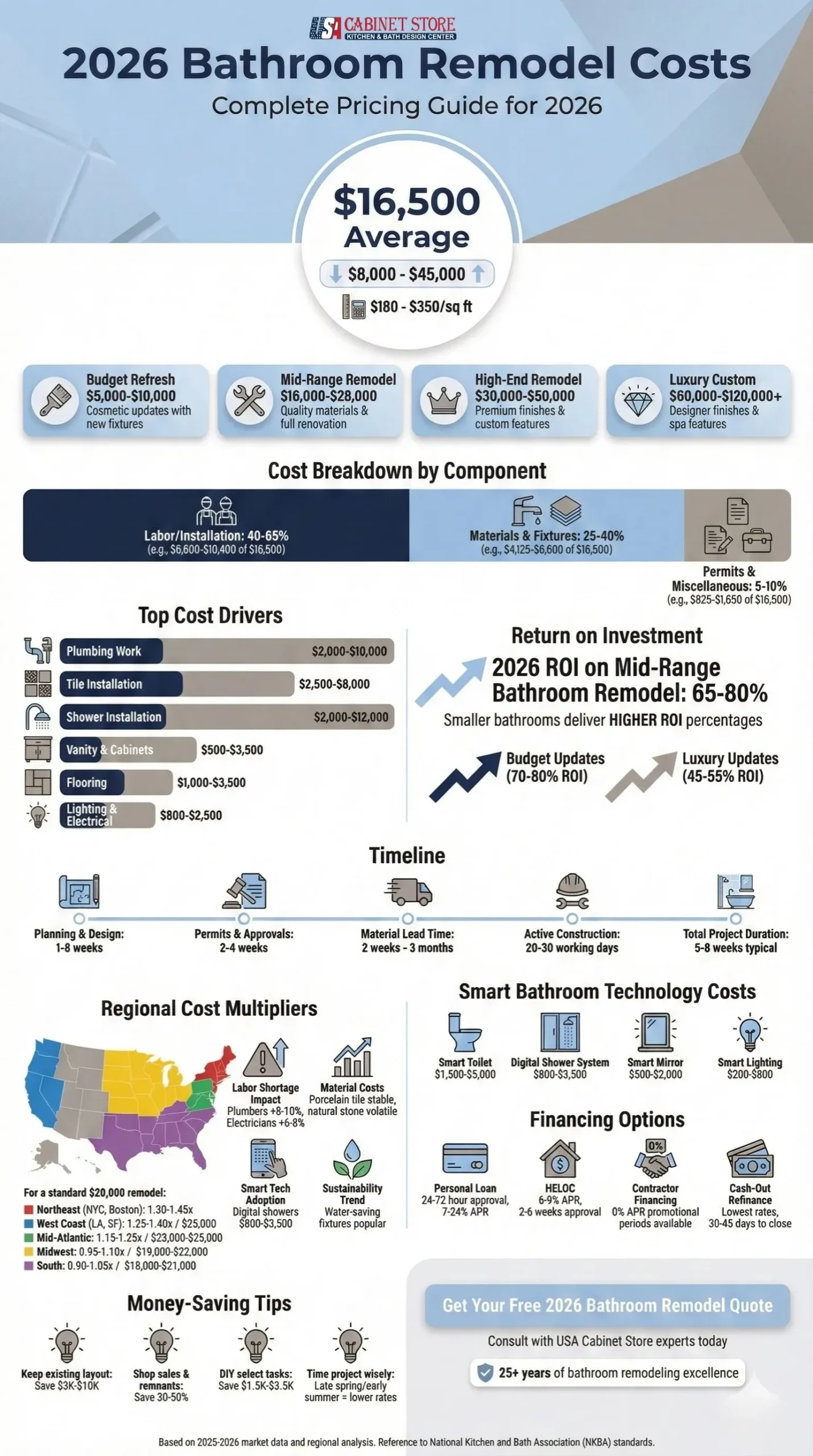
In 2026, the national average bathroom remodel costs $16,500, with most homeowners spending between $8,000 and $45,000 depending on bathroom size, quality level, and regional location. This represents a 4-6% increase from 2025 due to skilled labor shortages and material cost inflation.
Planning a bathroom renovation requires understanding not just the costs, but also the impressive return on investment—mid-range bathroom remodels deliver 65-80% ROI, making them one of the best home improvement investments for 2026.
📊 2026 Bathroom Remodel at a Glance
Sources: Cost data compiled from This Old House (2025), Angi, HomeGuide, National Kitchen & Bath Association (NKBA), and 2025-2026 regional market analysis. Labor cost projections reflect skilled trade shortage impacts: plumbers +8-10%, electricians +6-8% year-over-year.
Bathroom Renovation Costs Per Square Foot
The 2026 national average for bathroom remodeling costs is $180-$280 per square foot for mid-range projects, with budget renovations starting at $80-$120 per square foot and luxury remodels reaching $500-$800+ per square foot.
2026 Per Square Foot Pricing:
– Budget (cosmetic refresh): $80-$120/sq ft
– Mid-Range (quality updates): $180-$280/sq ft
– High-End (premium materials): $300-$450/sq ft
– Luxury (custom/designer): $500-$800+/sq ft
Example: A 5×8 bathroom (40 sq ft) would cost:
– Budget: $3,200-$4,800
– Mid-Range: $7,200-$11,200
– High-End: $12,000-$18,000
– Luxury: $20,000-$32,000+
Bathroom Remodel Cost By Project Cost
To help give you an accurate guess of what your bathroom remodel cost could be, we can look at individual parts of a bathroom renovation and their typical prices. You can use these bathroom remodeling costs to see where you might want to spend more or want to save money for your bathroom renovation.
Bathroom Remodel Costs: Demolition
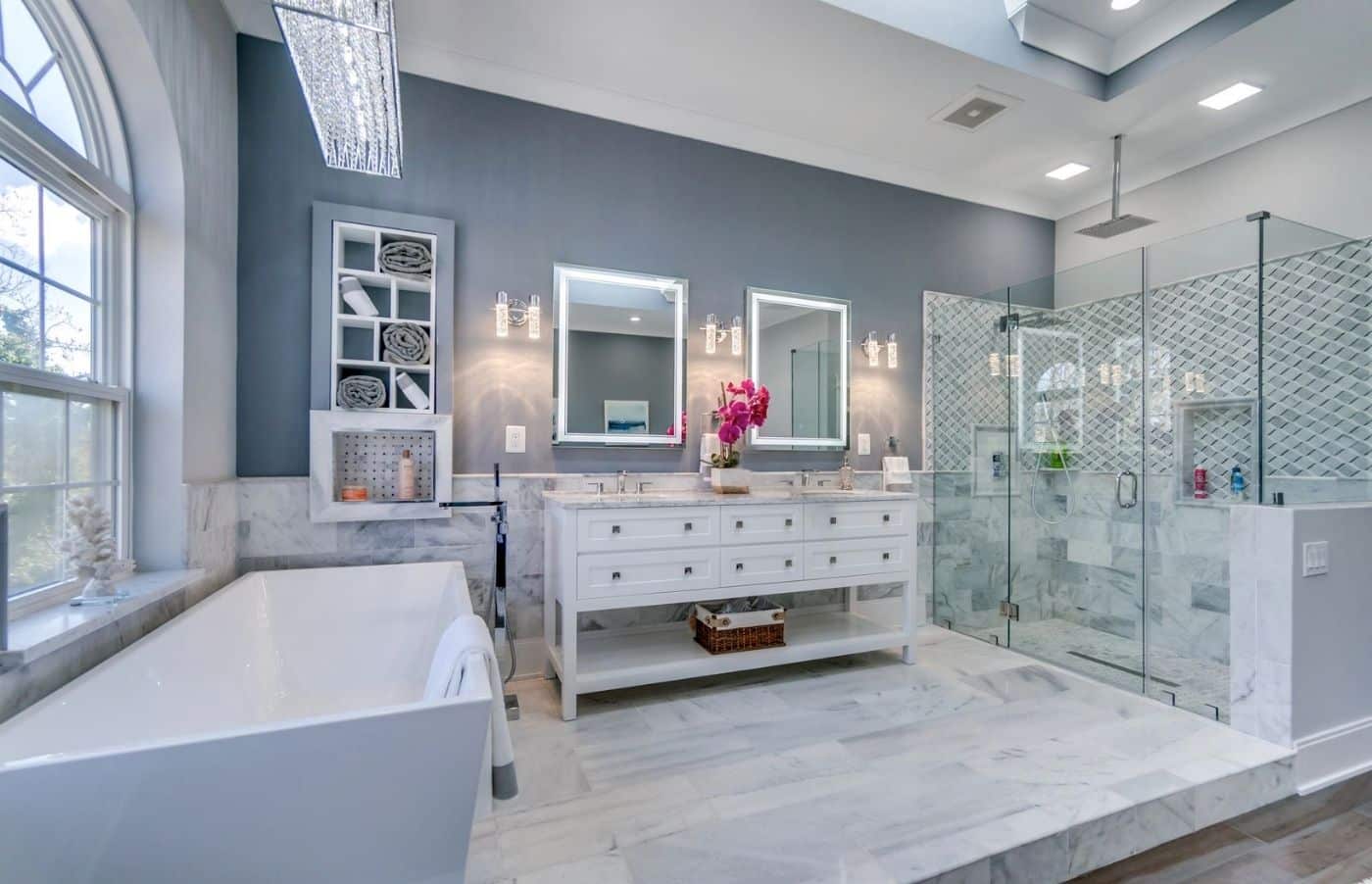
Some of the hardest parts of bathroom building you will never see in a remodeling magazine. The first step is to take out the old stuff, and the demolition costs from $390 to $2,100.
You may need to rent a dumpster during the bathroom demolition, which can make the process more expensive. A dumpster rental can cost from $160 to $630 per day.
If you have items that could be reused, even an old toilet paper holder, you might think of donating them to a good cause. Organizations like Habitat For Humanity might even come to pick up usable items that they will find a new home for.
Bathroom Vanities
Having a bathroom vanity in your home can help you with organization and design points. For a standard bathroom vanity, you could pay about $525 to $2,940.
On the other hand, a four-foot double vanity might cost you from $580 up to $3,360. These prices don’t reflect the cost of installing the units, which could be from $105 to $630.
Vanity Lights
Having some great vanity lights helps you to see yourself when you are getting ready. These items will cost you from $32 to $630 without the installation costs.
This price doesn’t reflect the cost of a mirror. A good mirror can reflect more light and make it easier to see while you prepare yourself for the world.
Shower Average Bathroom Remodel Cost
A shower might cost you as little as $210 for a prefabricated stall. If you want a custom walk-in shower, you might be paying more like $7,875.
If you want natural stone tile style in your shower, you might be paying an extra $1,050 or more. These prices reflect the labor costs for this work.
A custom shower is a luxury, but it can be well worth the price if you love them. Having a great shower is at the top of many people’s lists of desires in their bathroom.
Average Bathroom Remodel Cost For Toilet
A standard toilet costs from $105 to $630. Likewise, the cost of installing the toilet is $105 to $630.
For smart toilets with features like self-cleaning and handless operation, the cost is about double. These are low-flow toilets that will help conserve water.
If you are low on square footage, you might consider a wall-mounted toilet. These clever units put the tank in the wall behind it, saving some precious space in powder rooms.

Bathroom Floor
The most popular flooring option for bathroom renovations is floor tiles. They are great in wet environments like bathrooms, and will usually cost you from $525 to $3,673.
Some other options for bathroom floors are:
- Linoleum flooring is the most budget-friendly, starting at $105 up to $525.
- Vinyl plank starts at $160 up to $840.
- Wood flooring is about $210 to $1,785.
Remember, if you want to create a wet room, you will have to choose waterproof flooring like tiles. The waterproofing might add hundreds of extra dollars to your project budget.
Bathroom Walls
There are many options for your bathroom walls that you can choose from to create the perfect kitchen. Here is a breakdown of the costs of different wall materials:
- Tile walls = $15 to $20 per square foot
- Natural stone tile walls = $17 to $30 per square foot
- Drywall = $4 to $7 per square foot
Your bathroom walls need to reflect your style. You can go with a bold color or wallpaper that will reveal something about your character.
Type Of Bath Remodel
The use you see out of a bathroom renovation will also affect the total cost. Where in the floor plan the bathroom and who will be using it are the main bath remodel considerations.
Primary Bathroom Remodel 2026
For a complete primary bathroom renovation in 2026, expect costs between $18,000 and $80,000, with most homeowners spending $29,000-$50,000 for a mid-range remodel. This includes professional design services, quality fixtures, custom tile work, and potential layout modifications.
2026 Primary Bath Cost Breakdown:
– Budget refresh (cosmetic only): $18,000-$28,000
– Mid-range remodel: $29,000-$50,000
– High-end renovation: $51,000-$80,000
– Luxury spa retreat: $90,000-$120,000+
ROI Expectation: 55-65% return on investment when selling
Midrange Bathroom Remodel 2026
A professional mid-range bathroom remodel in 2026 typically costs $16,000-$28,000 for a full bathroom. This is the most popular tier, offering the best ROI (70-75%) with quality materials and professional installation.
What You Get:
– New vanity with quality countertop
– Tile shower or tub surround
– Updated fixtures and hardware
– New flooring (porcelain or luxury vinyl)
– Fresh paint and lighting
– Keep existing layout (saves $3,000-$10,000)
2026 Labor Costs Included:** – Plumbing: $3,000-$8,000 – Tile installation: $2,500-$6,000 – Electrical: $800-$2,500 – General contractor: 15-20% of total
Guest Bathroom Complete Remodel
A complete guest bathroom renovation in 2026 ranges from $8,000 to $35,000 depending on size (typically 40-60 sq ft) and quality level.
Guest bathrooms typically include a bathtub or walk-in shower plus vanity and toilet.
2026 Guest Bath Pricing:
– Budget update: $8,000-$13,000
– Mid-range remodel: $14,000-$22,000
– High-end renovation: $23,000-$35,000
Timeline: 4-6 weeks from demolition to completion
ROI: 70-80% return on investment
Half Bath Bathroom Remodel Cost
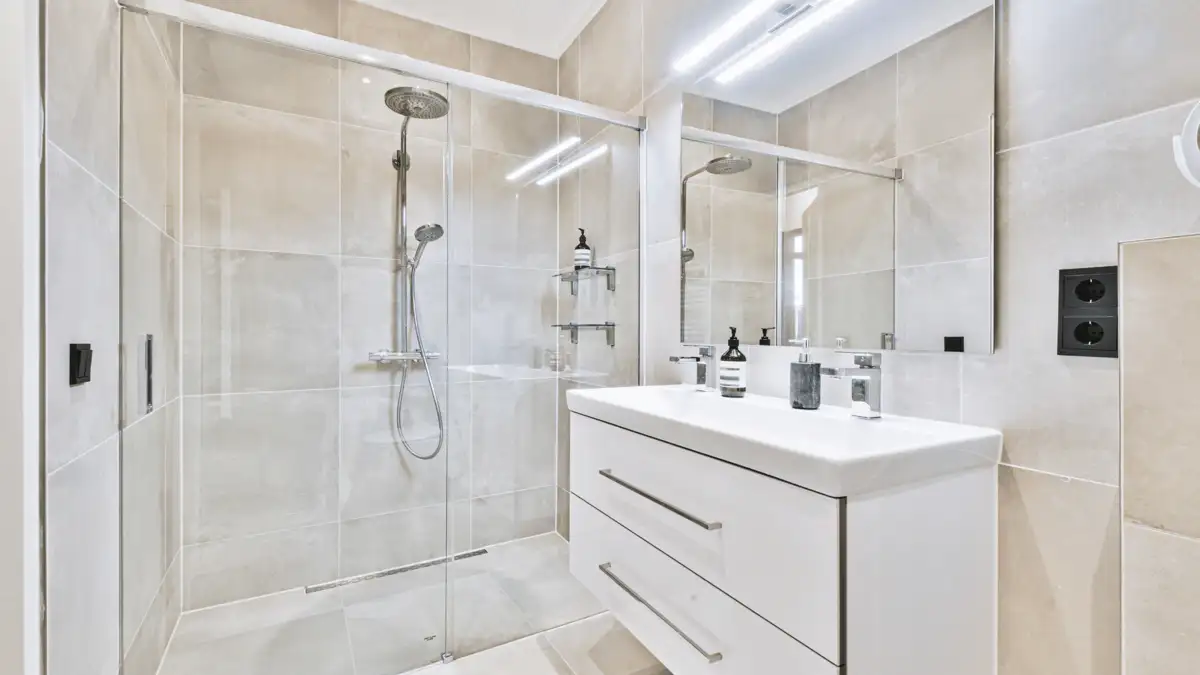
For a smaller square-foot bathroom prices vary between $5,390 and $8,385. A small bathroom remodel is not necessarily easier, but the need for materials is lower.
Half bathrooms are those that don’t have a tub or shower. This type of bathroom is normally near the living room where your guests can use it.
DIY Bathroom Remodel
Many people hope they can save money on bathroom renovations by doing the work themselves instead of hiring a professional contractor. On the surface, this seems like a sound bathroom remodeling idea, but it can quickly go downhill.
You are going to need to buy many tools to do a professional remodel that you may never use again. That drives your bathroom remodeling budget up, and might not be worth it.
Also, you’re going to make mistakes, which leads to repair costs. That right there will slow you down and raise the total price.
Home Improvement Store Prices
When you go to the home improvement store, you pay a higher price than a professional contractor. Bathroom renovation professionals get better deals because they bring more consistent business.
This fact can kill any savings you might have gained by doing a bathroom remodel on your own. You need to be especially vigilant of your materials costs when you shop at regular home improvement stores.
Taking your time to look for sales at remodeling stores can make a big difference in your overall remodeling budget. Patience really can pay off in the end.
Do You Have Skills?
It takes skills learned over the years to create a beautiful bathroom. Part of learning is also making mistakes, so be prepared to spend more replacing items that you break.
Bathroom Remodel by Location
Your location can greatly influence your total renovation cost. Bathroom renovations can happen in any part of the country, where the cost of living can vary widely.
In the highest-cost-of-living states, like New York and California, you might pay 20 percent more for a bathroom makeover. While in lower cost-of-living states, your final remodeling price could be significantly lower than in the average place.
Regional Differences In Bathroom Remodel Costs
Additionally, within one state you might find different bathroom renovation costs. For example, in Virginia, areas near Washington D.C. have much higher costs than rural parts away from the capital.

Financing Bathroom Remodeling
All this bathroom talk remodel cost has probably got you wondering about how you can pay for all of this. Having cash on hand for bathroom remodels is nice, but not always possible.
One option is to take out a home equity loan with your bank. Home equity loans are a way to get an updated bathroom using the value you have in your house.
If by chance you need to do a bathroom renovation because of an accident or natural disaster, your homeowners’ insurance might help with some of the costs. They might also help you with safety features, such as grab bars, which lower the chances of injuries.
Tips For Bathroom Renovation Budgets
The National Kitchen and Bath Association (NKBA) has many tips for staying on top of your bathroom remodel cost. Some of their most helpful advice includes:
- Determine how much you can comfortably spend on your bathroom remodel. It’s better to do this first to help you pick out materials and fixtures later.
- Break down your bathroom remodel costs to the smallest level. This makes your estimate more accurate to your project goals.
- Always expect the unexpected and have about 20 percent extra cash on hand for your bathroom remodel.
- Work with your contractors and practice consistent communication. This ensures that you are only paying for the things you want.
Making an itemized list of all the items you will purchase and the cost can give you a map of your expenses. Some folks find this technique saves them time and helps them remember what their budget is shaping up to be.
Should I Remodel My Bathroom?
The choice of bathroom remodeling may vary depending on your budget and if you can lose a bathroom for a few weeks to a month or more. A new bathroom is a major investment, and the decision shouldn’t be taken lightly.
For the most part, if you are sick of your current bathroom, you should do all you can to fix the situation. This might mean making some sacrifices to get your home the way you want it to be.
Living with a bad bathroom can reduce your quality of life. It’s just not worth it to spend your short time on this earth with an insufficient bathroom.
How much can homeowners expect to recoup in a 2026 home sale?
National ROI Averages for 2026
Mid-range bathroom remodels now deliver 65-80% ROI, making them one of the strongest home improvement investments. This means a $25,000 remodel adds $16,250-$20,000 to your home’s resale value.
ROI by Project Type (2026):
– Half bath/powder room: 75-85% (highest return)
– Guest bathroom: 70-80%
– Full family bathroom: 65-75%
– Primary/master bathroom: 55-65%
– Luxury custom bathroom: 45-55% (lowest return)
Why Budget & Mid-Range Remodels Win?
Smaller, strategic updates consistently outperform luxury renovations because:
1. Broader buyer appeal (not over-personalized)
2. Neighborhood value alignment
3. Focus on essentials buyers want (updated fixtures, fresh tile, good lighting)
Best High-ROI Updates for 2026:
– Walk-in shower conversion (from tub): 75-85% ROI
– New vanity & countertop: 70-80% ROI
– Fresh tile & flooring: 65-75% ROI
– Updated lighting fixtures: 70-80% ROI
– Modern toilet & faucets: 65-75% ROI
Worst Low-ROI Splurges:
– Heated floors: 40-50% ROI
– Custom stonework: 35-45% ROI
– High-end smart toilets: 40-50% ROI
– Luxury fixtures (gold-plated): 30-40% ROI
Are White Bathroom Remodels In Style?
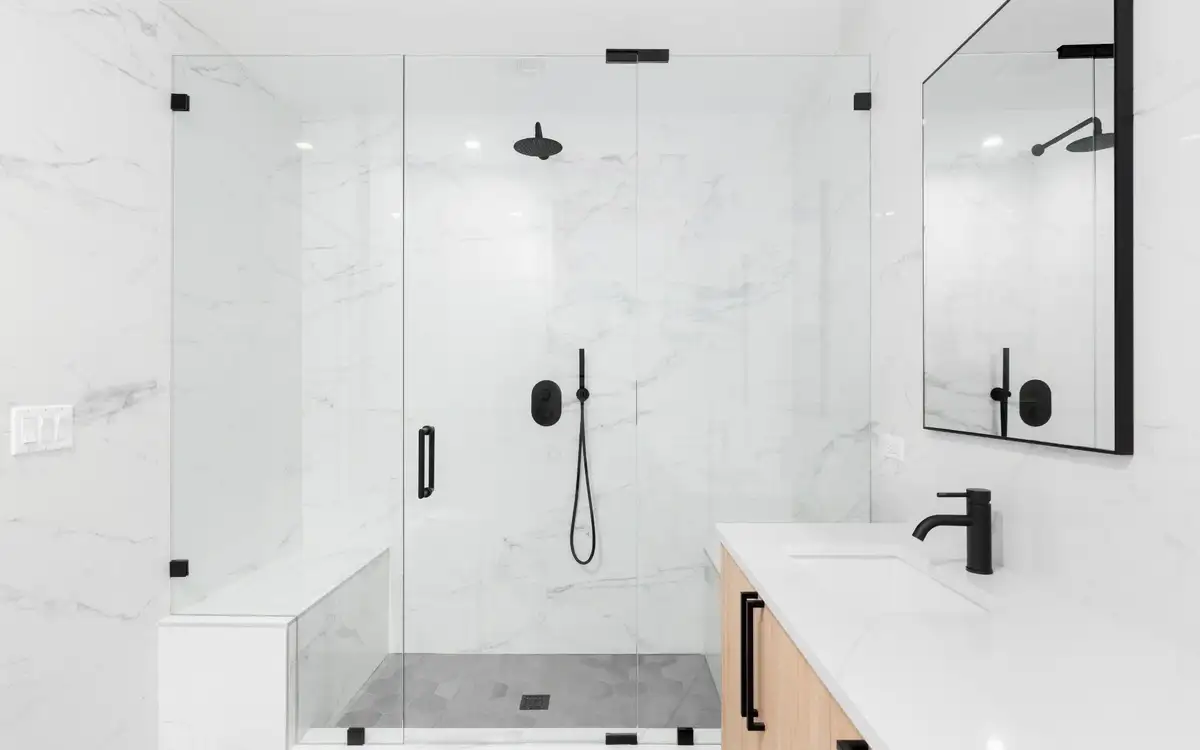
White bathrooms are a timeless look that you can feel confident in choosing for your home. The best features of white for bathrooms is that it looks clean and helps the space feel brighter and bigger.
These are great aspects to include in your bathroom remodel because you can enjoy them for years. My grandma used to always tell me that a white bathroom is the best bathroom, and I believe it to this day.
Are Subway Tiles Trending?
For a few years now subway tiles are all the rage in design magazines and on the internet. They are a great choice for a bathroom because they resist water and have a bright, textured appearance.
Though subway tiles are a subtle choice, they can make any bathroom look great. Give them a try in your bathroom remodel and you can see how great they look.
Bathroom Remodeling on a Budget
If you read this article and feel like there is no way you can afford a project like this, you shouldn’t give up! There are plenty of ways you can reduce costs and get the updated bathroom of your dreams.
A simple bathroom makeover can do wonders for your home. Start with a fresh coat of paint on the walls, and you will be surprised with how much better your bathroom looks already.
Next, add fixtures as you can afford them. Keep one eye on the hardware store sales and you will be able to save a ton of money in the end.
How to save money during a bathroom remodel?
If bathroom renovation costs feel high, then you need ways to save money on the construction process. Luckily, there are many techniques people have been using for years to create better bathrooms on small budgets.
A great place to start saving money is to reuse your existing bathroom fixtures. Some of the ways you can do this are:
- Repair old bathtubs to give them new life.
- Save old tiles and retile your walls with them.
- Check out second-hand stores for great deals on beautiful items.
- Ask your neighbors if they are throwing any of their bathroom items away.
- Fix cabinet doors with new hinges and pulls, instead of getting new cabinets.
Also, looking for sales on different bathroom items over a few years can lower your costs. It may take time, but you will be rewarded with a more affordable bathroom.
What is the Most Expensive Part of Bathroom Remodeling?
The most expensive part of bathroom remodeling could be plumbing costs. If your existing plumbing is in good shape, this won’t cost you too much.
What your bathroom budget gets you?
Now that you are aware of most of the basic costs of bathroom remodels, you might want to know what your budget will afford you. An example bathroom budget looks like the following:
- $1,000 to $5,000 – A fresh-looking bathroom with some of the old fixtures cleaned up. Some new items are mixed into the same footprint.
- $5,000 to $10,000 – A mid-size bathroom with every fixture new. This budget probably won’t get you your dream, custom walk-in shower though.
- $10,000 to $20,000 – A primary bathroom with all new fixtures. You will feel like you gained a new lease on life.
- $20,000 plus – This budget could allow you to expand your bathroom and even get features like heated floors. You can do almost anything you want with this amount.
Using this list of prices could help you decide how much to save up. There are lots of great tricks to create the bathroom of your dreams at a price you can afford.
Difference between a bathroom renovation and a bathroom remodel
You might get a little confused with all the talk about the costs of renovations and remodels. Here and now we can set the record straight for you.
A renovation is a project that refreshed and rejuvenates a space without changing its purpose or shape. When most people think of remodels, they are thinking of renovations.
A remodel can reimagine a space and alter its purpose and structure. A more appropriate use of bathroom remodeling would be if you were taking an old walk-in closet and transform it into a washroom.
Does Remodeling A Bathroom Cost More In Winter?
Some people might believe that remodeling a bathroom in winter might cost more than other times of the year. This is false, and you can find great deals on wintertime bathroom remodeling if you search around.
Many people hope to remodel their bathroom in the winter, and this might make contractors busier, so they might raise prices. You’ll have to talk to your bathroom remodeler to see how you can work out the best price for what you want.
Cheapest Time Of Year For A Bathroom Remodel
If you are hoping to find the least expensive month to start a bathroom remodel, look for when most people want to do a project. In many parts of the country, late spring and early summer are the cheapest time of year for bathroom remodeling.
This could be because children are getting out of school, and there will be more people at home needing the wash closet. Whatever the reason for this fact, contractors are more likely to look for extra work and lower their prices accordingly.
To find the cheapest time for a bathroom remodel in your area, it never hurts to call some contractors and ask. They might be able to schedule your project for a time when they can lower the pirce and get the job done faster.
2026 Bathroom Remodeling Market Outlook
Labor Shortage Impact
The skilled trades shortage continues to affect bathroom remodeling costs in 2026. Licensed plumbers command $85-$175/hour (up 8-10% from 2025), while electricians charge $60-$145/hour (up 6-8%). This labor shortage also extends project timelines by 1-2 weeks in many markets.
Material Cost Stabilization
After years of volatility, bathroom materials are stabilizing in 2026 with modest 2-3% increases:
– Porcelain tile: Stable pricing
– Fixtures (toilets, sinks): +2-3%
– Vanities & cabinets: +3-4%
– Copper plumbing: +2-4%
Smart Technology Adoption
Smart bathroom technology costs are dropping while adoption increases. In 2026, expect to pay:
– Digital shower systems: $800-$3,500
– Smart toilets: $1,500-$5,000
– Smart mirrors: $500-$2,000
– Voice-activated lighting: $200-$800
Building Code Updates
New ventilation and waterproofing requirements in many jurisdictions may add $500-$1,500 to code compliance costs in 2026, particularly for moisture management systems.
Frequently Asked Questions About Bathroom Remodel Costs in 2026
What specific features define the difference between a ‘mid-range’ and ‘upscale’ bathroom remodel in 2026?
A mid-range bathroom remodel ($16,000–$28,000) focuses on quality over luxury, featuring durable porcelain tile, solid wood or engineered vanities, standard chrome or brushed nickel fixtures, and prefabricated shower systems with basic customization. Upscale or high-end remodels ($30,000–$50,000) incorporate premium materials like natural stone tile, custom cabinetry with soft-close mechanisms, designer fixtures in specialty finishes (matte black, gold, mixed metals), frameless glass shower enclosures, and often include layout changes or structural modifications.
The key difference lies in customization depth and material quality: mid-range projects use readily available, proven products installed efficiently, while upscale projects feature bespoke elements, hand-selected materials, and artisan installation techniques that require additional labor hours.
Which bathroom materials are predicted to be most price-volatile leading up to 2026?
Copper-based plumbing materials are expected to see 2–4% price increases in 2026 due to global supply chain constraints and mining output limitations. Natural stone products (marble, granite, quartzite) remain volatile with 3–6% fluctuations based on import costs and quarry production. Conversely, porcelain tile pricing has stabilized with only 1–2% projected increases, making it a smart budget choice for 2026 projects.
Brass and bronze fixture finishes may see 3–5% increases due to raw material costs, while mass-produced chrome and stainless fixtures remain price-stable. Lumber for vanity construction has stabilized after 2021–2023 volatility, with only modest 2–3% increases expected.
How is the skilled trade labor shortage expected to impact hourly rates for bathroom remodeling by 2026?
Licensed plumbers now command $85–$175 per hour in 2026, representing an 8–10% increase from 2025 rates, with the shortage particularly acute in urban markets where demand exceeds supply. Electricians charge $60–$145 per hour (up 6–8% from 2025), while specialized tile installers see rates of $12–$22 per square foot, up from $10–$18 in 2024.
This shortage also extends project timelines by 1–2 weeks on average as contractors juggle multiple jobs and struggle to staff projects fully. Homeowners booking projects 2–3 months in advance may secure better rates and faster schedules than last-minute bookings.
For a 2026 home sale, does a minor bathroom refresh yield a better ROI than a full gut renovation?
Yes, data consistently shows budget and mid-range bathroom updates deliver 70–80% ROI, significantly outperforming luxury renovations that typically return only 45–55%. A $10,000 cosmetic refresh (new vanity, paint, fixtures, lighting) often recoups $7,000–$8,000 at resale and appeals to a broader buyer base.
Full gut renovations costing $40,000–$60,000+ can actually reduce ROI percentage because they’re often over-customized to current owners’ tastes and exceed neighborhood comparable values. The sweet spot for pre-sale remodels is $15,000–$25,000, focusing on walk-in showers, modern vanities, quality tile, and updated lighting—features universally desired by buyers.
What is the projected 2026 cost difference in maintenance and lifespan between a prefab shower and a custom tiled one?
Prefabricated acrylic or fiberglass shower units cost $800–$2,500 installed with a 10–15 year lifespan and minimal maintenance (simple cleaning, occasional caulk replacement). Custom tile showers cost $3,500–$15,000 installed but can last 20–30+ years with proper maintenance, requiring periodic grout resealing ($200–$400 every 2–3 years) and potential re-grouting ($500–$1,500 every 10–15 years).
Over 20 years, a prefab shower costs roughly $3,500 total (initial install $2,500 + replacement $1,000), while a custom tile shower costs approximately $5,000–$6,500 ($5,000 initial + $1,000–$1,500 maintenance), but offers significantly better aesthetics, home value addition, and durability. For homes being sold within 5–10 years, prefab makes financial sense; for long-term residences, custom tile provides better value.
What are the hidden costs (e.g., HVAC, structural engineering) when adding a new bathroom in 2026?
Adding a new bathroom (versus remodeling existing) typically costs $15,000–$50,000+ and includes numerous hidden expenses beyond basic fixtures. Structural engineering fees run $500–$2,500 for load calculations and floor reinforcement if adding a bathroom on a second story. Extending HVAC ductwork costs $1,000–$3,500, while adding electrical circuits runs $500–$1,500.
Plumbing rough-in for a new bathroom (running water supply, drain lines, and vent stack) costs $2,000–$5,000 versus $500–$1,600 for modifying existing plumbing. Building permits for new bathrooms cost $300–$1,500 (versus $200–$800 for remodels), and many jurisdictions require architect or engineer stamped plans adding $1,000–$3,000. Factor in framing new walls ($1,500–$4,000), drywall ($1,000–$2,500), and waterproofing ($500–$1,200)—costs not needed in remodels.
Are there projected tax credits or grants available in 2026 for medically necessary ADA bathroom renovations?
The IRS allows medical expense deductions for medically necessary home modifications including ADA bathroom remodels, though they must exceed 7.5% of adjusted gross income to qualify. Some state and local programs offer direct grants: California’s CalHFA offers up to $10,000 for accessibility modifications, while Florida’s SHIP program provides grants up to $7,500 for elderly homeowners.
Veterans may qualify for VA Home Improvement and Structural Alteration (HISA) grants providing up to $6,800 for service-connected disability modifications. Medicare doesn’t cover home renovations, but some Medicare Advantage plans offer supplemental benefits for bathroom safety modifications (grab bars, walk-in tubs). Check with your local Area Agency on Aging—many offer low-interest loans or grants specifically for aging-in-place bathroom modifications.
What is the projected payback period in 2026 for installing high-efficiency toilets and showerheads via utility savings?
High-efficiency toilets (HETs using 1.28 gallons per flush versus older 3.5–7 gallon models) save a family of four approximately 16,000–20,000 gallons annually, translating to $80–$120 in water/sewer savings per year. With HETs costing $180–$600 versus standard toilets at $150–$400, the premium pays back in 2–5 years.
WaterSense-certified showerheads (2.0 GPM versus standard 2.5 GPM) save about 2,700 gallons annually per person, equating to $30–$50 per person yearly in combined water and water heating costs. At $40–$150 for efficient showerheads versus $20–$80 for standard, payback is typically 6 months to 2 years. Many utility companies offer rebates ($50–$150) that provide immediate payback on these upgrades.
What is the cost to move plumbing for a tub-to-shower conversion in 2026?
Converting a tub to a shower without moving plumbing costs $2,000–$8,000 for basic prefab units or $3,500–$12,000 for custom tile showers when staying in the existing footprint. Moving plumbing adds $500–$1,500 per fixture relocated, as supply lines, drain pipes, and vent stacks must be rerouted.
For example, relocating a shower valve 3 feet costs approximately $600–$900 in additional plumbing labor, while moving a toilet to a new wall can add $1,000–$1,500 (drains require precise slope and venting). If converting a tub/shower combo to separate soaking tub plus walk-in shower, expect plumbing costs of $3,000–$6,000 just for the rough-in work before fixtures. Walk-in tub installations specifically cost $3,000–$15,000 depending on features and plumbing modifications required.
What are the typical ‘hidden fees’ or access charges for remodeling in a high-rise condo building projected for 2026?
High-rise condo bathroom remodels include building-specific costs that single-family homeowners don’t face: condo association/HOA approval fees ($200–$1,000), architectural review committee submissions ($150–$500), and special insurance riders ($200–$600) often required during construction. Building access fees for contractor parking, elevator reservations, and loading dock use run $50–$200 per day, adding $1,000–$3,000 to multi-week projects.
Material delivery and debris removal require coordination through building management, often with mandatory use of designated service elevators during off-hours (increasing labor costs 10–20%). Some buildings require engineering reports for any plumbing or structural work ($500–$2,000), plus deposits ($1,000–$5,000) held until project completion and inspection. NYC specifically can see bathroom remodel costs 25–40% higher than suburban projects due to these access constraints and stricter building codes.
Which financing option is expected to have faster approval times and more flexible terms for a 2026 remodel?
Personal loans offer the fastest approval (24–72 hours) and most flexibility for bathroom remodels under $35,000, with rates ranging 7–24% APR depending on credit score and no collateral requirement. Home equity lines of credit (HELOCs) provide better rates (6–9% APR in 2026) but require 2–6 weeks for approval and appraisal, plus using your home as collateral.
Contractor financing through companies like GreenSky or Synchrony often features promotional 0% APR for 12–24 months with approval in 5–15 minutes, making it attractive for mid-range projects ($10,000–$30,000). However, deferred interest can apply retroactively if not paid within the promo period. For projects over $50,000, cash-out refinances offer lowest rates but take 30–45 days to close and only make sense if current mortgage rates are competitive.
What is the projected cost for an electrician to wire a bathroom for multiple smart devices in 2026?
Basic electrical work for smart bathroom devices (adding outlets, installing switches) costs $60–$145 per hour with most jobs requiring 4–8 hours ($240–$1,160 total). Installing dedicated 20-amp circuits for heated floors, smart mirrors, or high-powered features adds $500–$1,200 per circuit.
Comprehensive smart bathroom wiring (outlets for smart mirror, toilet, shower, heated floors, plus low-voltage for sensors and controls) typically runs $1,500–$3,500 depending on bathroom size and device count. Add $300–$800 for a subpanel if existing electrical panel lacks capacity. Many smart devices require neutral wires at switch locations—retrofitting these in older homes adds $150–$300 per switch location.
What is the projected cost of permits and tool rental for a DIY bathroom remodel in 2026?
DIY bathroom remodel permits cost the same as contractor-pulled permits: $200–$1,200 depending on jurisdiction and scope (building $75–$650, plumbing $90–$425, electrical $60–$450). However, DIYers must navigate the application process themselves and may face scrutiny during inspections if work isn’t professional-grade.
Tool rental significantly impacts DIY budgets:
Tile saws ($40–$80/day), demolition equipment ($60–$120/day), power tools ($30–$60/day), and specialty plumbing tools ($25–$50/day) can total $500–$1,500 for a 2–3 week project. Add material waste (15–20% more than professionals due to mistakes) and potential do-over costs ($500–$2,000 for fixing errors), and true DIY savings shrink from an apparent 40–50% labor savings to just 20–30% overall.
How do material import tariffs and taxes differ and affect 2026 bathroom remodel costs between the US and Canada?
In 2026, Canadian bathroom remodels generally cost 15–25% more than US projects due to provincial sales taxes and higher labor costs. However, the US has recently introduced steep import tariffs on international materials that significantly increase the price of imported fixtures and cabinets.
Material Import Tariffs
While USMCA-compliant North American goods maintain a 0% tariff in both countries, the US has significantly increased duties on international imports for 2026. US homeowners and contractors now face a 50% tariff on imported bathroom vanities and cabinets, a universal 10% tariff on all global imports, and 24–46% duties on specific Asian materials.
Labor and Sales Taxes
Canadian projects face higher upfront costs because GST/HST adds 5–15% to all materials and labor depending on the province, whereas the US has no federal sales tax. Additionally, Canadian construction labor runs 20–30% higher due to stricter building codes, more inspection points, and higher prevailing wages.
Accessibility Tax Incentives
Tax relief for accessibility or medical remodeling differs significantly between the two countries, with Canada offering a more accessible direct credit and the US requiring out-of-pocket expenses to exceed a specific income threshold.
-
Canada: The Home Accessibility Tax Credit (HATC) offers a 15% non-refundable credit on up to CAD $20,000 in eligible expenses, providing a maximum return of CAD $3,000.
-
United States: The Medical Expense Deduction allows deductions for medically necessary home improvements, but only for the portion of the expenses that exceeds 7.5% of the taxpayer’s Adjusted Gross Income (AGI).
What does a $10,000 bathroom remodel look like?
A $10,000 budget sits at the top of the budget-refresh tier ($5,000–$10,000). It covers a cosmetic-to-light update that keeps your existing layout and plumbing in place: a new vanity, toilet, flooring, fixtures, lighting, and paint. For new tile, a new shower, or layout changes, plan for the mid-range tier of $16,000–$28,000 instead.
What is the 30% rule in remodeling?
The 30% rule is a budgeting guideline: avoid putting more than about 30% of your total renovation budget into any single room, and keep a single-room remodel within roughly 20–30% of your home’s value so you don’t over-improve for the neighborhood. For most homes that keeps a bathroom in the $8,000–$45,000 range.
How do I increase my home value by $50,000?
A single bathroom remodel rarely adds $50,000 on its own — a mid-range bathroom typically recoups 70–80% of its cost at resale, not its full price. To approach a $50,000 increase, homeowners usually combine high-return projects: a bathroom remodel plus a kitchen update and curb-appeal improvements. Within the bathroom, focus your dollars on the highest-return updates: walk-in showers, vanities, lighting, and ventilation.
What is the hottest bathroom trend in 2026?
The defining 2026 trend is the warm, spa-like bathroom: nature-inspired colors such as sage, warm beige, and muted greens replacing cool grays and all-white schemes, paired with curbless walk-in showers, floating vanities, and integrated smart technology like heated floors, smart toilets, and LED-lit mirrors. White remains a timeless base and subway tile is still popular, but 2026 leans warmer and more personal.
Are there new waterproofing membrane technologies expected by 2026 that could reduce labor costs?
Sheet membrane systems like Schluter KERDI and Wedi boards have revolutionized shower waterproofing, reducing installation time by 30–40% versus traditional hot-mop or multiple-layer systems. These cost $3–$8 per square foot for materials but save $500–$1,500 in labor on typical showers through faster installation.
Liquid-applied waterproofing membranes (RedGard, Hydroban) offer even faster application at $1.50–$3 per square foot and can be DIY-applied, though professionals achieve better results. Upcoming innovations include antimicrobial membranes that resist mold growth and smart membranes with moisture sensors that alert homeowners to leaks before visible damage occurs—expect these premium options to cost 25–40% more but offer long-term savings through damage prevention.
Want a quick estimate? Try our free NOVA Remodeling Cost Calculator to get an instant personalized estimate for your project.
 Updated for 2026 Market Rates
Northern Virginia Remodeling Budget Planner
Provided by USA Cabinet Store
Project Configuration
Define your dream space and your live cost projection appears at the bottom.
© USA Cabinet Store. All Rights Reserved.
Visit our official website: usacabinetstore.com
NOVA 2026 Pricing Index v3.3
USA Cabinet Store has the expertise, selection, and service to bring your bathroom vision to life. Contact us today to schedule your free design consultation and take the first step toward your dream kitchen.
Finding The Best Bathroom Remodel Contractor
Choosing the right bathroom contractor is crucial to a successful bathroom remodel. Look for licensed professionals with verifiable experience, transparent pricing, and strong customer references.
Ready to Start Your 2026 Bathroom Remodel?
Get a detailed, no-obligation estimate from USA Cabinet Store’s team of certified bathroom remodeling experts with 25+ years of experience.