
Your shower glass looked perfect for about six months. Then came the faint spotting, then the milky film, then the day you scrubbed for an hour and it still looked dirty. Most people respond by buying a stronger cleaner. That is usually the wrong move, and sometimes it makes things permanently worse.
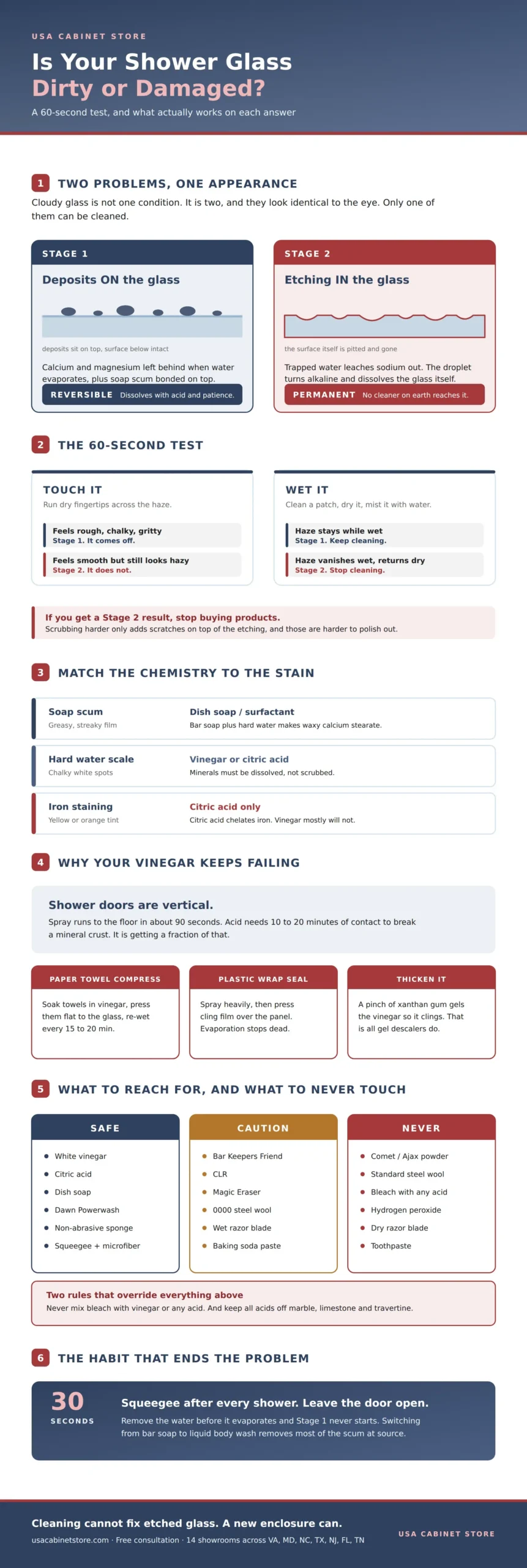
Here is what almost no cleaning article tells you. Cloudy shower glass is not one problem. It is two, and they are completely different. One sits on top of the glass and dissolves in about fifteen minutes. The other is chemical damage inside the glass itself, and no cleaner made will touch it. Before you buy anything, you need to know which one you have. This guide shows you how to tell in sixty seconds, what actually works on each, and what to do when the answer is that cleaning is finished.


- Light film, cleaned in the last month. Mild dish soap, warm water, microfiber, squeegee. Stop there.
- White spotting you can feel with a fingertip. Acid is what you need, not scrubbing. Diluted vinegar or citric acid with a real dwell time.
- Years of buildup, several products already failed. Step up to a dedicated descaler and use the plastic-wrap dwell method below.
- Smooth to the touch but still hazy after a full clean. Your glass is etched. Cleaning will not fix this. Skip to when cleaning stops working.
Etched glass cannot be cleaned back to clear. If yours has crossed that line, a new enclosure is the fix. Our designers will tell you honestly which situation you are in.
Book a free consultationWhy glass shower doors go cloudy in the first place
Glass feels like an inert surface. It is not. Tempered shower glass is a sodium silicate, and its surface is microscopically porous, full of tiny peaks and valleys that give minerals and soap something to grab. Water does not just sit on it. Water reacts with it.
That reaction runs in two stages, and telling them apart is the whole game.
Stage 1: stuff lands on the glass
Municipal water carries dissolved calcium and magnesium. The USGS classes water as soft up to 60 milligrams per liter of calcium carbonate, moderately hard to 120, hard to 180, and very hard above 180, which is roughly 10.5 grains per gallon. When a droplet dries on your door, the water leaves and the minerals stay, mostly as calcium carbonate and magnesium carbonate. Repeat that a few thousand times and you get the white haze.
Soap makes it worse in a specific way. Bar soap is built on fatty acid salts like sodium stearate. Hit that with the calcium in hard water and it converts to calcium stearate, which is an insoluble, waxy, extremely sticky solid. That is soap scum. It bonds to the glass as a new compound, and it traps moisture and minerals underneath itself. The U.S. Geological Survey describes this same reaction between calcium and soap.
All of Stage 1 is reversible. Every bit of it comes off with the right chemistry and enough patience.
Stage 2: the glass itself starts breaking down
Leave Stage 1 alone long enough and the trapped moisture goes to work on the glass. Hydrogen ions from the water swap places with sodium ions in the glass surface. The sodium migrates out into the water droplet. That droplet turns alkaline. Once its local pH climbs past 9.0, it starts severing the silicon-oxygen bonds that hold the glass network together.
The result is a microscopically pitted surface that scatters light. That is etching. The restoration trade calls it shower glass cancer, which sounds dramatic until you understand there is no cleaner on earth that reverses it. You cannot wash away a hole.

Here is the part that surprises people. A heavily fogged door that runs with water is often in better shape than one with a light misting that just sits there. Running droplets carry the leached sodium down the drain. A thin static film lets the pH climb and the glass gets attacked. So the shower you use twice a day and squeegee can outlive the guest shower nobody touches.
The 60-second test: is your glass dirty or damaged?
Do this before you buy a single product. Restoration professionals run these two checks first, because the answer decides everything that follows.
Test one: touch it
Run clean, dry fingertips across the hazy area.
- Rough, chalky or gritty. Deposits are sitting on top. Stage 1. Fully fixable.
- Smooth as new glass, but still visibly hazy. Stage 2. The cloudiness is coming from inside the surface.
Test two: wet it
Clean a small section properly, dry it fully, then mist it with plain water and watch.
If the haze vanishes the instant it gets wet and comes straight back as it dries, that is etching. The water is temporarily filling the microscopic pits and matching the refractive index of the glass, so light passes through cleanly for a moment. It is a reliable field test, and it takes ten seconds.
If you get a Stage 2 result, stop buying cleaners. Nothing in the next four sections will help you, and aggressive scrubbing at that point only adds scratches on top of the etching. Go to when cleaning stops working.

Soap scum and hard water are not the same problem
Most doors have both, which is why single-ingredient solutions disappoint. They need opposite treatments.
| Soap scum | Hard water scale | |
|---|---|---|
| What it is | Calcium stearate, a waxy solid formed from soap plus minerals | Calcium and magnesium carbonate crystals |
| Looks like | Greasy, streaky, slightly yellow film | Chalky white spots, dull haze, crusty rings |
| What removes it | Surfactants. Dish soap, degreasers | Acid. Vinegar, citric acid, oxalic acid |
| Yellow or orange tint | Body oils and product residue | Iron in the water. Needs citric acid, not vinegar |
| Prevention | Switch from bar soap to liquid body wash | Squeegee, or soften the water at the source |
That table explains why vinegar plus dish soap became the internet’s standard answer. The acid dissolves the mineral lattice and the surfactant lifts the fatty layer. The chemistry behind it is sound. It just needs to be used correctly, which brings us to the part everyone skips.
The yellow and orange staining is a different problem. That is iron, and vinegar mostly will not shift it. Citric acid will, because it chelates iron rather than just reacting with carbonate. If you are on well water and your stains have a rusty tone, go straight to citric acid.
The pro method, step by step
For a typical door with normal buildup, this is the sequence. It is chemical work, not muscle work.
- Rinse the glass with warm water. Warm surfaces let acids work faster and you clear off anything loose.
- Mix your solution. One cup distilled white vinegar, one cup water, one teaspoon of dish soap in a spray bottle. For heavy mineral staining use two tablespoons of citric acid powder in one cup of warm water instead.
- Spray from the top down and coat it completely. Patchy coverage gives you patchy results and a visible tide line.
- Let it dwell 10 to 20 minutes. This is the step that does the actual work. Light staining, 5 to 10 minutes. Moderate, 10 to 15. Severe, 15 to 20 and re-spray if it starts drying. Never let the solution dry on the glass.
- Agitate gently with a non-abrasive sponge. Small circles. Keep the surface wet the whole time. When the gritty sound and feel stop, the deposits are gone.
- Rinse thoroughly with warm water. Leftover acid residue causes fresh cloudiness and attracts dirt.
- Squeegee top to bottom, then buff with a dry microfiber cloth. The job is not done when the glass is clean, it is done when the glass is dry.
- Dry the edges, hinges and hardware separately. Standing water at the bottom edge is where the next problem starts.
If two full passes of that leave you where you started, do not escalate the scrubbing. Escalate the chemistry, or run the 60-second test again, because you may be dealing with Stage 2.
Every cleaner people try on shower glass, ranked
This is the table we wish existed when we started answering this question in the showroom. Coated glass means factory or aftermarket treatments like ShowerGuard, EnduroShield or Diamon-Fusion. Stone means marble, limestone or travertine anywhere the overspray can land.
| Product | How it works | Plain glass | Coated glass | Stone nearby | Verdict |
|---|---|---|---|---|---|
| White vinegar | Acetic acid converts carbonate to soluble calcium acetate | Yes | Check the maker first | No | Best all-round starting point |
| Citric acid | Stronger on scale, and chelates iron | Yes | Check the maker first | No | Better than vinegar on rust tones, barely smells |
| Dish soap / Dawn Powerwash | Surfactants emulsify the fatty scum layer | Yes | Yes | Yes | Safest option in the house. Does nothing to scale |
| Bar Keepers Friend | Oxalic acid plus fine abrasives | Yes, with care | No | No | Effective, but their own label says rinse within a minute and do not let it sit longer than necessary |
| CLR | Lactic and gluconic acids with surfactants | Yes | No | No | Strong on heavy scale, corrosive to metal frames and hardware. Keep it off the trim |
| Baking soda paste | Mild abrasion only | Yes, gently | No | No | Fine alone. Do not mix it with vinegar, see below |
| Magic Eraser (melamine) | Microscopic abrasive, not a chemical cleaner | Yes, wet only | Risky | No | Works like ultra-fine sandpaper. Never use it dry |
| 0000 steel wool | Physical micro-abrasion | Yes, heavily lubricated | No | No | Only the 0000 grade, only soaking wet. It rusts on contact with acid, so rinse fast |
| Wet razor blade | Shears crusted deposits off | Experienced hands only | No | n/a | Shallow angle, glass soaking wet. Dry scraping gouges permanently |
| Comet, Ajax, scouring powder | Coarse abrasion | No | No | No | Scratches glass and dulls hardware finishes. Skip it |
| Hydrogen peroxide | Mild oxidizer | Harmless on glass | Check first | Check first | Door makers warn it corrodes metal even at low concentration. Popular advice, poor idea |
| Bleach | Disinfectant, does nothing to scale | Pointless | No | No | Corrodes hinges and tracks, and mixing it with acid is dangerous |
| Rain-X and similar repellents | Silane polymer bonds to the glass surface | Yes, on clean dry glass | Not over ShowerGuard | Yes | Actually helps. Reapply every few months |
| Toothpaste | Abrasive with added binders | No | No | No | A social media myth. Leaves film and scratches |
The baking soda and vinegar problem
Nearly every cleaning article recommends mixing baking soda with vinegar and pointing at the fizz as proof it is working. The fizz is proof of the opposite. Baking soda is a base and vinegar is an acid. Combine them and they neutralize each other, releasing carbon dioxide and leaving you with saltwater and a mild abrasive slurry.
You have not made a stronger cleaner. You have destroyed the acid that was going to dissolve your limescale and replaced it with scrubbing. If you want the mild abrasion, use baking soda paste on its own. If you want the mineral dissolving, use the acid on its own. Using both at once gets you the weaker half of each.

Frameless enclosures, curbless wet rooms and low-maintenance surfaces have changed what a bathroom asks of you. Walk one of our 14 showrooms and see the difference in person.
Bathroom remodeling Walk-in shower ideasThe dwell-time trick that separates pros from everyone else
Here is the real reason your vinegar spray underperforms. Shower doors are vertical. You spray, and gravity pulls the solution to the floor in about ninety seconds. The acid needs fifteen minutes of contact to break down a mineral crust, and it is getting one and a half.
Professionals solve this three ways. Any of them will outperform buying a stronger product.
- The paper towel compress. Soak paper towels in vinegar and press them flat against the glass so they stick. Re-wet them every 15 to 20 minutes. For badly neglected doors, keep that going for an hour or more. It looks ridiculous and it works better than anything you can buy.
- The plastic wrap seal. Spray your descaler heavily, then press cling film over the whole panel. Evaporation stops completely and the chemical digests the scale for a full hour. This is the move for years of buildup.
- Thicken it. A pinch of xanthan gum turns vinegar into a gel that clings instead of running. Commercial descalers sold as gels are doing exactly this and charging you for it.
Adding a squirt of dish soap to your vinegar helps for the same reason. It raises viscosity so the mix clings longer, on top of cutting the greasy layer.

What you should never use on shower glass?
Shower door manufacturers publish do-not-use lists, and they are more specific than most homeowners expect. Delta Shower Doors names six chemicals outright: naphtha, hydrogen peroxide, toluene, ethyl acetate, lye and acetone. Their reasons matter, because several of these dissolve the silicone that keeps water inside your shower rather than inside your subfloor.
Note that hydrogen peroxide appears on that list. It also appears in plenty of cleaning guides as a recommended treatment. The company that made your door says it corrodes metal even at low concentrations. We would take the manufacturer’s word on this one.
Two more that should never come near shower glass. Hydrofluoric acid, sold in some rust and mineral removers, attacks the silica network directly and will destroy the pane. And sodium hydroxide, or lye, is caustic enough to etch glass permanently on its own.
Chlorine bleach reacting with an acid releases chlorine gas, which causes acute respiratory injury and chemical burns to the airway. Bleach plus ammonia produces chloramine gas with similar effects. The CDC documents both. If you have used bleach in the shower, rinse everything thoroughly and ventilate before any acid touches that surface. And never mix household cleaners unless the label tells you to.
Coated glass changes all of the above
If your enclosure was installed in the last decade or so, there is a decent chance the glass is treated. Two very different technologies get called the same thing, and they need different care.
Factory inorganic coatings
Guardian’s ShowerGuard is the reference example. The glass surface is sealed through a patented ion beam process during manufacturing. Because the coating is inorganic, Guardian describes it as permanent and says it never needs to be reapplied. It works by stopping the reaction from starting, which is to say it prevents Stage 2 rather than just hiding Stage 1.
Guardian rules out abrasive cleaners on it. On the question of adding a repellent over the top, their position is that aftermarket coatings are not necessary or recommended on ShowerGuard glass, and that using one is at your own risk, since they cannot guarantee it will bond or perform. They do note it is unlikely to damage the glass or void the warranty. So if you have ShowerGuard, the Rain-X is probably wasted money rather than a mistake.
Aftermarket silane coatings
EnduroShield, Diamon-Fusion and consumer products like Rain-X use silane and siloxane chemistry. Applied to pristine dry glass, the molecules bond covalently to the hydroxyl groups on the surface, filling in the porosity so water beads and runs instead of sheeting and evaporating in place. EnduroShield states these can cut cleaning time by up to 90 percent.
Their care instructions ask for a damp microfibre cloth and mild detergent weekly, and rule out gritty, abrasive, highly acidic or highly alkaline cleaners. Consumer-grade repellents wear off with mechanical use and harsh shampoos, so plan on reapplying every few months.
How to tell if your glass is coated?
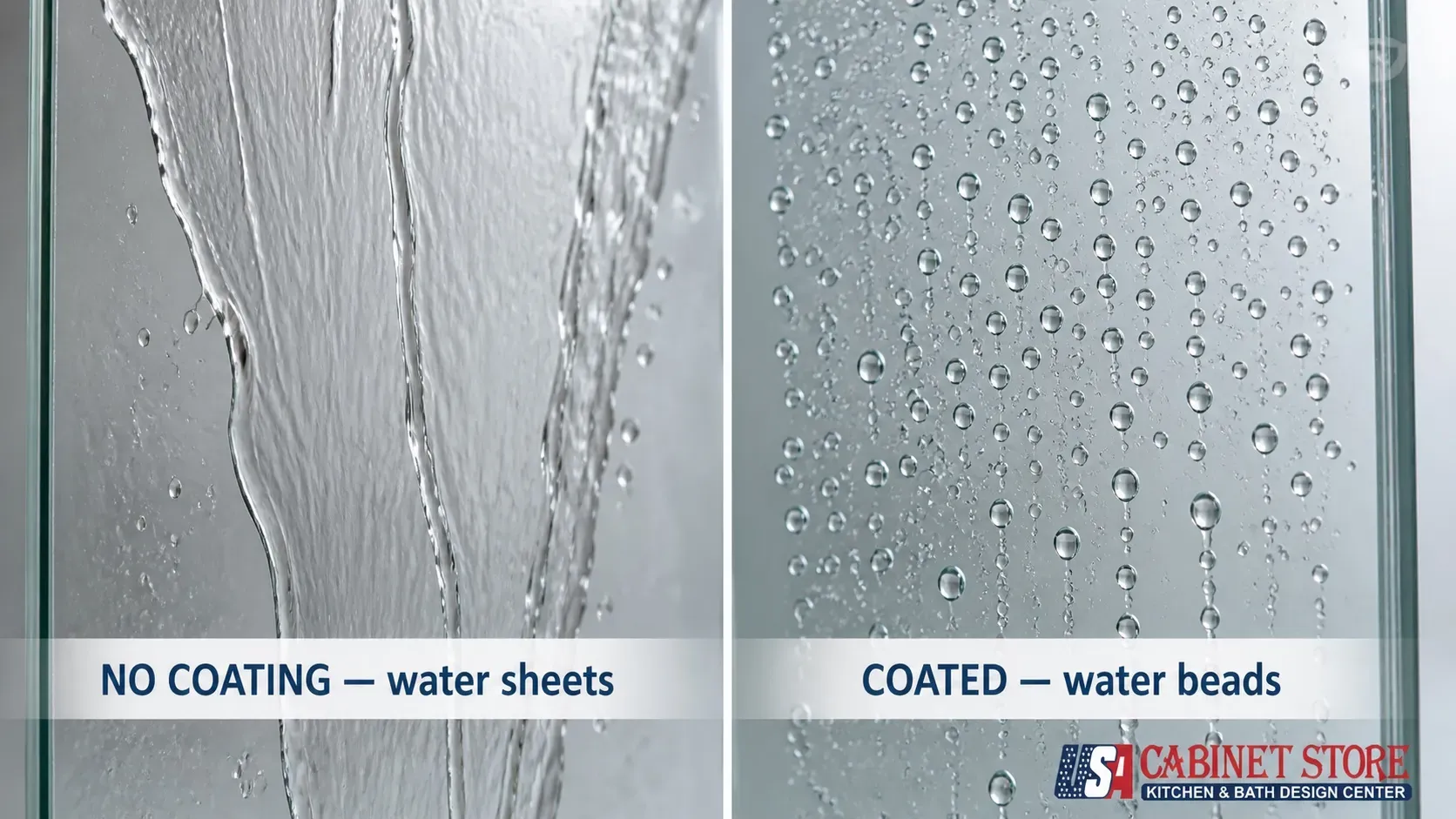
Rinse a clean panel and watch the water. Tight beads that roll off mean an intact coating. Water spreading into a flat sheet means either no coating or one that has worn away. Then check your paperwork or ask your installer, because it decides whether Bar Keepers Friend is a tool or a mistake.
One warning here. Every manufacturer publishes a different vinegar dilution. EnduroShield suggests roughly one part vinegar to four parts water for hard water conditions. Others publish 50/50. There is no universal recipe, and the maker of your specific glass outranks any article on the internet, including this one.
If there is natural stone in your shower, read this first
Vinegar is fine on glass. It is not fine on marble, limestone or travertine, and this is the caveat that most cleaning advice leaves out entirely.
Calcareous stone reacts with acid. The Natural Stone Institute puts it bluntly: acids will etch or burn the surface of your stone. They also break down sealers, so the stone needs resealing sooner. And an etched stone surface cannot be DIY-repaired. It needs professional refinishing.
This matters more in 2026 than it did five years ago, because natural stone, honed finishes and biophilic materials have taken over bathroom design. A shower with a travertine bench, marble curb or limestone floor is now common, and overspray from a vinegar bottle reaches all of them. If you are still choosing surfaces, our guide to shower floor materials covers which ones tolerate acidic cleaners and which do not.
- Wet the stone with plain water first so it absorbs less if acid lands on it. The same caution applies to natural stone tile anywhere in the enclosure.
- Apply acid to a cloth and wipe the glass rather than spraying an aerosol into the enclosure.
- Rinse the stone thoroughly the moment you finish the glass.
- Use a pH-neutral cleaner on the stone itself. Never vinegar, lemon or citric acid.
Textured, frosted, reeded and rain glass
Patterned glass is having a moment in design, and it is significantly harder to keep clear. The grooves are perfect harbors for scum and scale, and the two tools that make flat glass easy both fail here. A squeegee blade rides over the ridges without touching the valleys. A flat cloth does the same.
- Use a soft-bristled brush or an old toothbrush, working the bristles into the pattern rather than across it.
- Spray warm vinegar solution generously and let it sit longer than you would on flat glass, since it has to seep into the texture.
- Rinse harder than feels necessary. Residue trapped in grooves dries into fresh haze.
- Dry with a towel, not a squeegee. Thirty seconds with an old bath towel after each shower keeps textured glass clear for weeks.
Tracks, seals and hardware: the part everyone skips
Spotless glass sitting in a grimy track still reads as a dirty shower. And the track is where leaks and mold actually begin.
Sliding door tracks
Vacuum the track with a crevice tool while it is completely dry. This is the professional step almost nobody does at home. Spray liquid onto dry dust and hair first and you turn it into mud that smears into the corners.
Once it is vacuumed, plug the weep holes with paper towel, pour warm vinegar into the channel and leave it overnight. Next morning, soak it up, scrub with a stiff-bristled brush or old toothbrush, rinse and dry completely. A hairdryer on cool gets moisture out of corners a cloth cannot reach.

Metal finishes
Treat the enclosure as several materials, not one. Anodized aluminum is sensitive to acid. Matte black, brushed gold and living-finish brass need gentle, non-abrasive care and drying afterward or they spot. Wipe in the direction of the grain on brushed metals, never in circles. And a small dab of baby oil buffed onto clean hardware with a microfiber cloth helps repel the next round of water spots.
The silicone seal
The bottom sweep and the perimeter caulk are the two spots homeowners ask us about most, and there is an honest limit here. Aging silicone is porous, and mold spores get down inside it. Once you see black ghosting behind the bead rather than on it, bleach gels and sprays will not reach the colony. The only real fix is to cut the old silicone out, sanitize the substrate and re-caulk with fresh sanitary-grade sealant. It is a two-hour job that beats another year of scrubbing something that will not come clean.
The exhaust fan
Worth adding to the list twice a year. Kill the power, pop the cover off its side clips, vacuum the dust from the blades and housing, wash the cover and refit. A clogged fan moves a fraction of its rated air, and everything in this article gets harder in a bathroom that stays humid.
When customers come into the Fairfax showroom frustrated with their glass, the frame is usually the real culprit. Framed sliders have channels, overlaps and a bottom track that hold water by design. Frameless panels have far fewer places for buildup to hide, which is a big part of why they have taken over. If you are already unhappy with cleaning, that is worth factoring into your next remodel.
How hotels keep glass shower doors so clean
It is a fair question, and the answer is not a secret product. It is three structural advantages you can partly copy.
- The glass is wiped after every single use. Housekeeping squeegees and buffs dry at every checkout. Water never sits long enough to deposit anything.
- Many properties run building-wide water softening. Ion-exchange resin swaps calcium and magnesium for sodium. Sodium salts still spot, but they are highly water-soluble and never form the concrete-like scale calcium does.
- The glass is often treated. Commercial enclosures frequently get hydrophobic coatings specified at install, so the surface fights back for years.
You can replicate all three at home. A squeegee costs eight dollars, a coating costs a little more, and if you live somewhere with hard water, a softener fixes the cause instead of the symptom. And open walk-in showers skip the door entirely, which removes the hardest surface in the room to maintain.
The maintenance schedule that ends the problem
Prevention costs a fraction of restoration in time, money and chemicals. This is the routine to aim for.
| How often | What to do | Why it matters |
|---|---|---|
| After every shower 30 seconds | Squeegee top to bottom. Leave the door open. Run the fan for 15 minutes. | Removes the water before it can evaporate. Stops Stage 1 before it starts. |
| Weekly 5 minutes | Mild detergent and microfiber over glass and hardware. Rinse. Dry. | Clears soap residue while it is still soft. |
| Monthly 30 minutes | Full acid treatment with proper dwell time. Clean tracks and seals. Rinse and dry completely. | Catches mineral film before it crystallizes. |
| Every 3 to 4 months | Reapply water repellent. Inspect silicone. Check hinges and rollers. | Keeps the coating working and catches leaks early. |
| Twice a year | Deep clean the exhaust fan. Reassess water hardness if spotting is accelerating. | Ventilation is doing half the work you are not seeing. |
Two habits do more than the rest combined. Squeegee every time, and switch from bar soap to liquid body wash. Bar soap is the raw material for calcium stearate. Take it out of the shower and you remove most of the scum problem at the source.

When cleaning stops working, and what happens next
If your glass passed the smooth-but-hazy test, no product will help. Here is what your actual options are, honestly.
Professional polishing with cerium oxide
Etched glass can sometimes be restored by physically removing the damaged top layer. The abrasive used for this is almost always cerium oxide, a rare-earth compound that supplier data sheets put at roughly 6 to 7 on the Mohs scale. That is the same neighborhood as the glass itself, which is exactly the point. Aluminium oxide is far harder, since corundum defines 9 on the Mohs scale, and that is why it is generally kept away from finished glass. Cut too aggressively and you trade chemical hazing for mechanical hazing.
Cerium oxide works through chemical-mechanical planarization. Friction generates heat, the heat lets cerium ions interact with the silica, the surface softens at a molecular level, and the pad shears away nanometer-thin layers. It leaves optical clarity rather than swirl marks.
And it is not a DIY job. It requires a rotary or dual-action machine running 1,200 to 1,500 RPM with a felt pad, worked in small sections with constant temperature monitoring. Get the glass too hot and localized thermal expansion can shatter a tempered panel while you are standing in front of it. Hand polishing does not generate enough heat to trigger the reaction, so it simply does not work.
There is a catch, and you should hear it before you pay anyone. Polishing strips away the protective repolymerized layer and exposes fresh, highly porous silica. Unsealed, restored glass degrades faster than new glass. Post-restoration coating is not optional.
Replacing the panel or the enclosure
In a lot of cases, replacement is the better economics. Professional polishing plus sealing on a multi-panel enclosure often approaches the cost of new glass, and new glass can be specified with a factory coating that prevents the whole cycle from restarting. Our shower remodeling cost guide breaks down what a full enclosure swap runs in 2026.
These are the signals we tell homeowners to replace rather than restore:
- Haze that stays after a full acid treatment and reads smooth to the touch.
- Visible scratches or swirl marks from previous cleaning attempts.
- Rusted or seized tracks, loose hinges, doors that stick or do not seal.
- Water escaping the enclosure, which usually means failed silicone or misaligned glass.
- A framed slider you have never liked cleaning, in a bathroom you were planning to update anyway.
If it is that last one, the glass is telling you something about the layout rather than the cleaning. It is worth looking at current bathroom layouts and shower sizing before you spend money on a panel that goes back into the same frame.
What homeowners actually run into
These are real comments from public Reddit threads, quoted as written and linked to the source. They line up almost perfectly with what walks into our showrooms.
“I have tried: CLR, Bar keepers friend, Scrub daddy tangerine paste, Windex, Dawn dish soap. I’ve used a regular sponge, steel wool, a cleaning brush, and paper towels. Nothing works. Help!!”
Our read: five products that all work by different mechanisms, all failing, is the classic signature of Stage 2 etching. No sixth product changes that. Run the wet test before spending another dollar.
“would descaler hurt natural stone? I can’t use vinegar because I’m afraid of etching….”
Our read: a good instinct, and yes, most descalers are acidic and will do the same thing vinegar does. Wet the stone first, apply the acid to a cloth instead of spraying, and rinse the stone immediately after.
“OMG, yes! Wish I had known this before I ended up with these annoying micro-scratches”
Our read: this is the cost of skipping the diagnosis. Abrasives on glass that was already etched swap one kind of permanent haze for another, and micro-scratches are harder to polish out than mineral pitting.
“For those with textured glass like me where the squeegee doesn’t do a lot I leave an old towel handy and dry the glass after every shower. It takes less than 30 seconds and keeps the glass looking new for weeks on end.”
Our read: the single best piece of advice in any of these threads, and it is free. Squeegees do not work on textured glass. A towel does.
“I spent 3 hrs of scraping, scrubbing wipe rinse and repeat but that’s what it took was pure hands on cleaning effort.”
Our read: ten years of buildup, three hours of labor, and by their own account 95 percent of the way there. That result is real, and so is the fact that the plastic wrap dwell method would have done most of it chemically while they sat down.
Frequently Asked Questions for Clean Glass Shower Doors
What is the best thing to clean a glass shower door with?
For most doors, equal parts distilled white vinegar and water with a teaspoon of dish soap. The acid dissolves mineral scale and the surfactant lifts soap scum. Spray it on, let it dwell 10 to 20 minutes, agitate gently with a non-abrasive sponge, rinse thoroughly and dry. If your glass has a factory coating, use the manufacturer’s recommended cleaner instead, since coatings have different tolerances.
Why is my shower glass still cloudy after cleaning?
Most likely the glass is etched rather than dirty. Run two checks. If the surface feels smooth but still looks hazy, and if the haze disappears the moment you mist it with water then returns as it dries, the silica surface has been chemically corroded. No cleaner reverses that. Your options are professional polishing with cerium oxide or replacing the panel.
Does CLR damage glass shower doors?
CLR does not damage plain untreated glass, and it is effective on heavy mineral scale. The risk is everything around the glass. It is corrosive to metal frames, tracks and hardware finishes, and it should not be used on coated glass or near natural stone. Apply it to the glass only, keep it off the trim, and rinse thoroughly.
Can I use Bar Keepers Friend on shower glass?
Yes on plain glass, with one important rule that comes from the manufacturer. Bar Keepers Friend works through oxalic acid combined with a mild abrasive, and its own directions say to rinse thoroughly within a minute of application, warning that to avoid damage you should not let the product sit longer or rub harder than necessary. Do not use it on coated glass, since the abrasives can strip the coating.
Will a Magic Eraser remove water spots from glass?
It will remove light spots and soap scum, but understand what it is. Melamine foam is an abrasive, not a chemical cleaner, and it behaves like extremely fine sandpaper. Always use it fully wet with light pressure. Never use it dry, and never on treated or coated glass, because it strips protective layers.
What works better, CLR or vinegar?
CLR is faster and stronger because it uses lactic and gluconic acids rather than dilute acetic acid. It is the better choice for thick, old calcified deposits. Vinegar is cheaper, gentler on hardware and fine for routine maintenance and light to moderate scale. Try vinegar with a proper dwell time first, and escalate to CLR only if that fails.
How long should vinegar sit on shower glass?
Between 5 and 20 minutes depending on severity. Light spotting needs 5 to 10 minutes, moderate buildup 10 to 15, and heavy scale 15 to 20 with a re-spray if it starts drying. Never let the solution dry on the glass. For serious buildup, hold vinegar-soaked paper towels against the panel or cover the sprayed glass with cling film so it cannot evaporate.
Can hard water permanently damage shower glass?
Yes. If mineral deposits sit long enough, trapped water leaches sodium out of the glass, the droplet turns alkaline, and once its local pH passes 9.0 it begins dissolving the silicon-oxygen bonds in the glass itself. That leaves microscopic pitting that scatters light permanently. It is why removing water promptly matters far more than owning a strong cleaner.
What should you never use on shower doors?
Avoid abrasive scouring powders such as Comet and Ajax, standard steel wool, stiff bristle brushes, dry razor blades and toothpaste. Keep bleach and strong ammonia off metal frames, hinges and coated glass. Door manufacturers also warn against naphtha, hydrogen peroxide, toluene, ethyl acetate, lye and acetone, several of which dissolve the silicone seals that keep water in the shower.
How do hotels keep glass shower doors so clean?
Three things. The glass gets squeegeed and buffed dry after every use, so water never sits long enough to leave minerals. Many properties run building-wide water softeners, which replace calcium and magnesium with sodium salts that stay water-soluble. And commercial enclosures are often specified with hydrophobic coatings at install. All three are available to homeowners.
Should I mix baking soda and vinegar to clean shower glass?
No. Baking soda is a base and vinegar is an acid, so combining them neutralizes both and leaves you with carbon dioxide, saltwater and a mild abrasive paste. You lose the acid that was going to dissolve the limescale. Use baking soda alone if you want gentle abrasion, or acid alone if you want to dissolve minerals, but do not combine them and expect a stronger cleaner.
Can you use vinegar on glass shower doors with a marble surround?
Only with care. Vinegar is safe on glass but acids etch marble, limestone and travertine, and they break down stone sealers. Wet the stone with plain water first, apply the vinegar to a cloth rather than spraying it into the enclosure, and rinse the stone immediately afterward. Clean the stone itself with a pH-neutral product only.
If your glass is past cleaning, or the layout was always the problem, our designers will walk the whole bathroom with you. Family-owned since 2011, with free 3D design and installation by our own team.
Book your free consultation Find a showroom14 showrooms across Virginia, Maryland, North Carolina, Texas, New Jersey, Florida and Tennessee.