
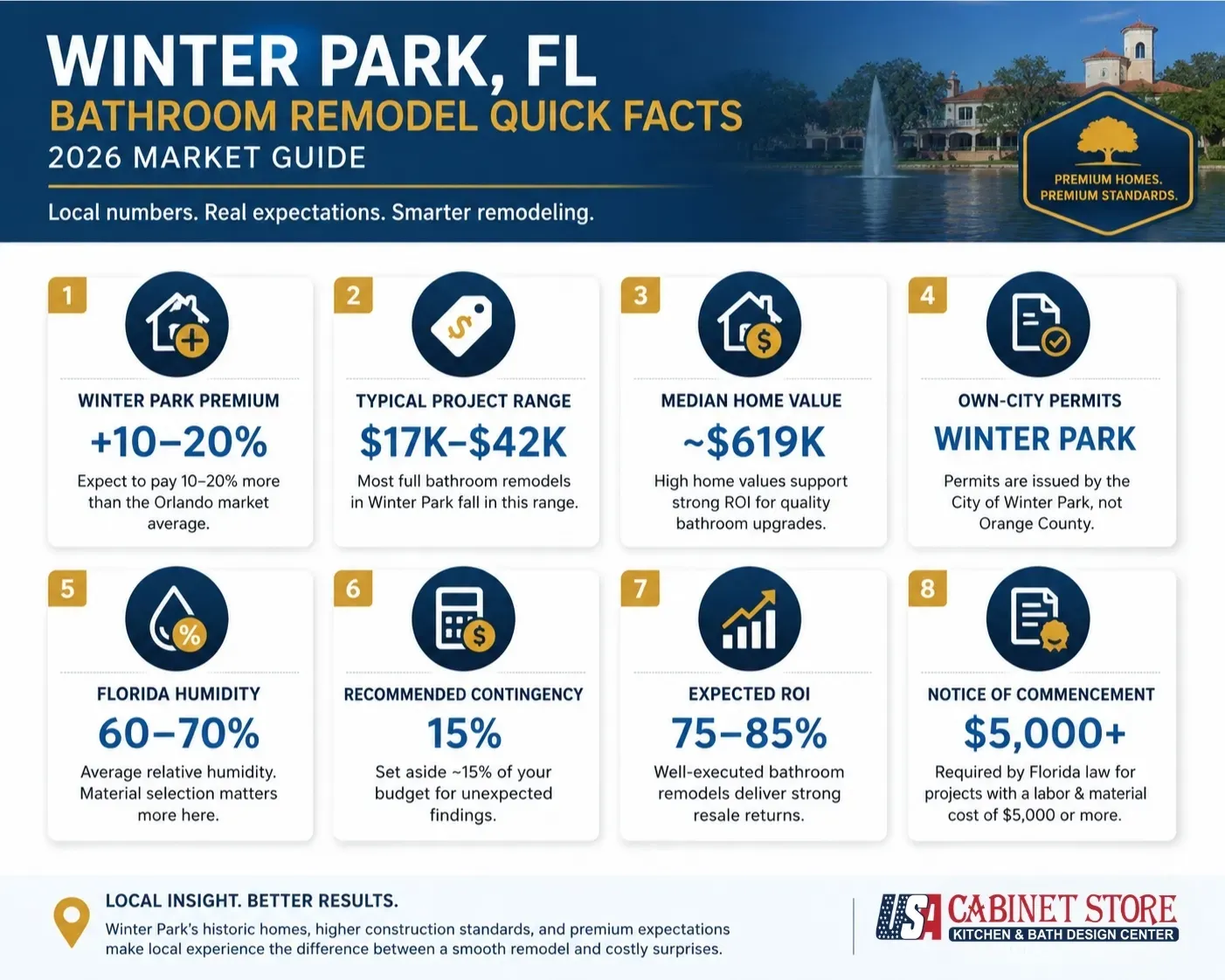
Most Winter Park homeowners spend between $17,000 and $42,000 on a full bathroom remodel in 2026, which runs about 10 to 20 percent higher than the Greater Orlando average. That gap is not a markup. It is the real cost of remodeling inside a city that runs its own building department, on housing stock that often predates World War II, for a buyer pool that expects frameless glass and quartz instead of builder-grade. Bathroom remodeling in Winter Park follows different rules than a generic Orlando project, and the homeowners who get burned are almost always the ones who budgeted off a citywide number.
This guide is the same thing our design team tells clients who walk into our Winter Springs showroom from the 32789 ZIP code. What it actually costs. What the old houses hide behind the tile. How the city’s permitting and historic rules really work in 2026, including the new state law that changes the small-project math on July 1. And where the money is worth spending if you ever plan to sell. Think of this as the Winter Park companion to our complete Orlando bathroom remodeling guide: we pull the cost framework from our Orlando bathroom remodel cost breakdown, then adjust it for everything that makes Winter Park its own animal.
How we built these numbers. The cost ranges below come from our own completed Central Florida bathroom projects, the published Orlando market data we link to, and the 2025 Cost vs. Value Report for the South Atlantic region. Every legal threshold, permit rule, and incentive in this guide links to the city, state, or federal source so you can verify it yourself before you spend a dollar.
★ Winter Park Bathroom Remodel · 2026 Quick Facts ★
What Bathroom Remodeling Costs in Winter Park (2026)
Start with the metro baseline. Across Greater Orlando, the market average for a bathroom remodel sits near $10,510, and most projects land between $5,709 and $15,372. That number blends $2,500 paint-and-fixture refreshes with $40,000 gut renovations, so it is close to useless for planning. Winter Park sits at the higher end of that metro spread for reasons we will get into, so build your budget off the tier that matches your actual scope, not off the citywide average.
Here is the working framework we use when we price Winter Park projects out of our Winter Springs showroom, which is about ten minutes from Park Avenue.
Winter Park bathroom remodel cost tiers
| Tier | Winter Park range | Timeline | What you actually get |
|---|---|---|---|
| Cosmetic refresh | $3,500–$10,500 | 1–3 weeks | Paint, new fixtures, vanity swap, maybe new flooring. Same layout, no plumbing moved. |
| Partial remodel | $10,000–$26,000 | 3–5 weeks | Gut the wet area, tiled shower, new vanity and toilet, updated lighting. Layout stays. |
| Full remodel (standard bath) | $17,000–$42,000 | 6–10 weeks | Down to the studs, new waterproofing, tile, glass, code-compliant electrical and ventilation. |
| Primary / master bath | $28,000–$60,000+ | 8–12 weeks | Larger footprint, separate tub and shower, double vanity, some plumbing relocation. |
| Upscale / spa-grade | $55,000–$95,000+ | 10–14+ weeks | Frameless glass, custom cabinetry, large-format stone-look porcelain, premium fittings. |
These ranges take the published Orlando tiers and apply the 10 to 20 percent Winter Park premium across the board. For a sanity check against independent data, the 2025 Cost vs. Value Report puts a mid-range bathroom remodel in the South Atlantic region near $25,600 and an upscale, spa-grade bath above $80,000, which lines up with our full-remodel and spa tiers. If your project moves plumbing, adds a shower, or finishes in natural stone, use the full-remodel range and skip the citywide average entirely.
Why Winter Park runs above the Orlando average
Three forces push Winter Park pricing above the metro midpoint, and they stack on top of each other. First, the houses are old. A 1925 bungalow off Lake Sue hides problems a 2015 Lake Nona build never will, and those surprises cost money once the walls open. Second, the buyers are discerning. Homeowners in the 32789 ZIP spec frameless glass, custom tile, and premium fixtures as a starting point, not an upgrade, which lifts the materials line on every project. Third, skilled trades in an affluent, lot-constrained city stay booked and rarely discount. None of that is avoidable. It is the Winter Park tax, and it is real.

Cost by bathroom type
The type of bathroom matters more than square footage. A powder room has no tub, no shower, and often no tile, so it costs a fraction of a primary suite. Here is the 2026 pattern adjusted for Winter Park.
| Bathroom type | Assumed size | Cosmetic refresh | Partial remodel | Full remodel |
|---|---|---|---|---|
| Half bath / powder | 20–30 sq ft | $3,000–$7,000 | $6,000–$12,000 | $9,000–$17,000 |
| Full / guest bath | 35–50 sq ft | $4,500–$9,000 | $9,000–$17,000 | $17,000–$28,000 |
| Three-quarter bath | 40–60 sq ft | $3,500–$7,000 | $7,000–$14,000 | $14,000–$21,000 |
| Primary / master | 80–120+ sq ft | $9,000–$17,000 | $17,000–$34,000 | $28,000–$60,000+ |
💡 See real Winter Park pricing, not a ballpark. Our design team builds line-item estimates at the Winter Springs showroom, no surprise allowances. Book a complimentary consultation and walk out with numbers you can plan around.
Why Winter Park Remodels Cost More Than the Orlando Average
This is the section nobody else in the Winter Park search results will tell you, because most of them are selling a one-day acrylic shower swap and have no reason to talk about what is behind your walls. We do, because the surprises behind the walls are exactly where Winter Park budgets blow up.
What is behind the walls in an older Winter Park home
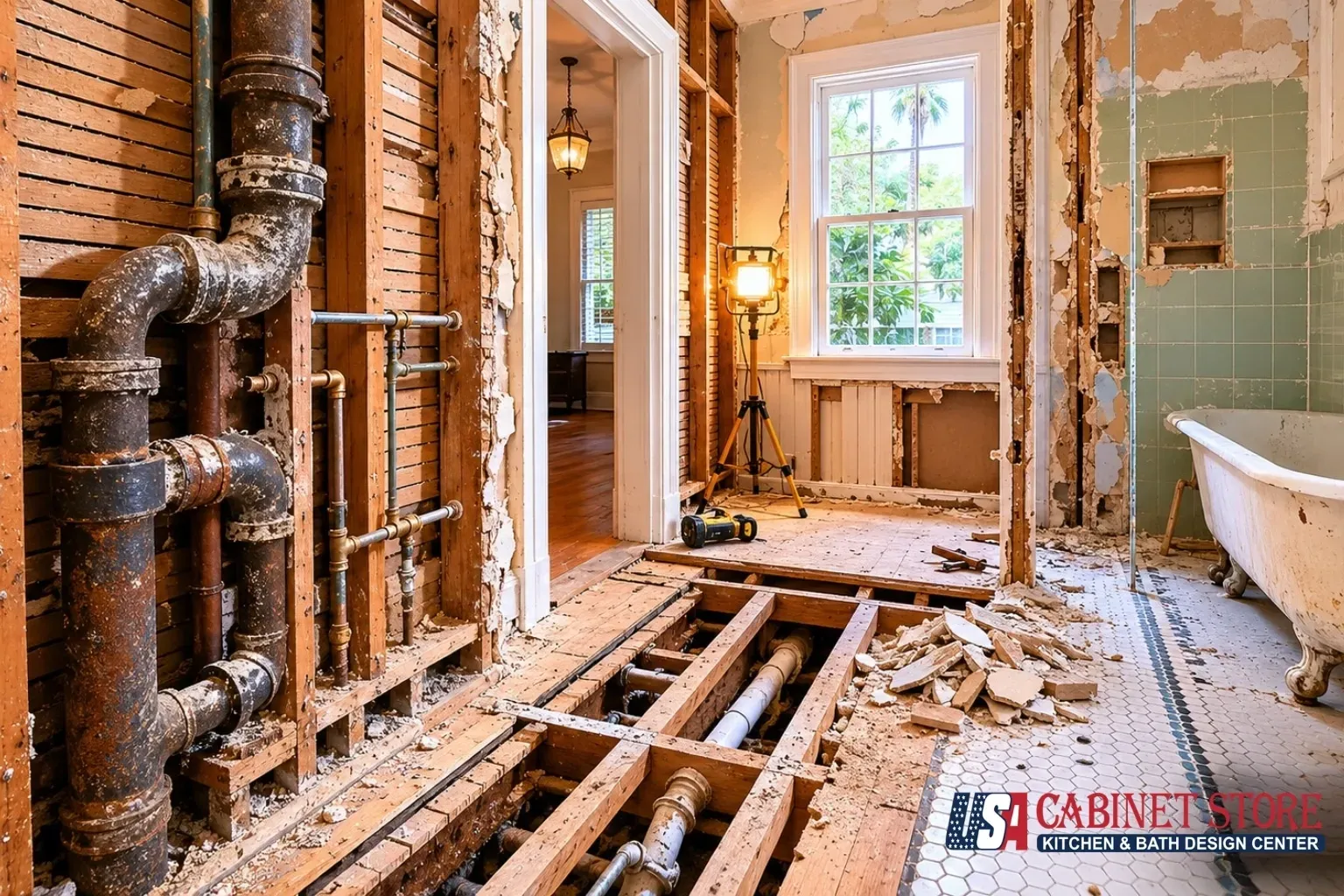
Winter Park grew up around Rollins College and the Winter Park Chain of Lakes in the late 1800s and early 1900s, and a lot of the housing stock reflects it. You will find 1920s Mediterranean Revival homes, Craftsman bungalows, and mid-century houses sitting on oversized lots all through Olde Winter Park and the streets near Park Avenue. They are beautiful. They are also full of building systems that predate every modern code. Open the wall on a pre-1960 Winter Park bath and you are likely to find:
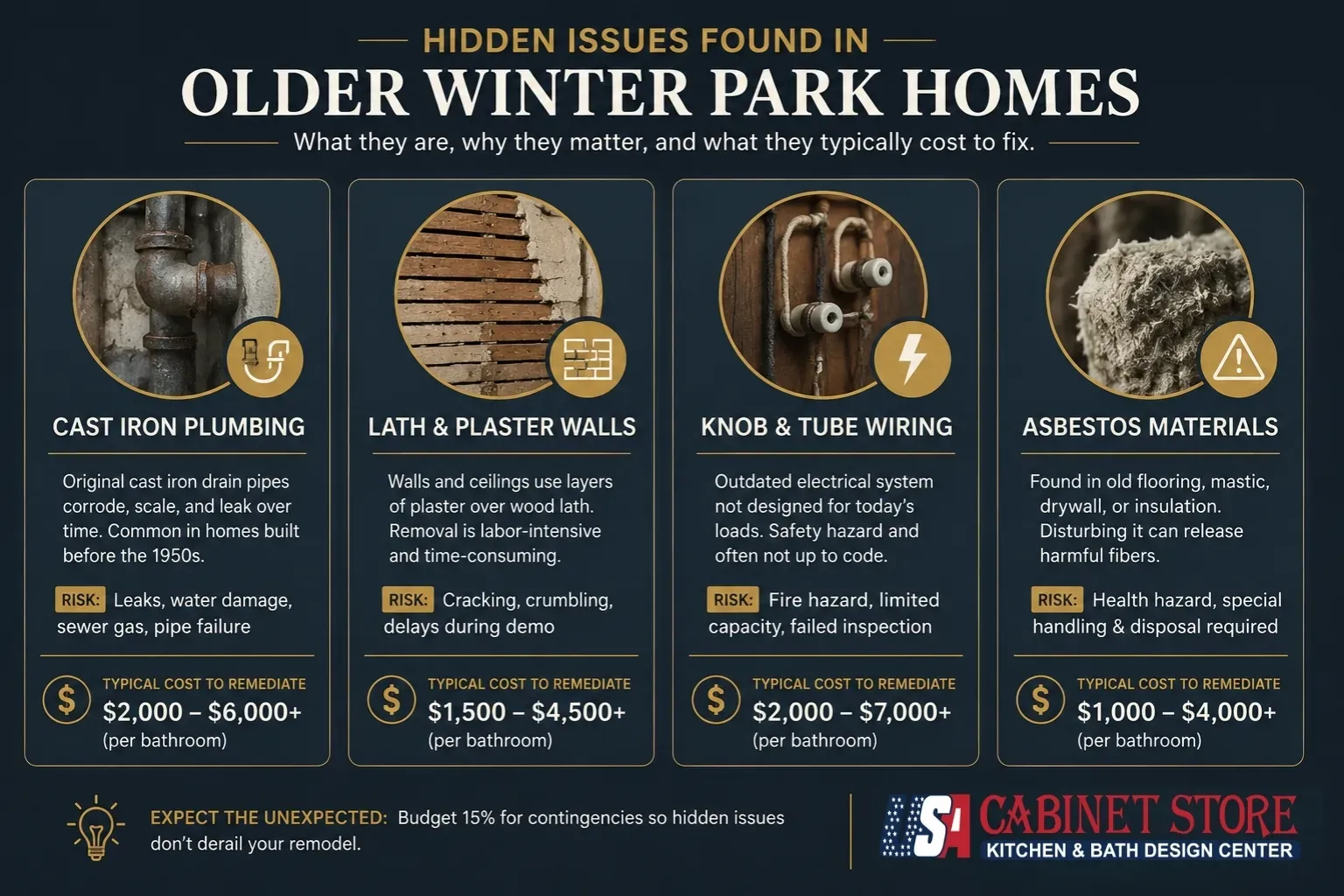
- Cast iron and galvanized steel plumbing. Galvanized supply lines corrode from the inside and choke water pressure. Cast iron drains crack and leak at the hubs. Once a wall is open, replacing them with PEX and PVC is the right call, and it adds $1,500 to $4,000 you did not see coming.
- Lath-and-plaster walls. Demolition is messier, slower, and more expensive than tearing out modern drywall, and the debris weighs more, which raises haul-away.
- Undersized or non-grounded wiring. Knob-and-tube and two-wire ungrounded circuits were normal a century ago. They are not code now.
- A slab-plus-crawlspace mix. Some Winter Park homes sit on slab, some on raised crawlspace, and some on both after decades of additions. Moving a drain in a slab means saw-cutting and re-pouring concrete, which can push a fixture relocation past $3,500 on its own.
Old wiring versus today’s Florida Building Code
The Florida Building Code does not care that your wiring was legal in 1928. For a bathroom, current code requires GFCI protection on the outlets, at least one dedicated 120V/20A branch circuit, a receptacle near each basin, and switch-controlled lighting. If your bath still runs on old ungrounded wiring, bringing it to code is not optional once you pull a permit, and it can add $800 to $2,500 depending on how far the panel sits from the bathroom.
Asbestos and lead: two different cutoffs
People lump these together, but the rules use different dates, and getting them right matters. Lead paint is the concern in homes built before 1978, the cutoff for the EPA Renovation, Repair and Painting rule, which governs how a paid contractor disturbs old painted surfaces. Asbestos shows up in materials that were common into the early 1980s, including floor mastic, old vinyl tile, and pipe insulation. You cannot legally disturb either one without proper handling. Budget $300 to $800 for testing on an older Winter Park home, and more if abatement turns something up. It is unglamorous and it is non-negotiable.
Why your contingency should be 15 percent, not 10
For newer Orlando construction, a 10 percent contingency usually covers the surprises. In Olde Winter Park and the older streets near Park Avenue, plan for 15 percent, and lean higher on anything built before 1950. The contingency is not padding. It is the line that keeps a discovered leak or a rotted subfloor from turning your remodel into a financing conversation halfway through.
💡 See real Winter Park pricing, not a ballpark.
Our design team builds line-item estimates at the Winter Springs showroom, no surprise allowances. Walk out with numbers you can plan around.
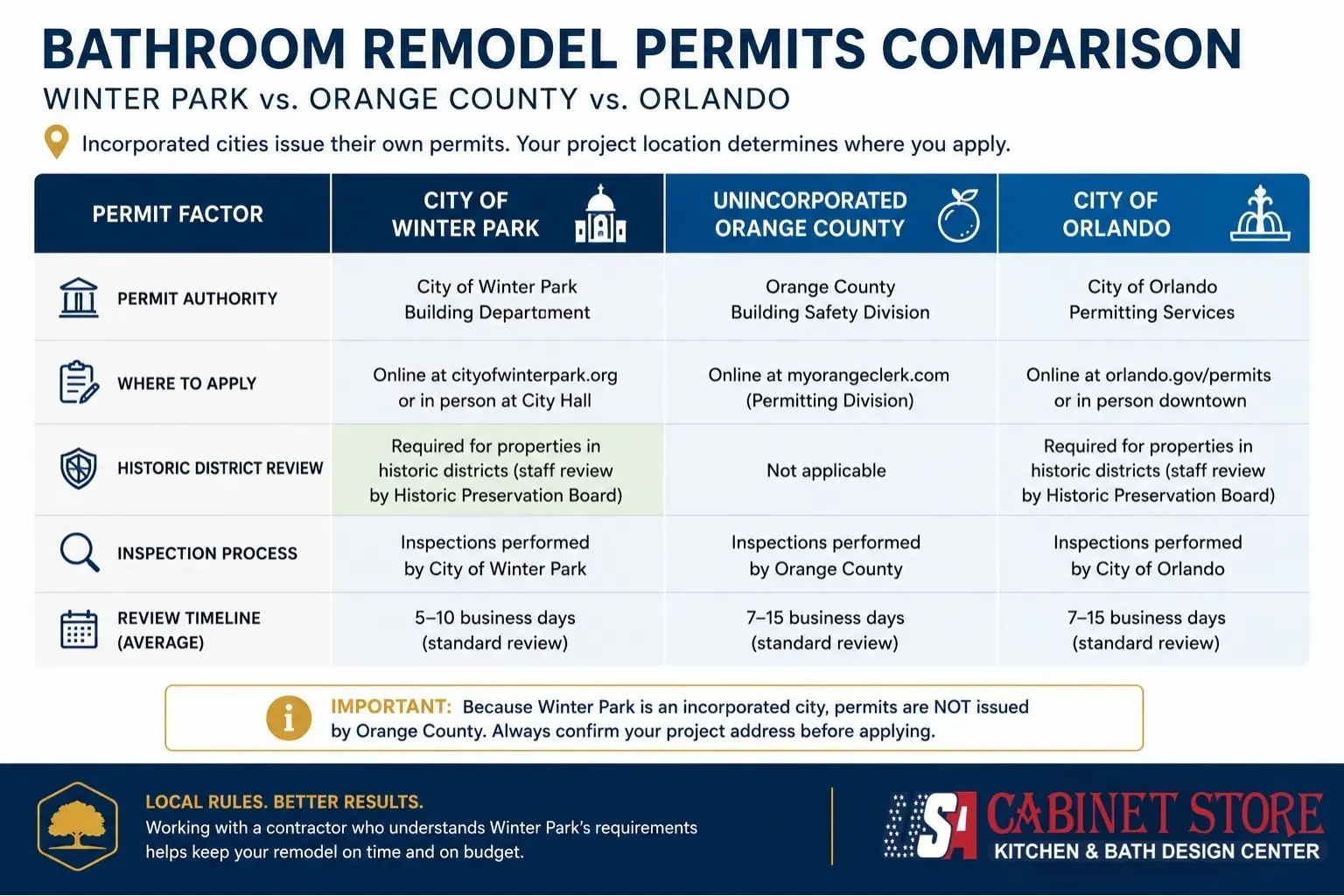
Permits and the City of Winter Park (It’s Not Orange County)
Here is the mistake we see most often: a homeowner reads an Orlando permit guide, assumes Orange County handles their project, then loses two weeks when they realize Winter Park does its own thing. Winter Park is an incorporated city with its own Building & Permitting Services Department. Your permit does not go through Orange County, and it does not go through the City of Orlando. It goes through Winter Park.
Winter Park Building & Permitting Services
The City of Winter Park runs its own permitting through an online self-service portal where you apply, pay invoices, and schedule inspections. A licensed contractor pulls the permit and schedules the inspections, which is one more reason to hire one who already knows the Winter Park system. Confirm current contact details and hours on the city’s Building & Permitting Services page before you apply.
One note on fees and timing. The city is amending its permit fee schedule in 2026, and Florida is adopting the 2026 Florida Building Code, Ninth Edition, at the end of the year. Because of that, do not budget off an old flat number you found online. Confirm current fees through the Winter Park self-service portal or by calling the office before you finalize your budget.
| If your home is in… | You file with | Portal | Historic review? |
|---|---|---|---|
| City of Winter Park | Winter Park Building & Permitting Services | EnerGov self-service | Exterior changes in historic districts only |
| Unincorporated Orange County | Orange County (Fast Track) | Fast Track Online | County-specific |
| City of Orlando | City of Orlando Building Dept | Orlando permitting | City-specific |
Winter Park is amending its permit fee schedule in 2026 and adopting the 2026 Florida Building Code (Ninth Edition) at year-end. Confirm current fees via the city self-service portal before budgeting.
When you actually need a permit
The line is finer than “cosmetic versus structural.” Winter Park’s own permit guidance treats paint, floor covering, and a like-for-like swap of a single sink, lavatory, or toilet as work that does not need a permit. But replacing bathroom cabinetry does trigger one, and so does anything that touches plumbing, electrical, or structure. When in doubt, check the city’s “Do I Need a Permit?” handout or call before you assume your project is exempt. Two state rules sit on top of the local permit:
- Notice of Commencement. Florida’s construction lien law (Chapter 713) requires a recorded Notice of Commencement for most permitted improvements, with a narrow exemption for small direct contracts (the statute sets that exemption around $2,500). When a Notice is required, the city will not pass the first inspection until it is recorded and posted at the job site. Because the exact threshold and process can hinge on your contract value and scope, confirm it with the city or a Florida construction attorney before work begins.
- Use a licensed contractor for regulated trades. Florida requires a licensed contractor for structural, electrical, plumbing, mechanical, and roofing work, regardless of the dollar amount. A handyman can handle truly minor cosmetic work, and the state’s “casual, minor, or inconsequential” exemption tops out near $2,500, but the moment a job touches a pipe, a circuit, or framing, a license is mandatory. Splitting one project into smaller invoices to dodge that line is illegal. Verify any license at the DBPR public lookup.
★ New for 2026: HB 803 Permit Exemption
From July 1, 2026, single-family work under $7,500 can skip a building permit. The catch: it does not apply to any plumbing, electrical, mechanical, gas, or structural work, or to homes in a flood hazard area. Most real bathroom remodels still need a permit. The exemption mainly helps a pure cosmetic refresh, and you must file a written request with your contract.
Excludes electrical
Excludes structural
Written request required
New for 2026: the HB 803 permit exemption
Florida House Bill 803 takes effect July 1, 2026, and it changes the math on small projects. Local governments must exempt owners of single-family homes from pulling a building permit for work valued under $7,500. On paper, that erases the permit step and its fees for a modest cosmetic refresh. In practice, the exemption is narrow, and most real bathroom remodels do not qualify, because it does not apply to:
- Any electrical, plumbing, mechanical, or gas work.
- Any structural change, including load-bearing walls, windows, doors, or roofing.
- Homes in a designated flood hazard area.
So a $7,000 refresh that is paint, a new vanity top, flooring, and a like-for-like fixture swap can skip the permit. The same budget spent relocating a shower drain or adding a circuit for a steam shower does not, and the plumbing or electrical permit still applies. The exemption is also not automatic. You or your contractor must submit a written exemption request with a copy of the contract, and you cannot split a $10,000 job into two $5,000 phases to slip under the line. For a typical Winter Park gut remodel, treat HB 803 as a small help on the cosmetic tier and nothing more.
Does the Historic Preservation board review my bathroom?
This trips people up, so let’s be precise. Winter Park has a Historic Preservation Board, and it does review changes in designated historic districts. But it reviews exterior alterations and additions: facades, windows, rooflines, footprint. An interior bathroom remodel of a designated structure that keeps the same windows and exterior is generally not reviewed. If your project enlarges the bathroom by bumping out an exterior wall or replacing a historic window, that is when the board gets involved. And there is no city fee for historic designation, design review, or the variances tied to it.
A grant most homeowners miss. If your home is on the Winter Park Register of Historic Places, the city’s Preservation Rehabilitation Grant Program can reimburse qualifying interior repairs that bring the structure up to current code, the exact kind of work an older bath forces, like replacing corroded cast iron or rewiring an ungrounded circuit. You apply through Planning & Zoning with a project description, photos of the existing condition, and an executed contract, and the work has to finish inside the program’s completion window. Confirm eligibility with the city before you count on it, but for a designated home, it can offset part of that 15 percent contingency.
🔧 Working on a bath in Winter Park, Maitland, or Baldwin Park? Our Winter Springs showroom at 5812 Red Bug Lake Rd handles design, permitting, trades, and installation as a single point of contact. Pull samples, see a 3D design, and leave with a line-item estimate. Call (407) 335-4404 or book online.
Designing for Florida Humidity in an Old Winter Park Bathroom
Central Florida air is humid year-round outdoors, and every shower spikes the moisture inside a bathroom well past comfortable. The goal is to keep indoor relative humidity below 60 percent, which is the level the EPA flags as the threshold for mold growth. That is the whole reason ventilation and moisture-resistant materials matter here more than they do up north. Skimping shows up as mold and rot, not just a dated look, and the right choices run about 10 to 20 percent more than the basic alternatives.
Porcelain over natural stone
Large-format porcelain that mimics marble costs 30 to 50 percent less than real marble, handles moisture without sealing, and resists the etching that ruins a marble floor in a few years of Florida cleaning products. Porcelain is fired hot enough to become nearly waterproof, with a water absorption rate under half a percent, so it shrugs off the staining and mold that plague porous stone in a humid bath. We steer almost every Winter Park client toward porcelain for floors and shower walls. Save the natural stone for a vanity top or an accent, where it stays dry and gets admired.
Mold-resistant board, waterproofing, and exhaust that vents outside
Behind the tile is where your remodel lives or dies. Cement board or mold-resistant drywall, a proper waterproofing membrane like Schluter KERDI or RedGard, and an exhaust fan that vents to the outdoors rather than into the attic are the three things that protect the whole investment. Florida code puts the exhaust on the plans for a reason: a fan dumping moist air into an attic rots the roof structure from the inside. Spend here and you never think about it again.
Plywood vanity boxes versus particleboard
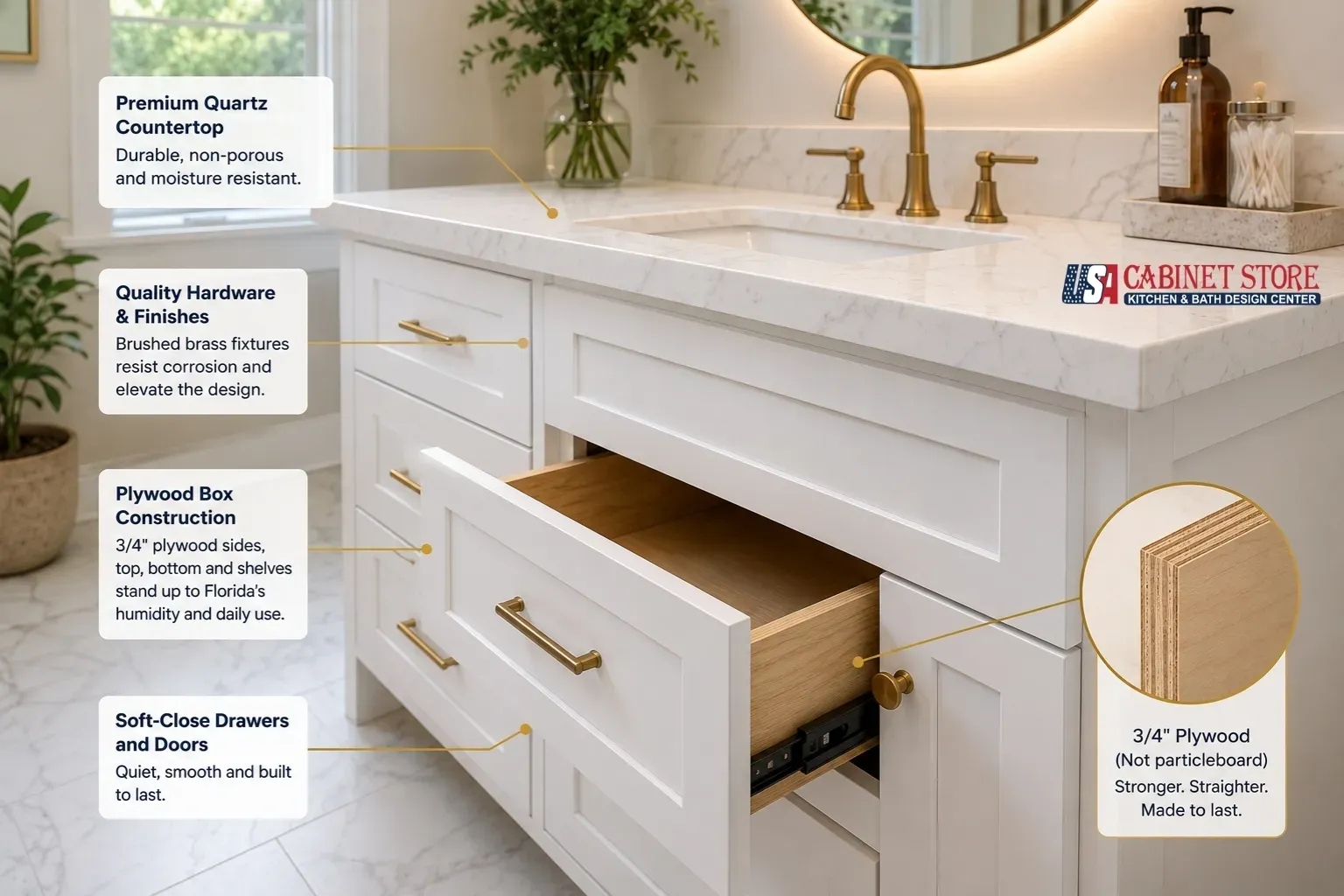
A particleboard vanity box absorbs airborne moisture, swells, and delaminates within a few years in a humid bathroom. A three-quarter-inch plywood box does not, because cross-laminated veneers resist the swelling and warping that destroy pressed wood chips. At USA Cabinet Store we build with 3/4-inch, KCMA-certified plywood cabinet boxes for exactly this reason, working with lines like Fabuwood, Showplace, UltraCraft, Mantra, and Wolf that hold up in Florida baths. Mantra is built in the United States, which keeps its pricing steadier than imported lines exposed to shifting tariffs. When you compare vanity quotes, ask what the box is made of before you compare the door style. Our guide to bathroom vanity types walks through the trade-offs.
WaterSense fixtures pay you back
EPA WaterSense fixtures earn their keep in a city with older homes. A WaterSense toilet uses no more than 1.28 gallons per flush, about 20 percent below the federal standard, and when it replaces an old 3.5-to-5-gallon toilet from the 1980s or 1990s, household flush water drops by 20 to 60 percent. A WaterSense showerhead runs at or below 2.0 gallons per minute against the 2.5 standard and saves a family roughly 2,700 gallons a year. Pair those with an efficient faucet aerator and the EPA puts typical utility savings near $110 a year, climbing toward $250 once you factor in the energy not spent heating water you no longer use. The savings are real and immediate, which is what makes the swap an easy yes in an older Winter Park bath.
Layout and Clearances in a Tight Historic Bath
A remodel that ignores clearances feels cramped no matter how nice the finishes are, and this is where Olde Winter Park bungalows fight back. Bathrooms from the 1920s and 1930s were often laid out as narrow five-by-eight-foot rectangles. There are two separate standards to know, and the original framing usually forces a choice between them.
The International Residential Code sets the legal minimums your permit is checked against. The National Kitchen & Bath Association recommends more generous numbers for comfort. They are not the same thing, and conflating them is how a bath ends up technically legal but cramped.
| Clearance | IRC code minimum | NKBA recommended | What it means in the room |
|---|---|---|---|
| Toilet centerline to side wall | 15 in. | 18 in. | 15 in. passes inspection but puts your shoulder against the wall. 18 in. feels normal and leaves room for the paper holder. |
| Clear floor space in front of a fixture | 21 in. | 30 in. | 21 in. is tight in a family bath. 30 in. lets you bend, dry off, and move without bumping a fixture. |
| Shower footprint | 30 x 30 in. | 36 x 36 in. | 30 x 30 in. is the edge of legal and your elbows find the glass. 36 x 36 in. is the comfortable target. |
In a true five-by-eight footprint, hitting the NKBA numbers is sometimes impossible without stealing space from the bedroom next door. The fix is usually the vanity. A floating, wall-mounted vanity opens up the floor visually and lets us set the height to suit the user, though it needs solid blocking in the wall to carry the load. A pedestal sink has the smallest footprint of all and suits a powder room, at the cost of zero storage. A freestanding vanity gives the most storage but eats the most floor. Picking the right one is how we keep a historic bath both code-compliant and livable, and it is a conversation worth having before demo, not after.
What a Winter Park Bathroom Remodel Returns at Resale?
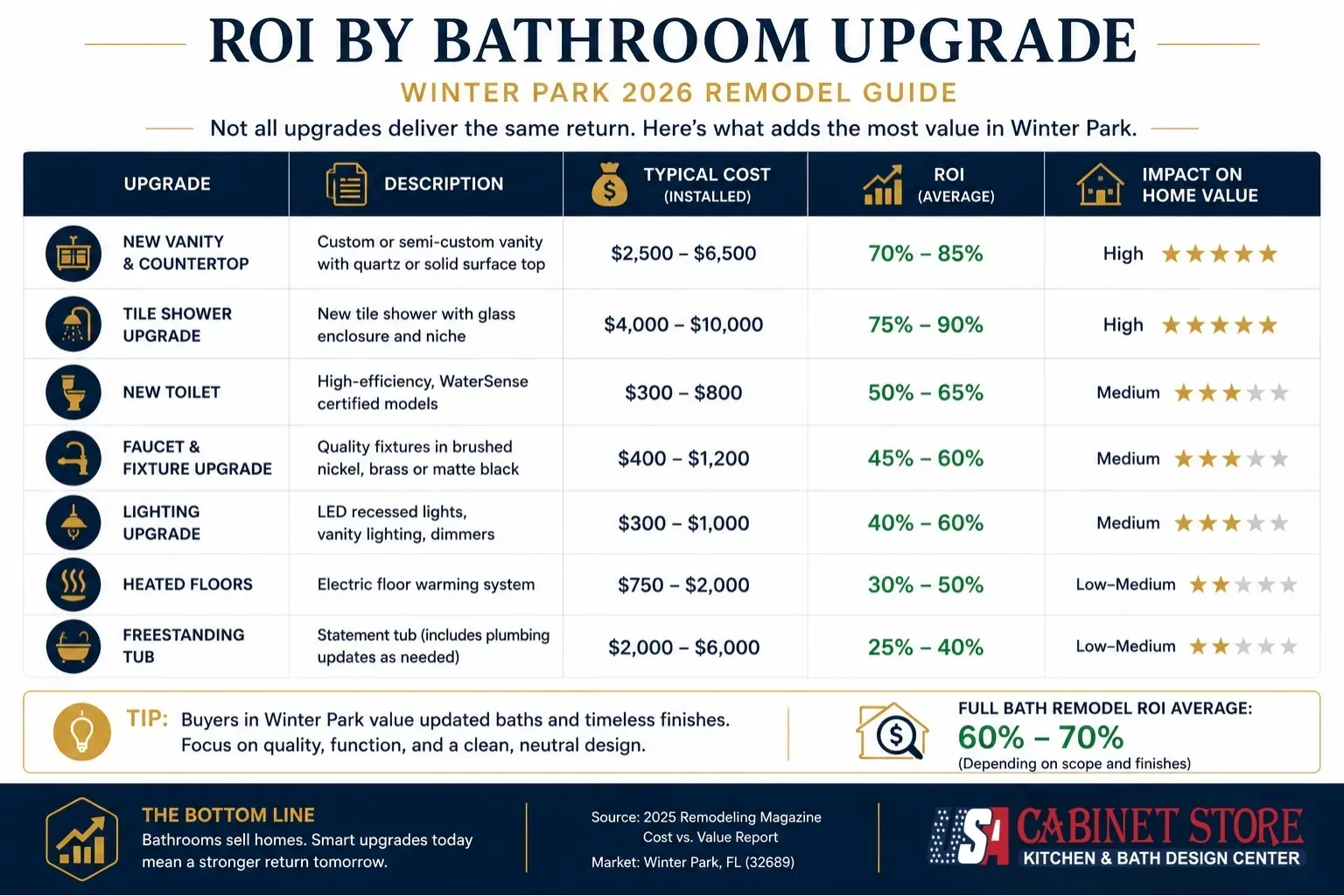
Here is where we part ways with most remodeling marketing. A bathroom remodel does not return its full cost when you sell. Treat it as a lifestyle upgrade that also helps the house move faster, not as a dollar-for-dollar investment. The independent 2025 Cost vs. Value Report, the standard benchmark for the trade, shows interior bathroom projects in the South Atlantic region recouping roughly 42 to 61 percent of their cost at resale. A universal-design bath that widens doorways and adds a curbless shower lands at the top of that range near 61 percent, a mid-range remodel sits in the middle, and an upscale spa bath recoups the least, closer to 42 percent. Those are sobering numbers, and they are the honest ones.
So why remodel at all? Because the value is not only in the appraisal. A modern, well-finished bathroom shortens days on market, raises buyer interest, and gives you daily use of the room for as long as you own the house. In a $700,000 Winter Park home, a builder-grade bath reads as deferred maintenance and quietly discounts the whole property. Bringing it up to the neighborhood standard protects your list price more than any single luxury feature does.
Spend where Winter Park buyers expect it
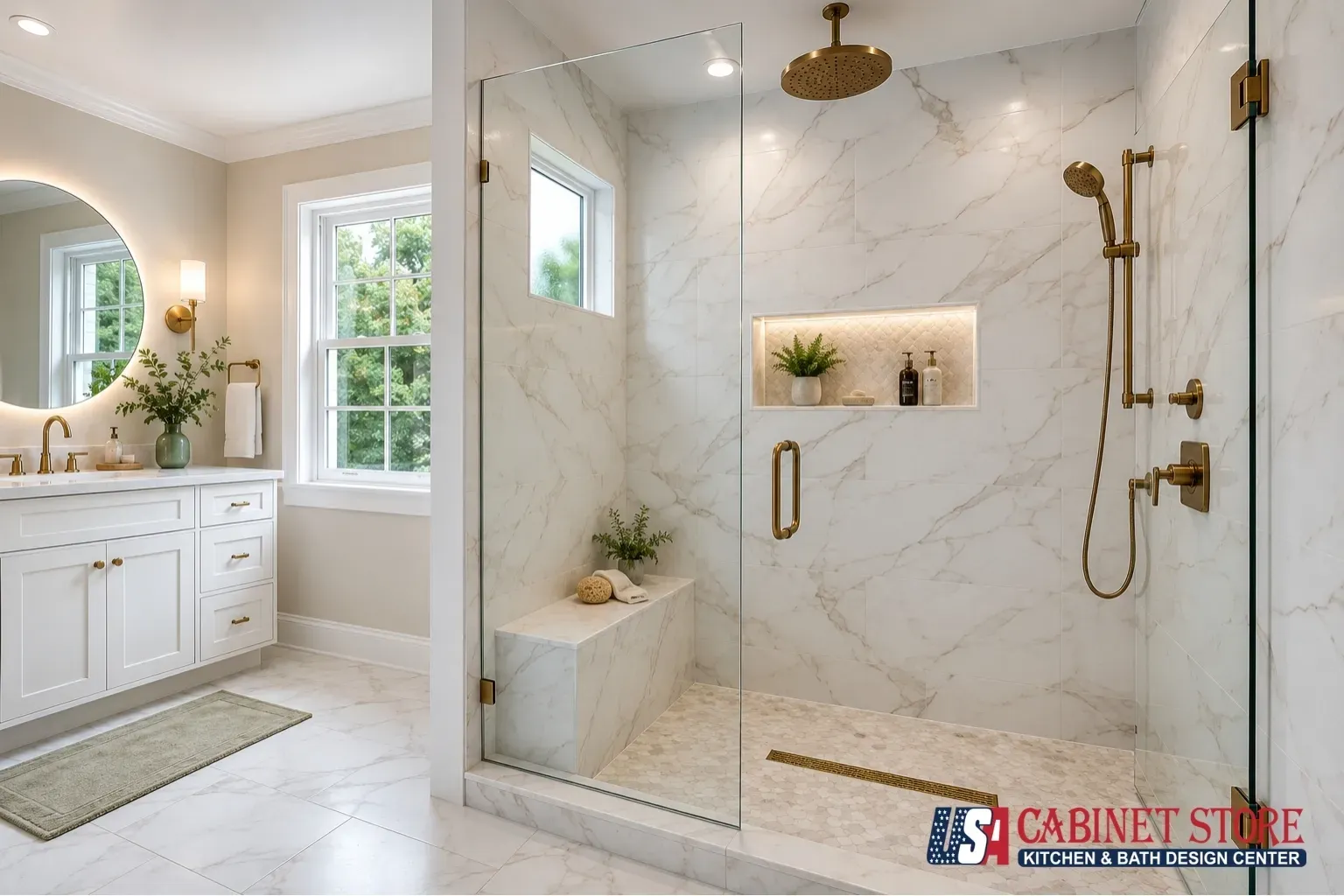
If you plan to sell within a few years, put the money where the next buyer looks. In the 32789 ZIP, the moves that consistently carry their weight are a tub-to-walk-in-shower conversion, a new vanity with a quartz top, layered LED lighting, fresh large-format tile, and WaterSense fixtures. Frameless glass, a custom or semi-custom vanity, and good lighting are baseline expectations in the Park Avenue corridor and the Vias, not upgrades. Our walk-in shower ideas are a good place to start, and for a truly high-end suite a steam shower reads as a genuine differentiator.
The splurges that rarely come back: heated floors, custom stone mosaics, and high-end smart toilets. Buy those for yourself, not for the next owner.
The over-improvement trap
The flip side of buyer expectations is the ceiling above them. Do not put a $90,000 spa bath in a $450,000 bungalow. A 1920s Craftsman in Olde Winter Park rewards a character-respecting mid-range remodel far more than a gut-to-luxury build the next buyer will never recoup. Match the bathroom to the house and the street. A Vias estate carries a spa primary bath. A bungalow does not.
Bathroom Remodeling by Winter Park Neighborhood
Pricing and approach shift block to block in Winter Park more than in almost any other part of Greater Orlando. Home age, lot size, and buyer expectations all play in.
Park Avenue corridor, the Vias, Lake Knowles Terrace
This is the premium core. Expect older, architecturally significant homes, the highest design expectations in the city, and the occasional brush with historic-adjacent rules if you touch the exterior. Budget for frameless glass, custom tile, and premium fixtures as a starting point, and plan a 15 percent contingency for what the old construction hides.
Kenilworth Shores, Windsong, Lake Sue
Lakefront and near-lakefront homes, often with larger primary suites and room for a separate tub and shower. These projects skew toward the primary and spa tiers, and the layout changes are where the budget grows. Plumbing relocation on a slab home here can add real money, so design around the existing stack where you can.
Olde Winter Park bungalows
Character is the asset, so the move is a remodel that respects it: period-appropriate tile, a vanity that fits the scale of the room, and modern systems hidden behind the walls. These are the homes where the 15 percent contingency earns its keep, because a 1920s bungalow always has a surprise. Resist the urge to over-improve.
Newer Winter Park and the Orange County edges
Post-2000 homes on the edges of the city, and addresses that fall in unincorporated Orange County rather than the city limits, price closer to the metro average and carry fewer hidden-condition surprises. Confirm which jurisdiction your address sits in before you assume Winter Park handles the permit, because the edge streets sometimes route through Orange County instead.
How Long a Winter Park Bathroom Remodel Takes?
The on-site build is rarely the slow part. Selections, permit review, and material lead times drive the schedule. A cosmetic refresh runs 1 to 3 weeks, a partial remodel 3 to 5, a full gut renovation 6 to 10, and an upscale spa primary bath 10 to 14 weeks or more.
A typical full-bath sequence is one to two weeks of planning and selections, then long-lead items like custom vanities and glass ordered in parallel, then the city permit review, then demolition and rough trades, inspections, waterproofing and tile, and finally fixtures and the punch list. Two Winter Park factors stretch it: the city’s permit review adds time on top of the build, and old-house surprises add days you cannot schedule in advance. Book your contractor 8 to 12 weeks ahead of your target start, especially if you want to finish before the October-through-February peak season when Central Florida crews book out.
How to Hire a Bathroom Remodeler in Winter Park?
The Winter Park search results are full of “free quote” buttons and one-day-bath promises. A real remodel needs a real contractor, and Florida law sets a clear bar.
Verify the license and the permit
Any plumbing, electrical, or structural work in your bath requires a DBPR-licensed contractor, no matter the price. Check the license number at the DBPR public lookup before you sign anything, and confirm the contractor will pull the Winter Park permit in their own name rather than ask you to pull an owner-builder permit so they can skip the liability.
Red flags that should end the conversation
- “We don’t need a permit for this.” If the work touches plumbing, electrical, or structure, it needs a Winter Park permit. A contractor dodging the permit is protecting their margin, not your house.
- A 50 percent deposit before work starts. A 10 to 20 percent deposit is normal. Half up front is not.
- Verbal estimates only. Get line items in writing. Vague allowances are where surprise bills hide.
- No proof of workers’ comp and liability insurance. If a worker gets hurt on your property and the contractor is uninsured, you can be on the hook.
- Pressure to sign today. Read the cancellation terms in the contract itself. Federal cooling-off rules give a three-business-day right to cancel only on certain sales made at your home or away from the seller’s normal place of business, so do not assume a blanket right to back out exists. A legitimate contractor never needs your signature in the room.
Why one point of contact beats juggling trades
Coordinating your own plumber, electrician, tile setter, and cabinet supplier sounds cheaper until the schedule slips and nobody owns the problem. USA Cabinet Store manages design, permitting, trades, and installation under one roof, with a single designer who stays on your project from the first consultation through the final walkthrough. Our estimates include the design, cabinets, countertop fabrication and install, tile, plumbing and electrical trade work, paint, permits, and project management, with anything excluded spelled out in writing up front. You can see the full scope on our bathroom remodeling services page.
Frequently Asked Questions Bathroom Remodeling In Winter Park FL
How much does a bathroom remodel cost in Winter Park in 2026?
A cosmetic refresh runs $3,500 to $10,500, a full standard-bath remodel runs $17,000 to $42,000, and a primary or spa-grade bath runs $28,000 to $95,000 or more. Winter Park sits about 10 to 20 percent above the Greater Orlando average because of older housing stock and higher design expectations.
Do I need a permit to remodel a bathroom in Winter Park?
Yes for anything that touches plumbing, electrical, or structure, and also for replacing cabinetry. Paint, flooring, and a like-for-like swap of a single sink or toilet generally do not need one. Winter Park issues its own permits through the City of Winter Park Building & Permitting Services, not Orange County. Most permitted projects also require a recorded Notice of Commencement under Florida’s lien law, Chapter 713; confirm the current threshold and process with the city.
Does the new HB 803 permit exemption cover my bathroom remodel?
Starting July 1, 2026, single-family work under $7,500 is exempt from a building permit, but the exemption excludes any plumbing, electrical, mechanical, gas, or structural work, and homes in flood hazard areas. Since most real bathroom remodels touch plumbing or electrical, the exemption usually applies only to a purely cosmetic refresh. It is also not automatic; you must file a written request with your contract.
Does Winter Park’s Historic Preservation board have to approve a bathroom remodel?
Usually no. The board reviews exterior changes in designated historic districts, such as windows, facades, and footprint. An interior bathroom remodel that keeps the same exterior does not trigger historic review, and there is no city fee for historic design review or related variances. If your home is on the Winter Park Register of Historic Places, the city’s Preservation Rehabilitation Grant Program may also reimburse qualifying code-related repairs.
Why do Winter Park bathroom remodels cost more than the Orlando average?
Three reasons stack up. Older homes hide cast iron plumbing, lath-and-plaster, and outdated wiring that cost money once walls open. Buyers expect frameless glass and quartz as a baseline. And skilled trades in an affluent, lot-constrained city stay booked and rarely discount.
How long does a bathroom remodel take in Winter Park?
A cosmetic refresh takes 1 to 3 weeks, a full gut renovation 6 to 10 weeks, and an upscale spa primary bath 10 to 14 weeks or more. The city permit review and old-house surprises both add time, so book your contractor 8 to 12 weeks ahead.
What problems show up in older Winter Park homes during a remodel?
Cast iron and galvanized plumbing that needs replacing, lath-and-plaster walls that are costlier to demo, knob-and-tube or ungrounded wiring that has to be brought to Florida Building Code, lead paint in homes built before 1978, and asbestos in materials common into the early 1980s. Budget a 15 percent contingency for older homes.
What is the realistic ROI on a bathroom remodel in Winter Park?
Independent 2025 Cost vs. Value data for the South Atlantic region shows interior bathroom projects recouping roughly 42 to 61 percent of their cost at resale, with universal-design baths at the top and upscale spa baths at the bottom. Treat a remodel as a lifestyle upgrade that also helps the home sell faster, not as a dollar-for-dollar return.
What clearances does a Winter Park bathroom need?
Code minimums under the International Residential Code are 15 inches from a toilet centerline to the side wall, 21 inches of clear floor space in front of a fixture, and a 30-by-30-inch shower. The NKBA recommends more for comfort: 18 inches at the toilet, 30 inches of clear floor space, and a 36-by-36-inch shower. Tight historic baths often cannot hit the NKBA numbers, which is why vanity choice matters.
Do WaterSense fixtures really save money in Florida?
Yes, especially when they replace old fixtures. A WaterSense toilet at 1.28 gallons per flush cuts flush water 20 to 60 percent against an old 3.5-to-5-gallon model, and a WaterSense showerhead saves a family about 2,700 gallons a year. The EPA puts typical utility savings near $110 a year, higher once you count the energy saved on water heating.
Do I need a licensed contractor for a bathroom remodel in Winter Park?
For any structural, electrical, plumbing, mechanical, or roofing work, Florida requires a DBPR-licensed contractor regardless of the project’s price. A handyman can only handle truly minor cosmetic work, and splitting a job to dodge that line is illegal. Verify any license at myfloridalicense.com and confirm the contractor pulls the Winter Park permit in their own name.
Start Your Winter Park Bathroom Remodel With USA Cabinet Store
Bathroom remodeling in Winter Park rewards homeowners who plan for the real number, the real housing stock, and the real permitting process, and it punishes the ones who budget off a generic Orlando average. Get the cost tiers right, set a 15 percent contingency on an older home, design for Florida humidity, respect both the code minimums and the NKBA comfort standards, and spend where the next buyer spends. Do that, and a Winter Park bathroom remodel is one of the best upgrades you can make in the home, even if it never returns every dollar at the closing table.
USA Cabinet Store has designed and installed bathrooms since 2011, and our Winter Springs showroom serves Winter Park, Maitland, Baldwin Park, and the rest of Central Florida with the same team-based approach we use across our 16 showrooms in eight states. The company was recognized with the NKBA Innovative Showroom Award at KBIS 2026. Walk in, pull samples, see your bathroom in 3D before demo day, and leave with a line-item estimate and no surprise allowances.
★ USA Cabinet Store · Serving Winter Park ★
Start Your Winter Park Bathroom Remodel
Line-item pricing, 3/4-inch plywood-box cabinetry, 3D design, and one point of contact from consultation to final walkthrough. NKBA Innovative Showroom Award winner, KBIS 2026.
📍 5812 Red Bug Lake Rd, Winter Springs, FL 32708 · 📞 (407) 335-4404 · ~10 min from Park Avenue