
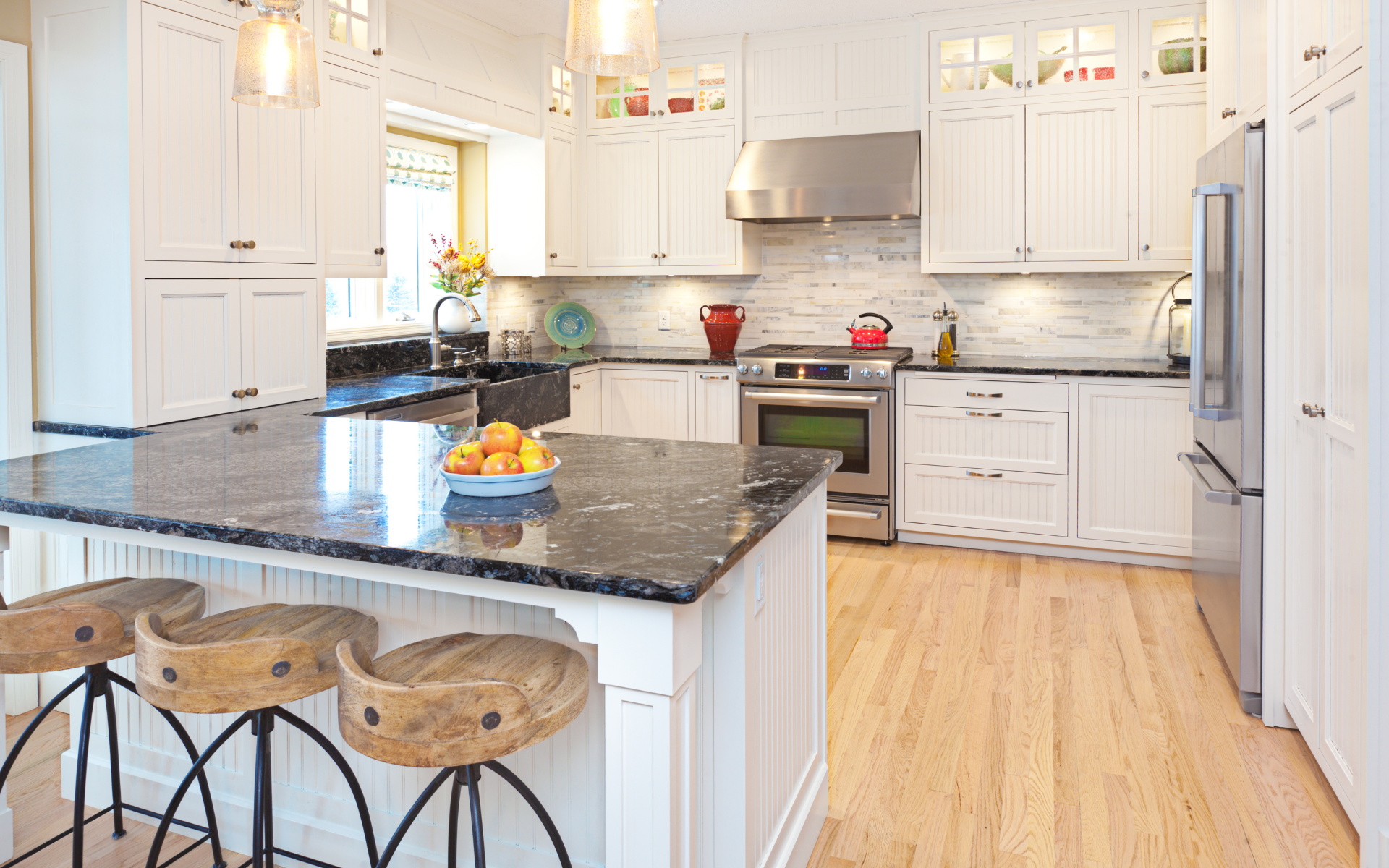
Complete Guide: Costs, Tariff Impacts, Design Trends & Budget Strategies
Last Updated: October 2026 | USA Cabinet Store
If you’ve been searching for “how much should a 10×10 kitchen remodel cost” or scrolling through Reddit and Quora threads to sanity-check contractor quotes, you’re not alone. A 10×10 kitchen is the industry’s standard pricing template. It’s used by cabinet manufacturers like Fabuwood and Showplace Cabinetry, big-box retailers like Home Depot and IKEA, and independent contractors alike. Understanding what’s included in that number is the first step to planning your remodel with confidence.
2026 Market Update: According to the National Kitchen & Bath Association (NKBA) and the 2025 Houzz Kitchen Trends Study, remodeling prices have settled down after the post-pandemic swings in lumber and labor costs. They’re more predictable now, but they settled at a higher level. The wild card is trade policy: tariffs on imported cabinets and timber still affect what you pay and how long you wait.
⚡ Quick Answer
In 2026, a 10×10 kitchen remodel typically costs $18,000–$35,000 for a basic remodel, $35,000–$70,000 for mid-range work and $70,000–$120,000+ for a high-end transformation nationally. In Northern Virginia, expect $30,000–$50,000, $45,000–$95,000 and $100,000–$175,000+. These figures reflect 2026 pricing, including tariffs on imported cabinets and steel.
Source: USA Cabinet Store 2026 Kitchen Remodeling Cost Guide
📋 10 Key Takeaways for Your 2026 10×10 Kitchen Remodel
Before diving into the details, here’s what every homeowner planning a 10×10 kitchen remodel needs to know:
- Expect to Pay $35,000–$70,000 for a mid-range 10×10 kitchen remodel in 2026 nationally ($45,000–$95,000 in Northern Virginia), priced for 2026 tariffs and labor costs.
- Cabinets Eat 30–40% of Your Budget — they’re the single biggest expense. Choosing US-made brands like Fabuwood or Showplace avoids the 25% import tariff on cabinets.
- The “Tariff Window” Closes January 2027 — the 25% tariff on imported cabinets is scheduled to rise to 50% on January 1, 2027. If an imported line is on your shortlist, order before the end of 2026.
- Labor Runs 20–35% of Cosmetic Projects and 35–50% of Full Remodels — skilled trades shortages have pushed rates up significantly, especially in metro areas like Northern Virginia and DC.
- A 10×10 Kitchen Is a Pricing Template — it represents ~20 linear feet of cabinets. Your actual kitchen gets priced by adjusting from this baseline.
- Shaker Cabinets Still Dominate — but the trend shifted from painted white to natural wood tones, especially rift-sawn white oak.
- Induction Cooktops Are Mainstream — faster and safer, but budget $2,000–$5,000 for electrical panel upgrades if switching from gas.
- Keep Your Layout to Save Big — moving plumbing adds $3,000–$8,000 and a gas line adds $1,500–$4,000. Keep sink and stove where they are.
- Minor Remodels Recoup 101–113% at Resale (101% in the Washington, DC market, 113% nationally) — one of the only home improvements that can pay for itself.
- Plan for 6–10 Weeks On Site — plus design time and cabinet lead time (2–5 weeks for stock, 5–9 for semi-custom, from final design sign-off), so order materials early.
What Is a 10×10 Kitchen, Really?
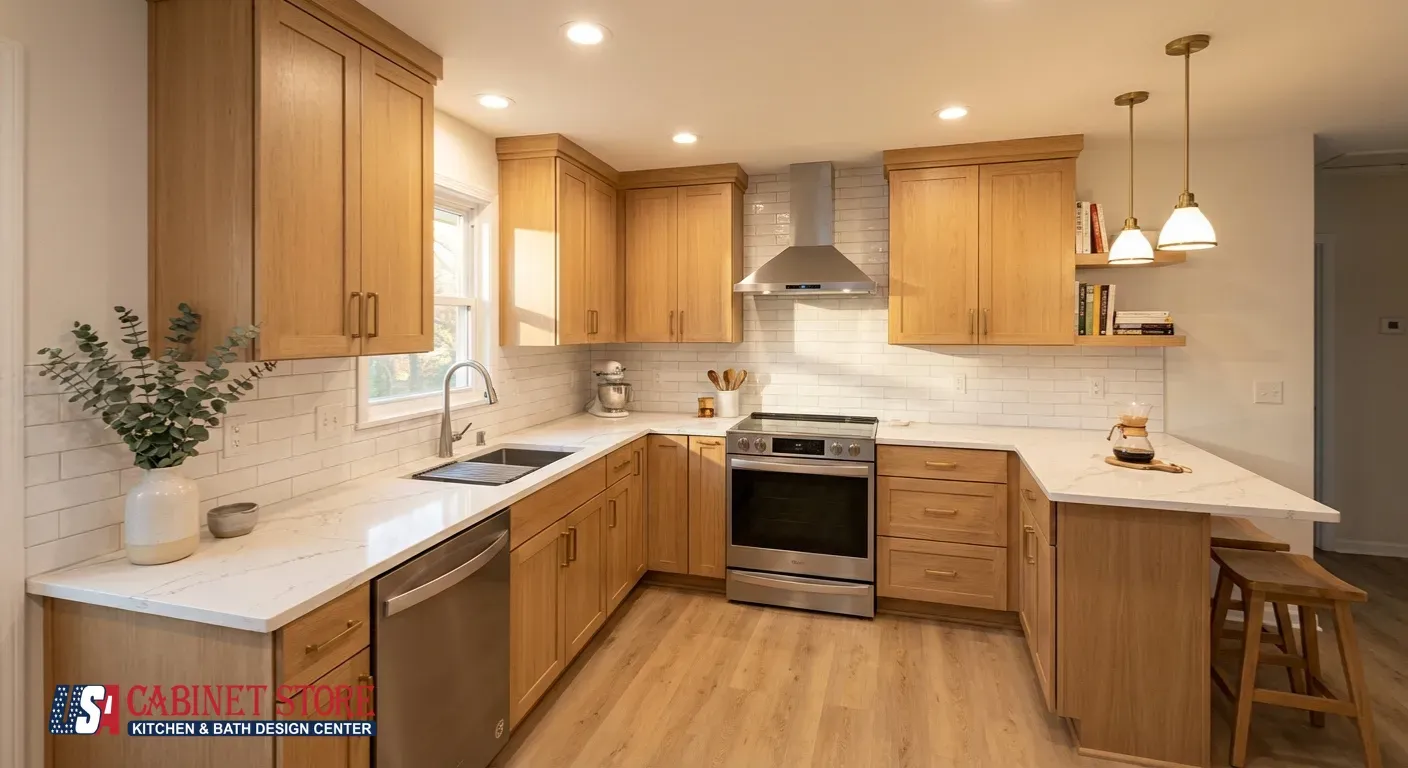
Remodelers, cabinet brands, and big-box stores all use the “10×10 kitchen” as a pricing template, not a strict room size. This 100-square-foot benchmark (measuring 10 feet by 10 feet) assumes:
- Around 100 sq. ft. of kitchen floor space
- Roughly 20 linear feet of cabinets (base and wall cabinets combined)
- A basic L-shaped layout with standard 30″ wall cabinets and 24″-deep base cabinets
- The classic work triangle connecting sink, range, and refrigerator
You might have an 8×12, 10×12, or 9×11 kitchen, or even a small galley or U-shaped layout. That’s fine. We still use the 10×10 model to estimate your cabinet package and then adjust the price to your actual measurements and linear footage.
2026 Cost Breakdown: Where Does the Money Go?
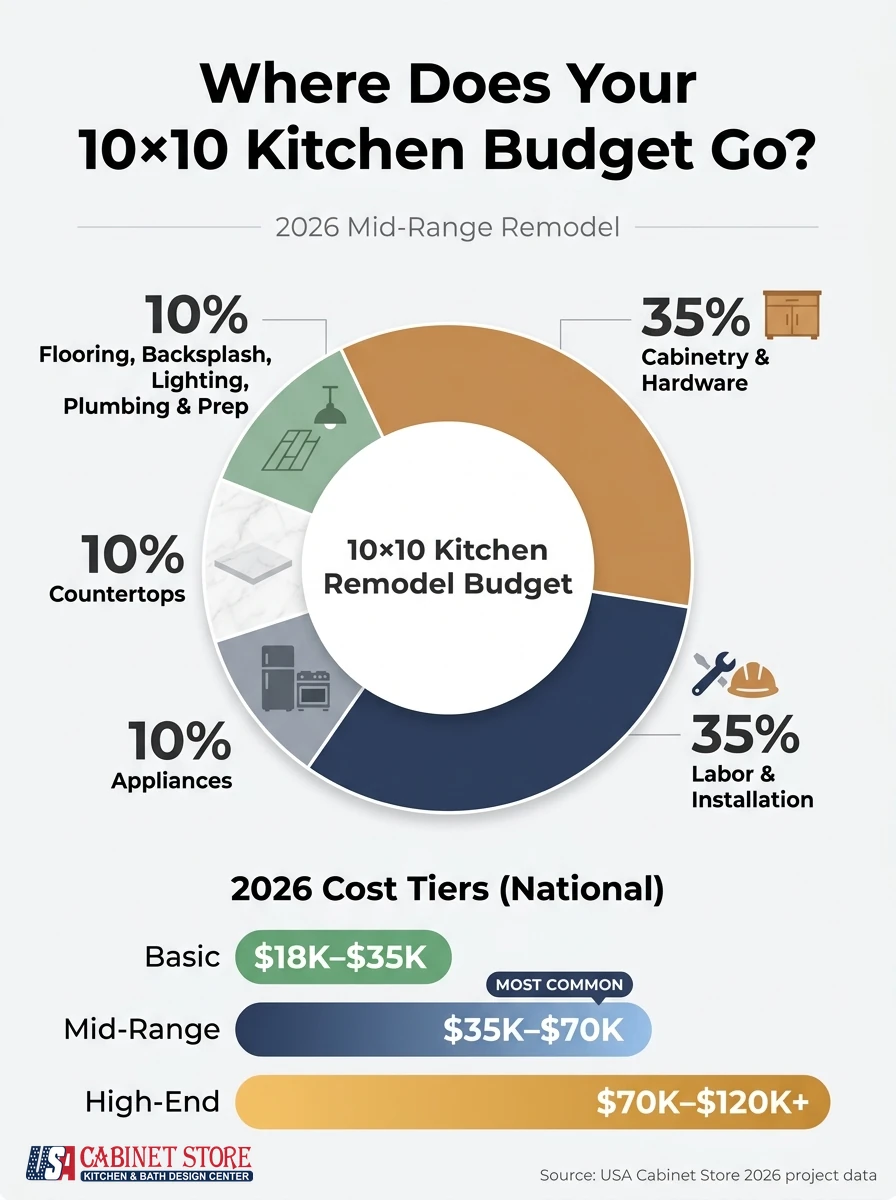
Most 10×10 quotes fall into one of three tiers. Based on our 2026 kitchen remodeling cost guide, a 10×10 kitchen (about 100 sq ft) sits in the medium-kitchen range and falls into three investment tiers:
Typical Cost Ranges by Project Level
| Project Level | National | Northern Virginia |
|---|---|---|
| Tier 1: Basic / Cosmetic BUDGETKeep layout; stock/RTA cabinets or cabinet refacing; laminate counters; basic recessed lighting & fixtures; LVP flooring; no plumbing changes | $18,000 – $35,000 | $30,000 – $50,000 |
| Tier 2: Mid-Range Remodel MOST POPULARGut existing cabinets/floors; semi-custom Shaker-style cabinets with soft-close hinges; quartz or granite counters; stainless steel undermount sink; complete appliance suite; subway tile backsplash; minor electrical/plumbing work | $35,000 – $70,000 | $45,000 – $95,000 |
| Tier 3: High-End Transformation PREMIUMFully custom cabinetry (rift-sawn white oak); natural quartzite or porcelain slabs; farmhouse sink; panel-ready appliances; smart technology; pot filler; pendant lighting; structural changes | $70,000 – $120,000+ | $100,000 – $175,000+ |
Northern Virginia covers Fairfax, Arlington, Loudoun and Prince William. A light cosmetic refresh (paint or refacing, new counters, hardware) can come in around $15,000.
Budget Allocation by Category
Understanding where your money goes helps identify areas for potential savings:
| Cost Category | Cosmetic % | Mid-Range % | Luxury % | Primary Driver |
|---|---|---|---|---|
| Cabinetry & Hardware | 30% | 35% | 38% | Custom woods, soft-close |
| Labor & Installation | 20% | 35% | 35% | Skilled trades shortage |
| Appliances | 15% | 10% | 10% | Steel and aluminum tariffs |
| Countertops | 10% | 10% | 10% | Laminate to quartzite |
| Flooring | 8% | 3% | 2% | LVP vs. porcelain tile |
| Backsplash | 4% | 2% | 1% | Subway tile to natural stone |
| Lighting & Electrical | 5% | 2% | 2% | GFCI outlets, pendants |
| Plumbing & Fixtures | 5% | 2% | 1% | Sink, faucet, pot filler |
| Demolition & Prep | 3% | 1% | 1% | Drywall repair, subfloor |
Cabinets 30–40%, labor 20–35% on cosmetic scopes and 35–50% on full remodels, appliances 10–20% and countertops 10–15%, in line with our main cost guide.
2026 Tariffs: What They Add to Your Cabinet Bill
Tariffs on imported cabinets, timber and steel are one of the biggest, least talked-about drivers of 2026 pricing. Understanding these tariffs can save you thousands, and it’s why working with domestic cabinet manufacturers like Fabuwood and Showplace Cabinetry has become increasingly attractive.
Cabinet Tariffs: The 2026 “Stability Window”
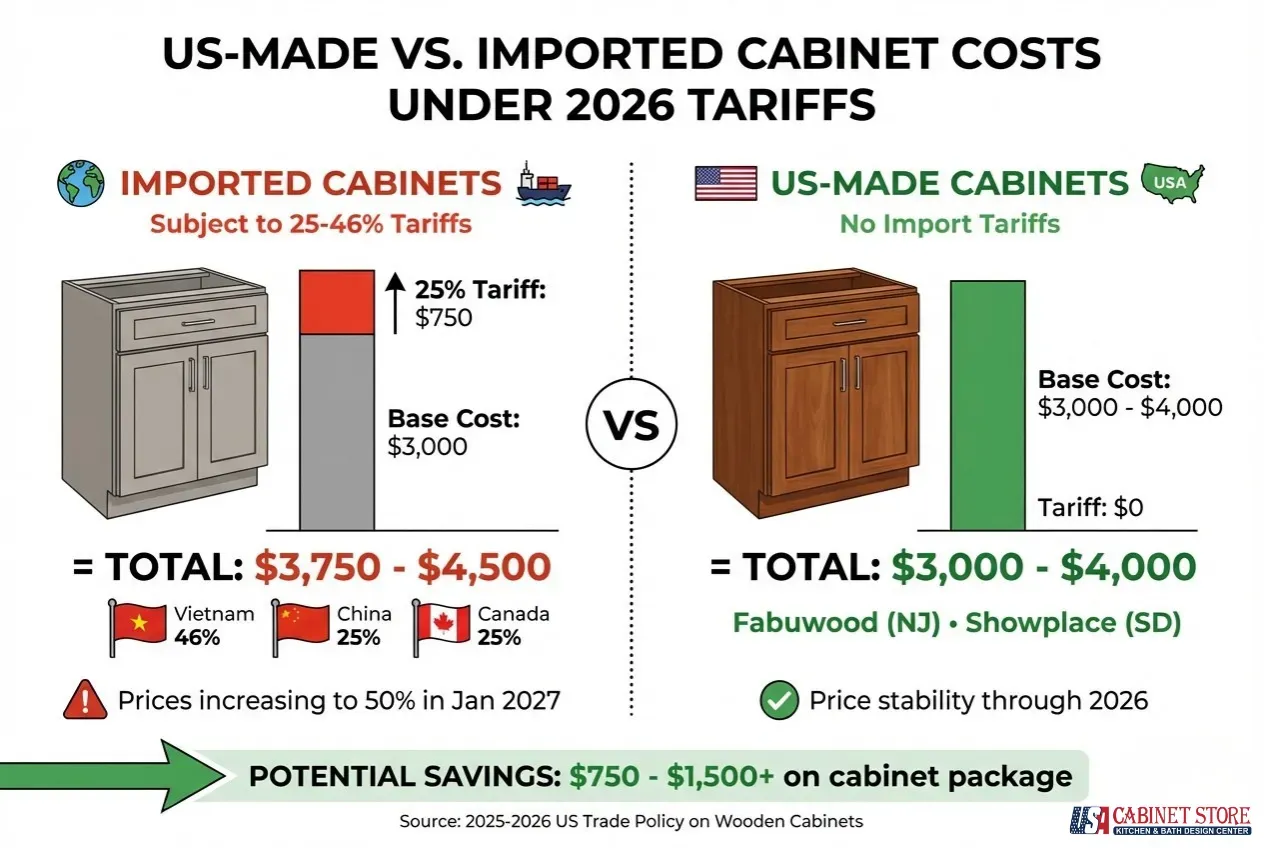
In late 2025, the U.S. government implemented a 25% tariff on imported kitchen cabinets and wood products, with a scheduled escalation to 50% originally set for January 1, 2026. However, this escalation has been postponed until January 1, 2027, creating a window of stability for 2026 projects.
- Current Rate: 25% on imported wooden cabinets (effective October 2025)
- Scheduled Increase: 50% on January 1, 2027
- US-Made Cabinets: not subject to the import tariff
- Lumber: 10% tariff on imported softwood lumber
Real-World Impact: Stock cabinets from overseas that cost $3,000 before the tariff now run about $3,750 at the 25% rate, and semi-custom imported cabinets that were $10,000 now run about $12,500. If the rate rises to 50% in January 2027, those figures become $4,500 and $15,000. This is why USA Cabinet Store partners with American manufacturers like Fabuwood (New Jersey) and Showplace Cabinetry (South Dakota), so our cabinets aren’t subject to these import tariffs.
Steel & Aluminum Tariffs on Appliances
As of June 23, 2025, a 50% tariff applies to the steel and aluminum content within imported appliances. Steel typically comprises about half the weight of major appliances, up to 100 pounds in a stainless steel refrigerator.
- Affects refrigerators, dishwashers, ranges, wall ovens, and range hoods
- Imported brand prices (Samsung, LG) up 5–10% on new inventory
- American-made brands minimally affected: GE Appliances, Maytag, Whirlpool, KitchenAid, BlueStar, Speed Queen
⚠️ Strategic Advice
The 25% cabinet tariff is scheduled to rise to 50% on January 1, 2027. If an imported cabinet line is on your shortlist, sign and order before the end of 2026. US-made lines like Fabuwood and Showplace are not affected either way.
Kitchen Cabinets: The Biggest Piece of Your Budget
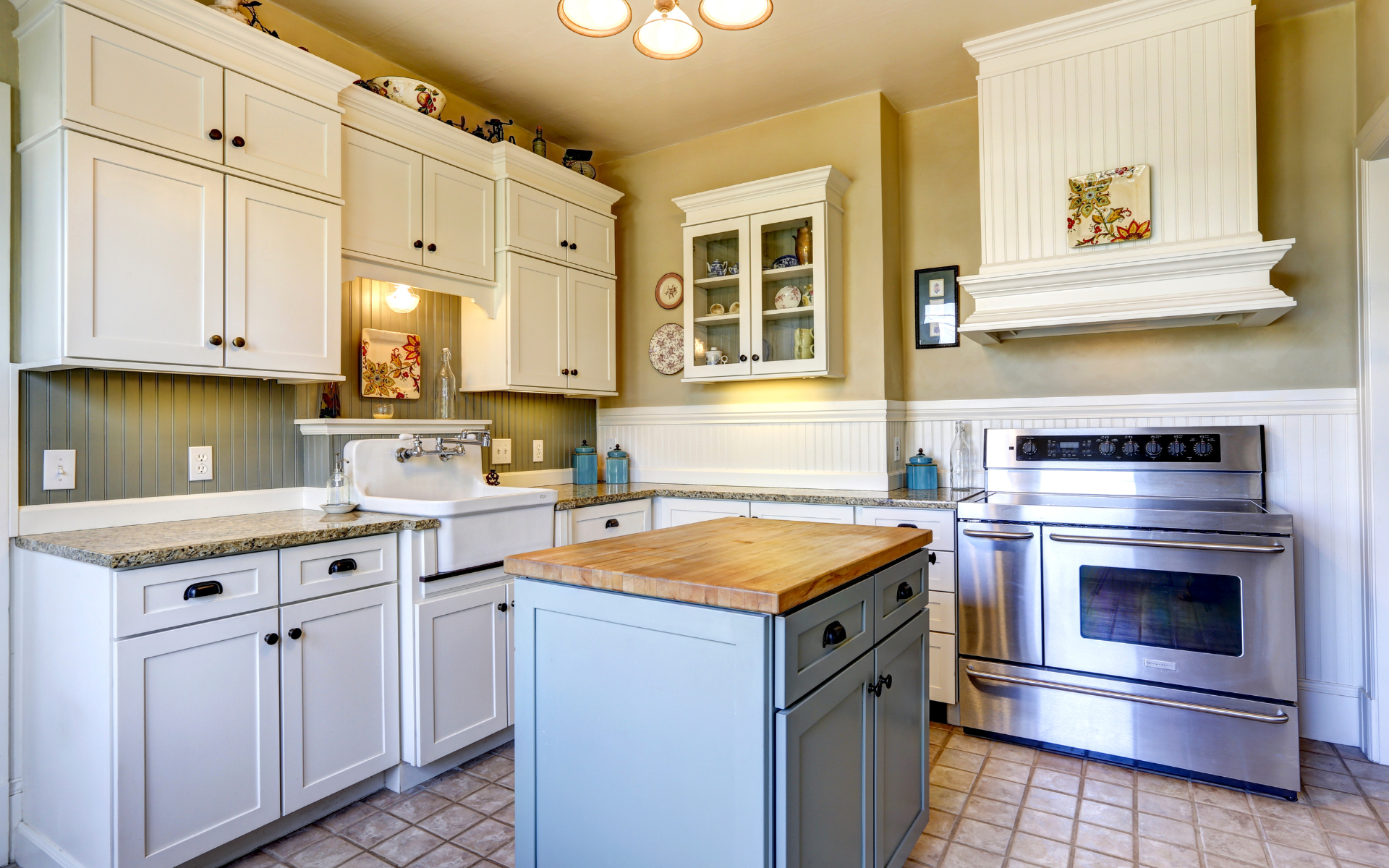
Cabinets typically consume 30–40% of a kitchen remodel budget. According to the 2025 Houzz Kitchen Trends Study, 85% of kitchen projects include cabinet upgrades, with nearly 70% replacing all cabinets. Here’s what to expect in 2026:
| Cabinet Type | Cost / Linear Foot | 10×10 Estimate | Tariff Impact |
|---|---|---|---|
| Stock/RTA (Imported) | $150 – $400 | $3,000 – $8,000 | HIGH (25%) |
| Stock (US-Made) | $120 – $350 | $2,400 – $7,000 | LOW (minimal) |
| Semi-Custom (Fabuwood) | $200 – $550 | $4,000 – $11,000 | LOW (US-made) |
| Semi-Custom (Showplace) | $250 – $700 | $5,000 – $14,000 | LOW (US-made) |
| Full Custom | $500 – $1,500+ | $10,000 – $30,000+ | VARIES BY SOURCE |
Lead times from final design sign-off: about 2–5 weeks for stock lines, 5–9 weeks for semi-custom, 7–11 weeks for custom and 10–14 weeks for European frameless.
How We Compare to Big-Box Stores: IKEA’s 10×10 cabinet packages typically run $4,000–$9,000 for boxes and fronts (no installation). Home Depot’s stock cabinets run about $4,000–$8,000 for a 10×10. However, these prices don’t include professional installation, which adds $1,500–$3,000. Our semi-custom Fabuwood and Showplace packages include plywood box construction, dovetail drawer boxes, and soft-close hinges as standard. At big-box stores, those are paid upgrades.

2026 Cabinet Trends & Features
The all-white, high-gloss kitchen is on its way out. In 2026, homeowners are choosing warmer looks like Japandi (a blend of Japanese and Scandinavian design) and organic modern, with natural wood, matte finishes and softer colors.
- Shaker Style Cabinets: Still the #1 most popular door style in America, now trending in warm wood tones rather than painted white
- Rift-Sawn White Oak: The defining material of 2026 luxury kitchens, with straight, vertical grain lines that feel organic but ordered (20–50% premium)
- Soft-Close Hinges & Drawers: Now expected as standard, not an upgrade; they prevent slamming and extend cabinet life
- Dovetail Drawer Construction: Sign of quality; interlocking joints are stronger than stapled or glued alternatives
- Floor-to-Ceiling Storage: The “cabinet gap” above upper cabinets is now considered a design flaw, so run cabinets to the ceiling for storage and visual height
- Appliance Garages: Dedicated cabinets with retractable doors to hide toasters, coffee makers, and stand mixers
- New Neutral Colors: “Mushroom,” “Putty,” and warm taupe tones replacing stark white and cool gray
Countertops: Choosing Durable vs. Budget-Friendly Options
For most 10×10 kitchens, you’ll have about 40–50 square feet of countertop surface. Most homeowners end up choosing between engineered quartz, natural quartzite and, more and more often, porcelain slabs.
| Material | $/Sq Ft Installed | 10×10 Est. | Heat Resist. | Maintenance | 2026 Trend |
|---|---|---|---|---|---|
| Laminate | $20 – $50 | $1,000 – $2,500 | Low | None | Budget choice |
| Butcher Block | $40 – $100 | $2,000 – $5,000 | Low | Oil regularly | Organic accent |
| Granite | $50 – $100 | $2,500 – $5,000 | High | Annual seal | Classic choice |
| Engineered Quartz | $60 – $150 | $3,000 – $7,500 | Low (resin) | None | Subtle patterns |
| Natural Quartzite | $100 – $200+ | $5,000 – $10,000+ | Very High | Annual seal | Luxury choice |
| Porcelain Slab | $60 – $120 | $3,000 – $6,000 | Excellent | None | Rising star |
| Marble | $100 – $250+ | $5,000 – $12,500+ | Medium | High (etches) | Timeless luxury |
| Soapstone | $70 – $120 | $3,500 – $6,000 | High | Oil optional | Niche appeal |
2026 Trend Note: Manufacturers are moving away from “extreme veining” that mimics marble too aggressively, which now looks artificial. The trend is toward subtle, natural-looking patterns or solid, warm hues. “Quiet” patterns are in; loud, jagged veins are out.
Backsplash Options: From Subway Tile to Statement Walls
A typical 10×10 kitchen has 25–35 square feet of backsplash area. While often overlooked in budget planning, the backsplash dramatically impacts the kitchen’s visual appeal.
- Ceramic Subway Tile: $10–$25/sq ft installed — The timeless choice; now trending in stacked (horizontal) patterns rather than traditional brick layout
- Glass Tile: $25–$50/sq ft installed — Reflects light beautifully; popular in coastal and modern designs
- Porcelain Tile: $15–$40/sq ft installed — More durable than ceramic; can mimic natural stone at lower cost
- Natural Stone (Marble, Travertine): $30–$75/sq ft installed — Luxury look; requires sealing to prevent staining
- Full-Height Slab: $50–$100/sq ft installed — Countertop material extended up the wall; seamless, dramatic look
Budget Estimate: For a 10×10 kitchen, expect $500–$1,500 for basic ceramic or porcelain tile, $1,500–$3,000 for glass or natural stone, or $2,500–$5,000+ for full-height slab installations.
Kitchen Flooring: Durability Meets Design
In a 10×10 kitchen (100 sq ft), flooring choices can dramatically alter the perception of space. Large-format tiles reduce grout lines, making the floor appear as a continuous surface and the room feel larger.
- Luxury Vinyl Plank (LVP): $4–$10/sq ft installed — The 2026 workhorse; 100% waterproof, scratch-resistant, and available in realistic wood looks. Ideal for budget and mid-range remodels.
- Porcelain Tile: $8–$20/sq ft installed — Extremely durable; 24×24″ or larger format reduces grout lines. Can mimic wood, marble, or concrete.
- Ceramic Tile: $5–$15/sq ft installed — Budget-friendly; wide variety of styles including classic checkerboard patterns making a 2026 comeback.
- Engineered Hardwood: $8–$18/sq ft installed — Warmer feel than tile; more stable than solid hardwood in kitchen humidity. Light oak tones dominate 2026 trends.
- Natural Stone (Slate, Limestone): $15–$30/sq ft installed — Luxury option; unique character but requires sealing and more maintenance.
Budget Estimate: For 100 sq ft: LVP runs $400–$1,000; porcelain tile $800–$2,000; engineered hardwood $800–$1,800.
Kitchen Sinks & Faucets: Why Workstation Sinks Win in Small Kitchens
The kitchen sink is the most-used fixture in your home. In 2026, workstation sinks have transformed this “hole in the countertop” into valuable prep space.
Kitchen Sink Styles
- Stainless Steel Undermount: $200–$600 — Most popular; easy to clean, durable, seamless countertop transition
- Farmhouse/Apron-Front: $400–$1,500 — Statement piece; exposed front panel requires specialized cabinet
- Composite/Granite Sink: $300–$800 — Heat and scratch resistant; available in colors to match countertops
- Workstation Sink: $400–$1,200 — Integrated ledge system supports cutting boards, colanders, drying racks. A 30″ workstation sink effectively adds 30″ of prep space, which makes a real difference in a 10×10 kitchen.
- Cast Iron: $400–$1,000 — Classic durability; heavy (requires reinforced cabinet); available in colors
Kitchen Faucet Options
- Pull-Down Sprayer: $150–$500 — Most popular style; high arc for filling pots
- Touchless/Motion-Sensor: $250–$600 — Hygienic; activate with wave of hand while handling raw meat
- Pot Filler: $200–$500 (plus $300–$500 installation) — Wall-mounted at stove; eliminates carrying heavy pots from sink
- Bridge Faucet: $300–$800 — Vintage/traditional style; exposed connection between handles and spout
Kitchen Appliances: Smart Technology & Tariff Considerations
Kitchen tech in 2026 is less about gadgets and more about features you’ll actually use. A standard appliance package (refrigerator, range, dishwasher, microwave, range hood) runs $2,000–$10,000 for budget to mid-range brands, and $20,000–$50,000+ for a professional suite.
Induction Cooktops: Faster, Safer, Now Standard
The biggest shift is induction cooking. It used to be a luxury upgrade; now most mid-range and high-end remodels include it.
- Speed: Boils water up to 50% faster than gas with precise temperature control
- Safety: Surface remains cool to the touch, which matters in tight 10×10 spaces where traffic passes close to the stove
- Health: No indoor air quality issues associated with gas stoves (NO2 emissions)
- Hidden Cost: Switching to induction often requires electrical panel upgrade ($2,000–$5,000) for a dedicated 40–50 amp circuit
Essential Appliances & 2026 Features
- Range Hood/Ventilation: Required by building code; 300–600 CFM for standard cooking, 900+ CFM for serious cooks. Budget $200–$1,500.
- Refrigerator: Counter-depth models ($1,500–$4,000) don’t protrude past cabinets; smart features include internal cameras and inventory tracking
- Dishwasher: Third rack and bottle jets now standard in mid-range ($600–$1,200); panel-ready models ($800–$2,000) integrate with cabinetry
- Wall Oven: Separate from cooktop; AI-powered models recognize food via internal camera and auto-adjust temperature
- Compact 24″ Suites: Brands like Bosch, Haier, and SMEG produce high-performance 24″ ranges and fridges perfect for 10×10 kitchens
Kitchen Lighting: The Three-Layer Approach
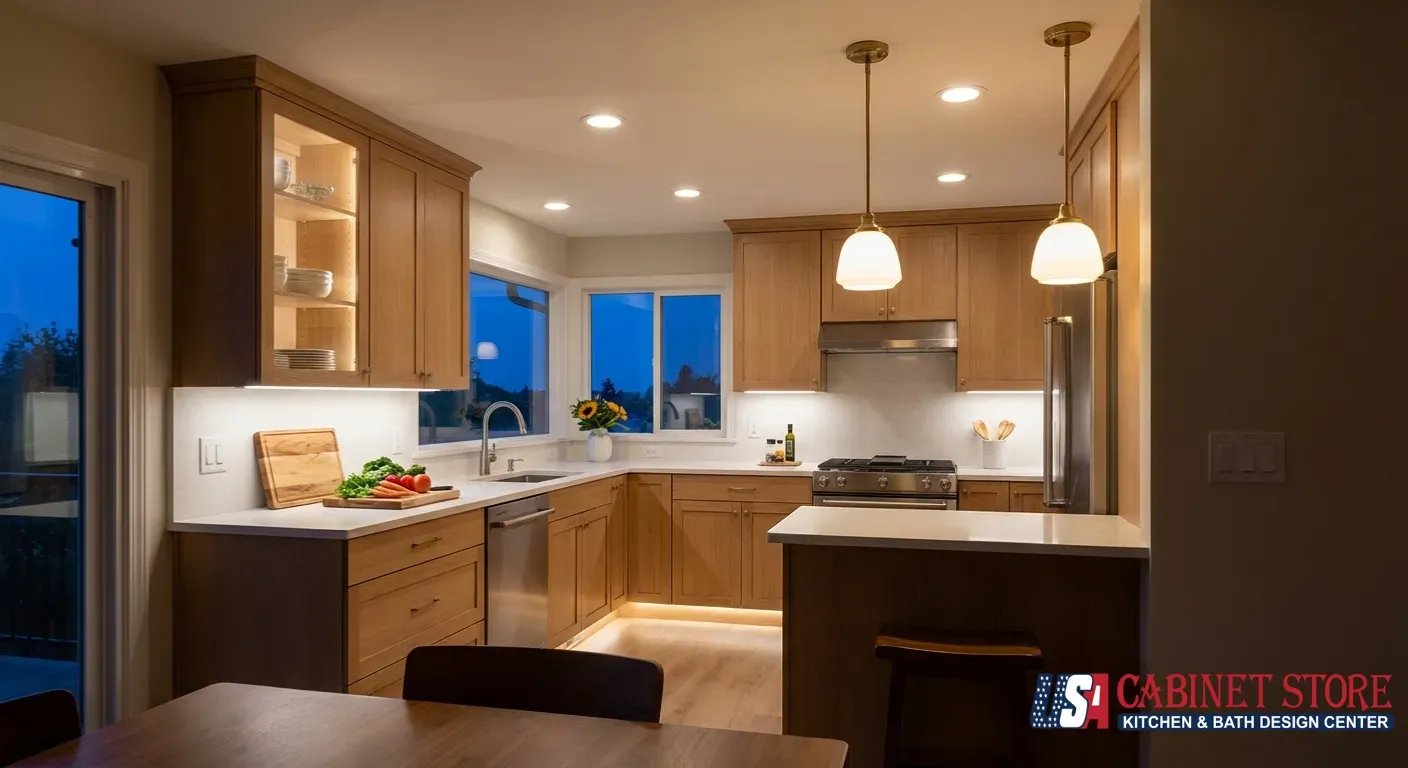
Lighting deserves a plan, not an afterthought. A single overhead fixture is insufficient for safe food prep and ambiance. The NKBA recommends a three-layer approach:
- Layer 1 — Ambient (General): Recessed can lights or flush-mount fixtures provide overall illumination. Plan for one 4–6″ recessed light per 25 sq ft. Budget: $100–$200 per fixture installed.
- Layer 2 — Task Lighting: Under-cabinet LED strips illuminate countertops for safe food prep. Essential for any working kitchen. Budget: $200–$600 for full kitchen.
- Layer 3 — Accent/Decorative: Pendant lights over islands or peninsulas add personality. In-cabinet lighting highlights glass-front cabinets. Toe-kick lighting adds drama. Budget: $150–$500 per pendant.
2026 Trend: Tunable white LED systems adjust color temperature through the day, with cool, bright light (4000K–5000K) for morning prep and warm, dim light (2700K–3000K) in the evening. Dimmer switches are now expected on all kitchen lighting circuits.
Labor Costs: The 2026 Reality
Labor is the hardest cost to predict in 2026. There aren’t enough licensed electricians, plumbers and finish carpenters, so their hourly rates keep climbing. Labor typically runs 20–35% of the budget on cosmetic scopes and 35–50% on full remodels, toward the top of that range in metro markets.
| Trade | National Avg. Hourly | High-Cost Markets (Northern Virginia, DC, SF, NYC) |
|---|---|---|
| Licensed Electrician | $50 – $100 | $90 – $130+ |
| Licensed Plumber | $60 – $120 | $100 – $150+ |
| Carpenter/Cabinet Installer | $40 – $80 | $60 – $100 |
| Tile Installer | $40 – $80 | $50 – $90 |
| Kitchen Designer | $50 – $150/hour or 5–10% of project | About 10% of project |
| General Contractor | 15–25% markup | 20–25% markup |
Code Requirements to Budget For: Kitchen electrical must include GFCI outlets within 6 feet of the sink, at least two 20-amp small appliance circuits, and a dedicated circuit for the dishwasher. If your home has an older electrical panel (100 amps or less), upgrading for induction cooking adds $2,000–$5,000.
Timeline Impact: The scarcity of labor extends project timelines. A mid-range 10×10 remodel now takes 6–10 weeks on site due to scheduling bottlenecks between trades.
Regional Pricing: 10×10 Costs by Market
Kitchen remodel costs vary significantly by location. Here’s what to expect in key markets:
| Location | Mid-Range 10×10 Remodel | Market Notes |
|---|---|---|
| Northern Virginia (Fairfax, Arlington, Loudoun, Prince William) | $45,000 – $95,000 | Premium labor rates; high demand; older homes may need electrical upgrades |
| Hampton Roads (Chesapeake, Virginia Beach) | $28,000 – $50,000 | Below the national mid-range ($35,000–$70,000); military relocation drives demand |
| Texas (Austin) | $28,000 – $48,000 | Rapid growth market; longer lead times for contractors |
| Texas (Dallas / Houston) | $25,000 – $45,000 | Competitive builder market; larger kitchens typical |
| St. Louis, Missouri | $22,000 – $40,000 | Lower labor costs; excellent value market |
National benchmark for a mid-range 10×10: $35,000–$70,000. See our 2026 kitchen remodeling cost guide for every size and tier.

10×10 Kitchen Layout & Design Ideas
In a 10×10 kitchen, every inch of walking space counts. The classic work triangle (the path between sink, range and refrigerator) should total 13–26 feet, with no single leg shorter than 4 feet or longer than 9 feet.
Layout Efficiency Comparison
| Layout Type | 10×10 Suitability | Pros | Cons |
|---|---|---|---|
| Galley (Parallel) | HIGH | Most efficient work triangle; maximizes counter runs; no dead corners | Can feel enclosed; typically allows only one cook |
| L-Shape + Island | MODERATE | Open feel; connects to adjacent rooms; allows small mobile island | Island clearance can be tight; requires careful dimensioning |
| U-Shape | LOW-MOD | Maximum storage volume; efficient work triangle | Creates two “dead” corners; can feel cramped; traps the cook |
| One-Wall | LOW | Cheapest; open floor space; great for open concepts | Least counter space; inefficient workflow (long distances) |
Can a 10×10 Kitchen Have an Island?
In a closed 10×10 kitchen, a traditional island often violates the 36″ minimum walkway clearance required by building code (42″ preferred for two cooks). However, if your kitchen opens to a dining or living area, a small island or peninsula can work well. Alternatives for 10×10 spaces include mobile kitchen carts and workstation sinks that add prep space without permanent footprint.
Space-Maximizing Storage Solutions
- Pull-Out Drawer Organizers: Deep drawers with dividers for pots, pans and lids, easier to reach than the back of a dark cabinet
- Lazy Susan / Magic Corner: “LeMans” pull-out systems bring blind corner contents into the room, so nothing gets lost in the corner
- Toe-Kick Drawers: Convert the 4″ toe kick space under base cabinets into shallow drawers for baking sheets and platters
- 15″ Upper as Base: Using shallower 15″-deep cabinets on one wall opens up 9″ of walkway while maintaining storage
- Walk-In Pantry: Per the NKBA 2026 report, 61% of designers expect walk-in pantries to gain popularity, which lets you concentrate cabinets in the main kitchen where they matter most
Tips to Remodel a 10×10 Kitchen on a Budget in 2026
- Start Planning Now: If imported cabinets are on your shortlist, sign and order before the scheduled 50% rate starts on January 1, 2027.
- Buy US-Made Cabinets: Domestically manufactured cabinets (like Fabuwood and Showplace) avoid the 25% cabinet tariff. Ask where boxes, doors, and hardware originate.
- Consider Cabinet Refacing: About 27% of homeowners opt for refacing ($4,000–$12,000) rather than full replacement. Refacing keeps the existing cabinet boxes and replaces the doors and drawer fronts.
- Keep Your Existing Layout: Moving plumbing costs $3,000–$8,000 and a gas line $1,500–$4,000. Keeping sink and stove in place saves significantly.
- Buy American Appliances: Brands like GE, Maytag, Whirlpool, KitchenAid, and BlueStar avoid steel tariff impacts on imported brands.
- Get Multiple Detailed Quotes: Compare line-item breakdowns from at least three contractors. Watch for allowances vs. actual material costs.
- Plan for Lead Times: Cabinets take 2–5 weeks for stock, 5–9 for semi-custom and 7–11 for custom (10–14 for European frameless), counted from final design sign-off; countertops 1–3 weeks to fabricate after the cabinets go in; appliances 4–12 weeks. Order early to avoid rush fees.
- Budget 10–20% for Contingencies: Hidden issues like outdated wiring, water damage behind walls, or subfloor problems are common in older homes.
Return on Investment (ROI) for Kitchen Remodels
Data from the 2025 Cost vs. Value Report indicates that while kitchens remain a top driver of home value, the ROI varies by project scope:
- Minor Remodel (about $28,500 avg): Recoups about 101–113% (101% in the Washington, DC market, 113% nationally), one of the few home improvements generating positive immediate return
- Midrange Major Remodel (about $83,000 avg): Recoups about 49–51% (49% in DC, 51% nationally), but provides significant lifestyle improvement and faster home sales
- Upscale Major Remodel (about $164,000 avg): Recoups about 32–36% (32% in DC, 36% nationally)
- The “Over-Improvement” Trap: Installing $100,000 of finishes in a modest home won’t yield proportional appraisal increase. A good rule: budget 5–15% of your home’s value for the kitchen
Financing Your 10×10 Kitchen Remodel
Many homeowners ask “how to pay for it” as urgently as “how much does it cost.” Common financing options include:
- Home Equity Loan: Fixed rate, lump sum; current rates 7–9%; tax-deductible interest if used for home improvement
- HELOC: Flexible line of credit against home equity; draw as needed during project; variable rate
- FHA 203k Loan: Rolls renovation costs into mortgage; good for major projects; requires FHA-approved contractor
- Personal Loan: Unsecured; faster approval (days vs. weeks) but higher rates (10–15%)
- Retailer Financing: Some offer 0% for 12–18 months, but watch for 25–30% deferred interest if not paid in full
Frequently Asked Questions for 10×10 Kitchen Remodel
How much does a 10×10 kitchen remodel cost in 2026?
The average cost of a kitchen remodel in 2026 is $27,000–$35,000 nationally, according to our 16 years of experience and 13-showroom data, with most projects between $15,000 and $75,000. A standard 10×10 kitchen (about 100 sq ft / 20 linear feet of cabinets) sits in the medium-kitchen range: expect $18,000–$35,000 for a basic remodel, $35,000–$70,000 for mid-range work and $70,000–$120,000+ for a high-end transformation. In Northern Virginia, the same 10×10 runs $30,000–$50,000 for a basic scope, $45,000–$95,000 for mid-range and $100,000–$175,000+ for high-end. The 10×10 figures reflect 2026 tariffs on imported cabinets and on the steel content of appliances.
Are kitchen cabinets more expensive in 2026 because of tariffs?
Yes. A 25% Section 232 tariff on imported wooden cabinets and vanities took effect October 14, 2025, and it remains in force in 2026. Unlike the broader country-by-country “reciprocal” tariffs, this is a national-security duty, so it wasn’t affected by the Supreme Court’s February 2026 ruling that struck those reciprocal tariffs down. Across our 13 showrooms and 16 years in the business, we’ve watched stock cabinets that ran about $3,000 pre-tariff climb to about $3,750 under the current rate. US-made cabinets from manufacturers like Fabuwood and Showplace Cabinetry aren’t subject to this import tariff, which is why we increasingly steer budget-conscious homeowners toward domestic lines. One thing to plan around: the 25% rate was originally set to double to 50% on January 1, 2026, but that increase has been delayed to January 1, 2027, so 2026 is effectively a pricing-stability window.
How can I save money on a kitchen remodel in 2026?
Buy US-made cabinets and appliances to avoid tariff impacts. Consider cabinet refacing instead of replacement. Keep your existing layout to avoid costly plumbing and electrical work. If you’re considering imported cabinets, sign and order before the scheduled 50% rate starts on January 1, 2027. Buy American-made appliances like GE, Maytag, and Whirlpool.
▶ What Does a 10×10 Kitchen Remodel Really Cost in 2026? The Honest Breakdown · USA Cabinet Store Podcast Series
How long does a 10×10 kitchen remodel take?
A mid-range 10×10 kitchen remodel takes 6–10 weeks on site in 2026, and a cosmetic refresh 2–4 weeks. Before work starts, plan 2–4 weeks for design, plus cabinet lead time counted from final design sign-off: about 2–5 weeks for stock lines, 5–9 weeks for semi-custom, 7–11 weeks for custom and 10–14 weeks for European frameless. Countertops take 1–3 weeks to fabricate once the cabinets are installed and templated, and appliances can take 4–12 weeks, so order them early.
What is the typical labor cost as a percentage of a kitchen remodel budget?
Labor typically represents 35–50% of the total project cost on full remodels in 2026, due to skilled trades shortages. Cosmetic scopes run 20–35%. In high-cost markets like Northern Virginia, Washington DC, San Francisco, and NYC, labor can approach 50% of the budget. Cabinet installation alone for a 10×10 is commonly $1,500–$3,000.
What is the ROI on a kitchen remodel in 2026?
According to the 2025 Cost vs. Value Report, minor kitchen remodels recoup about 101–113% of their cost at resale (101% in the Washington, DC market, 113% nationally), making them one of the best home improvement investments. Major midrange remodels recoup about 49–51% (49% in DC, 51% nationally) and upscale remodels about 32–36%, but they provide significant lifestyle improvement and faster home sales.
Can I add an island to a 10×10 kitchen?
In a closed 10×10 kitchen, a traditional island often violates the 36″ minimum walkway clearance required by building codes. However, if your kitchen opens to an adjacent room, a small island or peninsula can work well. Mobile islands, kitchen carts, and workstation sinks are popular alternatives that provide extra prep space without permanent footprint.
Which parts of a kitchen remodel should I never DIY?
For safety and code compliance, always hire licensed professionals for: electrical work (especially panel upgrades for induction and GFCI outlet installation), gas line relocation, plumbing rough-in, and structural changes. DIY-friendly tasks include painting, hardware installation, and simple backsplash tile. Improper electrical or gas work can void insurance and create serious hazards.
What is the best countertop material for a busy family kitchen?
Engineered quartz remains the top choice for busy families. It’s non-porous (won’t harbor bacteria), never needs sealing, and resists scratches and stains. The main limitation is heat sensitivity (don’t place hot pans directly on it). For those who want natural stone, quartzite offers similar durability with a more unique appearance but requires annual sealing.
Are Shaker-style cabinets still popular in 2026?
Yes, Shaker-style cabinet doors remain the #1 most popular choice in America according to the NKBA 2026 Kitchen Trends Report. However, the trend has shifted from painted white Shaker to natural wood tones, particularly white oak and walnut. The clean lines of Shaker style complement both traditional and modern kitchen designs.
🏠 How USA Cabinet Store Helps You Control Your 10×10 Kitchen Remodel Cost
Many homeowners come to us confused by wildly different quotes. Our job is to translate industry benchmarks into a clear, local, line-item plan:
- ✅ Free Design Consultation: We measure your space and clarify whether you need a budget refresh or full renovation
- ✅ Transparent 10×10 Pricing: Line-item breakdown of cabinets, counters, appliances, plumbing, electrical, and labor
- ✅ Good / Better / Best Proposals: Compare stock vs. Fabuwood semi-custom vs. Showplace premium side by side
- ✅ US-Made Cabinet Partners: Fabuwood (New Jersey) and Showplace (South Dakota) aren’t subject to import tariffs
- ✅ Showrooms You Can Visit: See Shaker-style doors, soft-close hinges, and real 10×10 displays at different price points
Schedule Your Free 10×10 Kitchen Design Consultation Today
www.usacabinetstore.com | (703) 936-8222
📍 13 showrooms in 7 states: Virginia, Maryland, North Carolina, Texas, Florida, Tennessee and New Jersey