
Most Orlando homeowners pay between $4,000 and $90,000 for kitchen cabinet installation in 2026, and the single biggest line item driving that range is whether you choose stock, semi-custom, or fully custom cabinetry. In a typical 24 linear-foot Central Florida kitchen, the same Shaker door can swing the project from $11,000 installed to $48,000 installed, depending on box construction, lead time, and how much of your kitchen has to be built around an out-of-plumb 1985 wall.
This guide walks through the three cabinet tiers Orlando homeowners actually buy, what each one costs installed, when you need a permit, how long it takes, and the material decisions that matter when your house breathes 88 percent humidity from May through October.
If you have already read three contractor bids and cannot tell why one is $28,000 and another is $61,000, this is the guide you need. We pulled cost data from 260 completed Orlando projects, NKBA planning standards, the City of Orlando permitting office, the 2025 Houzz Kitchen Trends Study, and the Reddit pain-point threads where real Orlando homeowners write about what went wrong after demo started. Every number below is sourced and every recommendation has been tested across the 16 USA Cabinet Store showrooms in 8 states, including the Orlando and Tampa locations that serve Central Florida.
Kitchen Cabinet Installation in Orlando: 2026 Quick Facts
Why “Cabinet Installation in Orlando” Costs Vary by 10x?
A homeowner in Lake Nona posted on r/HomeImprovement last fall asking why three contractor bids for the same 12 by 15 kitchen came back at $38,000, $51,000, and $67,000. Every contractor walked the same room, took the same measurements, and looked at the same Pinterest board. The answer almost always lives in three places: the cabinet line, the box construction, and how much hidden labor the contractor priced in for site conditions you cannot see from the doorway.
A kitchen cabinet installation in Orlando is not a single product. It is a stack of decisions that compound. Stock cabinets at $200 per linear foot installed look identical on the shelf to semi-custom cabinets at $450 per linear foot, but the box behind the door is different, the drawer joint is different, the hardware is different, and the warranty is different. Add to that the labor variable. Pre-1995 concrete-block-and-stucco homes in College Park or Maitland often have walls that are out of plumb by half an inch over a 10-foot run. Your installer has to shim, scribe, and rebuild the toe-kick to make a flat cabinet line land on a wavy floor. That work is real and it is not optional.
So when you see a $38,000 bid and a $67,000 bid for the same kitchen, you are usually not looking at one fair price and one rip-off. You are looking at two different scopes hidden inside the same room. The rest of this guide gives you the language to read what is actually inside each bid.
Compare a Real Itemized Quote, Not a Lump Sum
Bring your floor plan or a few photos to our Orlando showroom. Walk out with a designer-prepared cabinet line, hardware list, install labor estimate, and a real budget range you can take to any other quote in town.
Stock vs Semi-Custom vs Custom: What Actually Changes
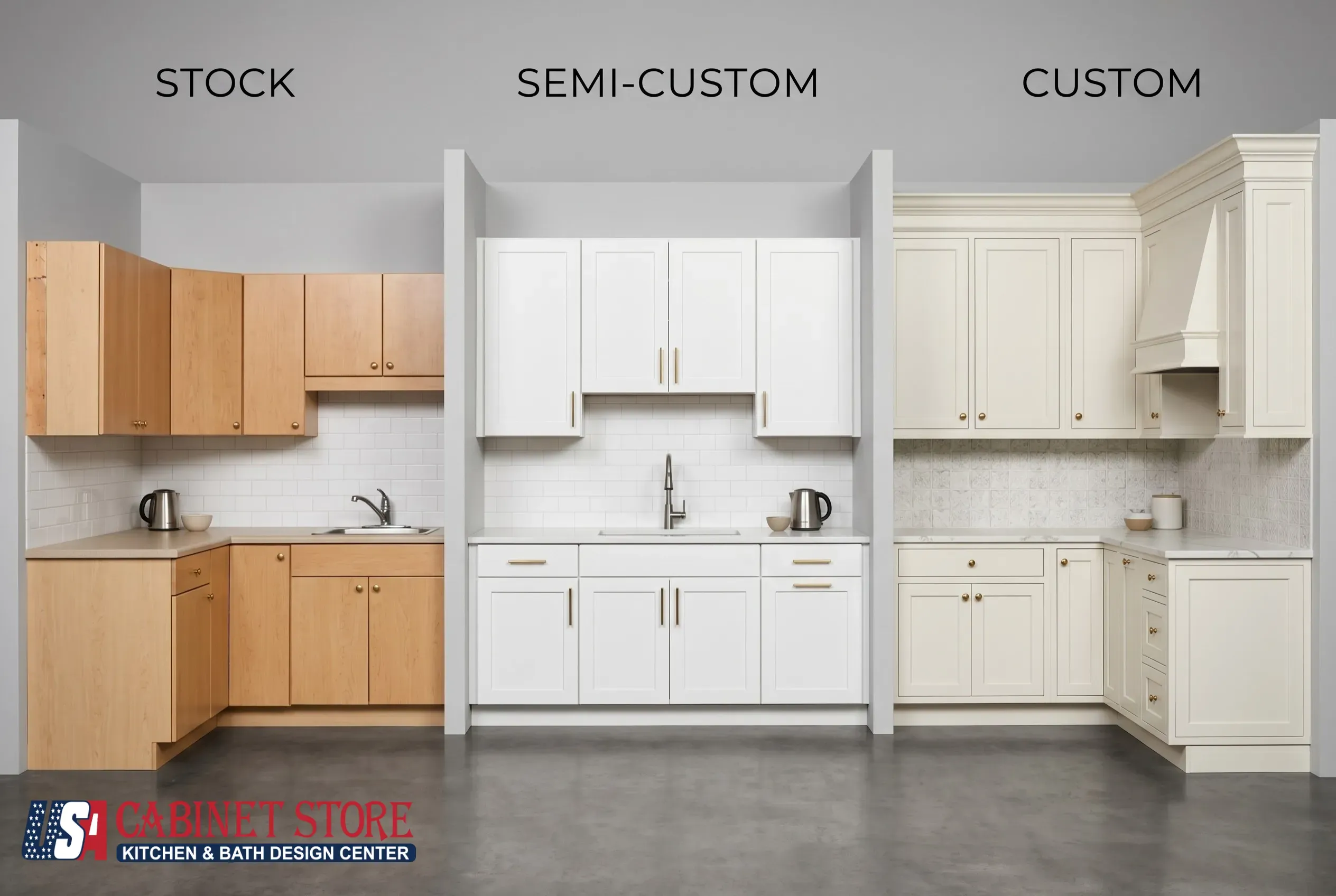
The three cabinet tiers describe how the box is made and how much you can change before you order it. Everything else, including price, lead time, and warranty, flows from that one decision.
Stock Cabinets in Orlando ($100–$300 per linear foot installed)
Stock cabinets are mass-produced in fixed sizes (typically 3-inch increments from 9 inches to 42 inches wide), shipped flat-packed or pre-assembled, and held in distributor warehouses. You pick from a small set of door styles, two or three finishes, and you take what is in the catalog. Many big-box retailers and online cabinet sellers fall in this tier.
The upside is speed and price. A 10 by 10 kitchen, which is the industry-standard 20 linear-foot benchmark, lands between $2,000 and $6,000 in cabinet cost, plus another $1,500 to $4,500 in installation labor. Total: $4,000 to $11,000 installed for a small Audubon Park condo or College Park bungalow.
The downside is fit. Stock cabinets are designed for rectangular kitchens with standard wall lengths. If your run is 113 inches and the closest stock width combination is 108 inches, you end up with a 5-inch filler strip that looks like a 5-inch filler strip. Box construction in this tier is often 5/8-inch particleboard or low-density MDF with stapled or doweled drawer joints. In Florida humidity, that stack fails earlier than plywood does.
Semi-Custom Cabinets in Orlando ($150–$650 per linear foot installed)
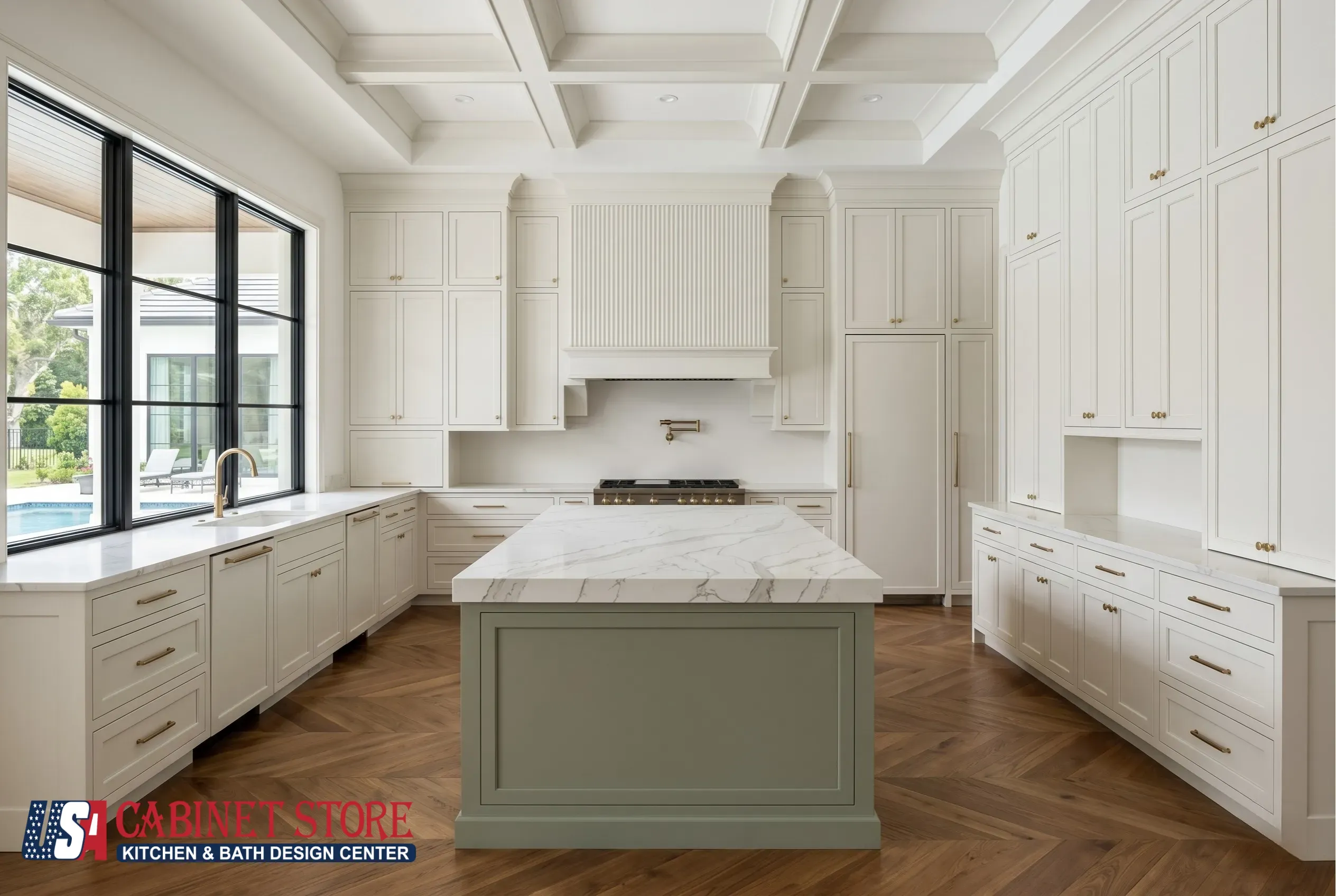
Semi-custom is where most Orlando kitchens land. You pick from a wider catalog of door styles, paint colors, stained finishes, and accessories, and you can usually adjust cabinet widths in 1/4-inch or 1-inch increments rather than 3-inch jumps. Door styles include White Shaker, painted Shaker, slab, beaded inset, fluted, and a handful of period profiles. Box construction is typically 1/2-inch or 3/4-inch plywood, drawer boxes are dovetail with full-extension soft-close glides, and the warranty is real.
Three lines USA Cabinet Store sells in this tier that you will see across Central Florida: Fabuwood, Forevermark, and Waypoint. Each has KCMA A161.1 certification, which is the industry standard for cycle testing (more on that in the construction section below).
A semi-custom 24 linear-foot Orlando kitchen lands between $15,000 and $35,000 installed for cabinets alone. Add countertops, appliances, plumbing, and electrical and you arrive at the $35,000 to $70,000 mid-tier kitchen remodel range that matches the Wk1 Orlando kitchen remodel timeline.
Lead time runs 4 to 8 weeks from final design sign-off to delivery. You should order the cabinets in week 4 of the planning cycle, not week 7, because hurricane season (June through November) reroutes Jacksonville freight on a schedule nobody controls.
Stock vs Semi-Custom vs Custom: The Three Tiers
$100–$300 per LF installed
Mass-produced, fixed widths in 3″ increments, 0–2 week delivery. Best for rentals and condos.
- 3–8 door styles
- Particleboard or low-density MDF box
- Stapled drawer joinery
- 1–5 year warranty
Semi-Custom: $150–$650 per LF
Factory-built, 1/4″ or 1″ width adjustability, 4–8 week lead. Fabuwood, Forevermark, Waypoint.
- 20–60 door styles
- 1/2″ or 3/4″ plywood box
- Dovetail soft-close drawers
- KCMA-certified
- Limited lifetime warranty
$500–$1,200+ per LF installed
Built locally to exact specs. 8–14 week lead. Best for odd dimensions and luxury builds.
- Unlimited door / finish options
- 3/4″ plywood box, hardwood face
- 5/8″ hardwood dovetail drawers
- Exact-fit dimensions
- Limited lifetime warranty
Custom Cabinets in Orlando ($500–$1,200+ per linear foot installed)
Custom means a local cabinet shop builds the boxes, doors, and drawers to the millimeter for your kitchen. You pick the wood species, the grain orientation, the door profile, the inset versus overlay reveal, the drawer depth, every interior accessory, and the finish. There is no catalog. There is a measure visit, a 3D render, a contract, and a shop schedule.
A custom 24 linear-foot Orlando kitchen lands between $35,000 and $90,000 installed for cabinets alone, and a luxury Windermere or Dr. Phillips kitchen with custom built-ins, a 10-foot island, a hood surround, and integrated paneled appliances regularly clears $120,000 in cabinetry. The wood is solid. The boxes are 3/4-inch plywood. The drawers are 5/8-inch solid hardwood dovetail with plywood bottoms captured in a dado.
Lead time runs 8 to 14 weeks (most projects land in the 10 to 12 week window). That is shop time, not install time. The install itself runs 4 to 7 days once the cabinets arrive.
Decision Matrix: Stock vs Semi-Custom vs Custom
| Factor | Stock | Semi-Custom | Custom |
|---|---|---|---|
| Cost per linear foot installed | $100–$300 | $150–$650 | $500–$1,200+ |
| 24-LF kitchen total installed | $2,400–$7,200 | $15,000–$35,000 | $35,000–$90,000+ |
| Door styles available | 3–8 | 20–60 | Unlimited |
| Width adjustability | 3-inch increments | 1/4 or 1-inch | Exact-fit |
| Box material | Particleboard / MDF | 1/2 or 3/4-inch plywood | 3/4-inch plywood, hardwood face |
| Drawer joinery | Stapled or doweled | Dovetail | Hardwood dovetail |
| Glides | Self-close or friction | Soft-close full-extension | Soft-close full-extension |
| KCMA certified | Sometimes | Almost always | Yes |
| Lead time | 0–2 weeks | 4–8 weeks | 8–14 weeks |
| Warranty | 1–5 years | Limited lifetime | Limited lifetime |
| Best for | Rentals, secondary kitchens, condos | Most Orlando homes | Custom layouts, luxury, odd dimensions |
How Much Will Kitchen Cabinet Installation Cost in Your Orlando Kitchen?
The honest answer depends on three numbers: linear feet of cabinetry, cabinet tier, and site conditions. Here is what each kitchen size typically costs in 2026.
10×10 Kitchen (20 linear feet, ~$4K–$24K cabinets installed)
The 10 by 10 benchmark is the industry standard. It fits a small Audubon Park or Thornton Park condo, a guest unit in a Winter Park Tudor, or the kitchen in many pre-1995 College Park ranch homes. At 20 linear feet, you are buying around 10 to 12 cabinet units.
- Stock tier: $4,000 to $8,000 installed
- Semi-custom tier: $9,000 to $24,000 installed
- Custom tier: $18,000 to $40,000 installed
A real example: a College Park ranch homeowner ordered semi-custom Fabuwood Shaker uppers and bases, dovetail drawers, soft-close glides, plywood boxes, plus four pull-out trays and a tray divider above the wall ovens. Cabinets came to $14,400. Install labor (including demo of the original 1972 cabinets, drywall patch, and leveling for a 3/8-inch high spot in the slab) came to $5,800. Total cabinet line: $20,200.
12×12 Kitchen (25 linear feet, ~$9K–$35K cabinets installed)
The 12 by 12 size is the most common Orlando spec for homes built in the 1990s and 2000s. Lake Mary, Hunter’s Creek, MetroWest, and most of Avalon Park fall in this size.
- Stock tier: $9,000 to $14,000 installed
- Semi-custom tier: $18,000 to $35,000 installed
- Custom tier: $30,000 to $60,000 installed
At this kitchen size you typically add an island (3 to 4 more cabinet units), which pushes you to 28–30 effective linear feet of cabinetry once corner cabinets are counted at half their nominal width.
12×15 and larger (30+ linear feet, ~$25K–$90K+ cabinets installed)
Windermere, Dr. Phillips, Bay Hill, and most newer Lake Nona homes sit in the 12 by 15 and larger bracket. These kitchens routinely include a full pantry wall, a tall appliance wall, a long island, and a coffee or beverage station. Linear footage of 32 to 40 is normal.
- Semi-custom tier: $25,000 to $55,000 installed
- Custom tier: $45,000 to $90,000+ installed
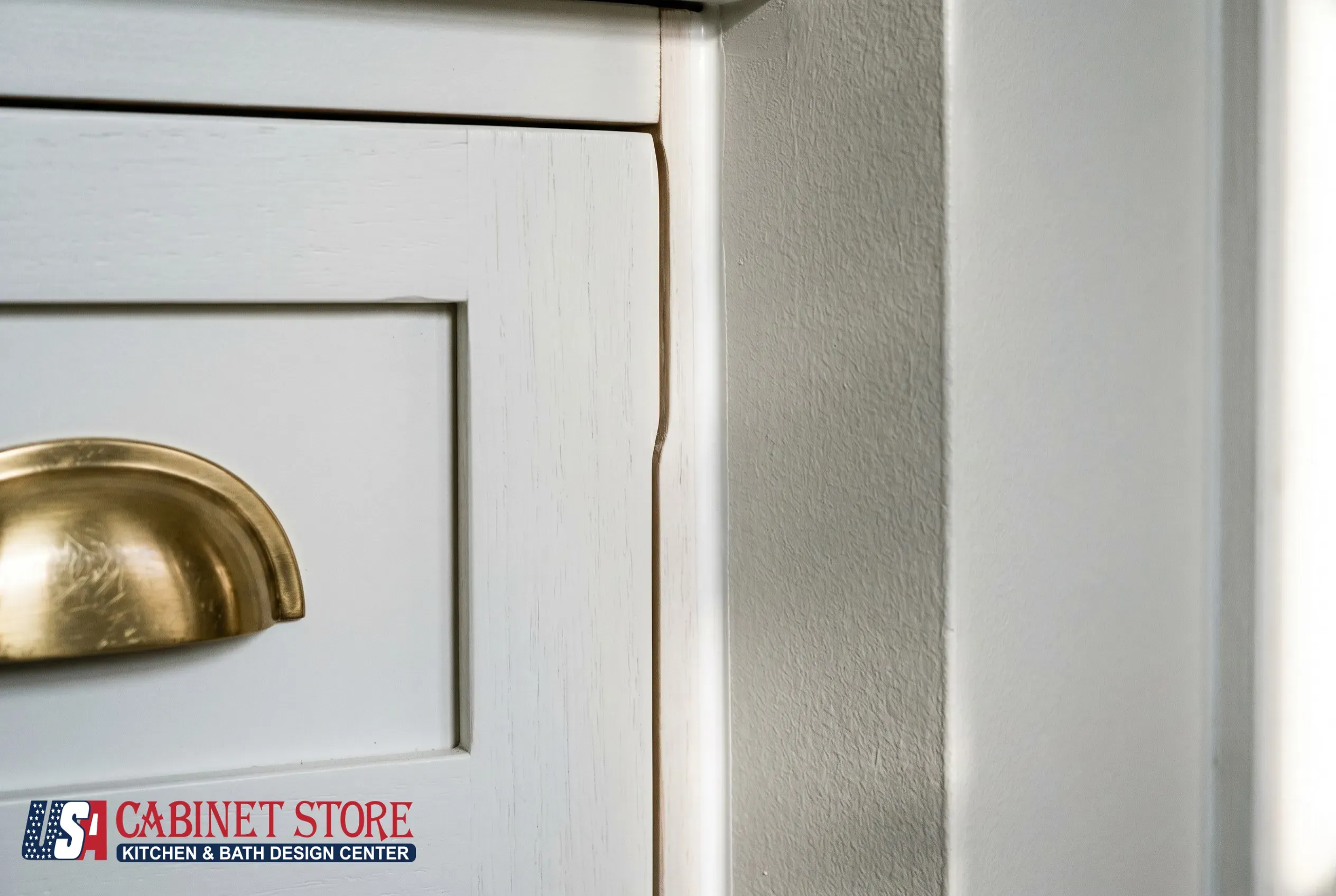
A real example: a 14 by 18 Windermere kitchen with 36 linear feet of cabinets, full custom inset Shaker in painted alabaster, dovetail drawers, all plywood boxes, a custom hood surround, and integrated paneled refrigerator and dishwasher cabinets. Cabinets came to $74,500. Install labor and trim-out came to $11,800. Total cabinet line: $86,300.
Where Every Dollar Goes (NKBA-Style Allocation)?
For a $30,000 mid-range Orlando kitchen cabinet installation, the National Kitchen and Bath Association budget allocation looks like this:
| Category | % of Total | $ on a $30K Project |
|---|---|---|
| Cabinet materials | 60% | $18,000 |
| Cabinet install labor | 20% | $6,000 |
| Demo and disposal | 5% | $1,500 |
| Drywall, leveling, paint touch-up | 5% | $1,500 |
| Hardware (pulls, knobs, soft-close upgrades) | 4% | $1,200 |
| Permits, project management, contingency | 6% | $1,800 |
These percentages shift with kitchen size. On a $75,000 custom job, cabinet materials climb to 70 percent and install labor drops to 15 percent in relative terms, because the boxes get more expensive faster than the install crew’s hours do. On a stock job, install labor is closer to 35 percent because the boxes are cheap.
The Hidden Line Items on Every Orlando Cabinet Quote
The Reddit complaint that comes up over and over is bid opacity. A lump-sum “Cabinets: $22,000” line on a contract tells you nothing. Here are the line items that should appear on every Orlando cabinet installation quote, with typical 2026 ranges from the City of Orlando market.
- Cabinet line and door style by SKU: priced per cabinet or per linear foot
- Filler strips, scribe pieces, and crown molding: $2 to $10 per linear foot installed
- Toe-kick and toe-kick wrap: usually folded into install labor
- Demo of existing cabinets and disposal: $300 to $1,000 (more for plaster walls)
- Drywall repair after demo (almost always required): $200 to $900
- Leveling and shimming for out-of-plumb walls or sloped floors: $200 to $600
- Electrical relocation (outlet behind microwave, range hood, under-cabinet circuit): $50 to $100 per hour, usually 4 to 8 hours
- Plumbing move (shifting sink position, dishwasher line, ice-maker tap): $45 to $200 per hour
- Soft-close hardware upgrade if not standard: $20 to $200 per cabinet
- Cabinet hardware (knobs and pulls): $300 to $1,900 across the kitchen
- Permit fees if plumbing or electrical changes: $50 to $400
- Project management or supervision percentage: 8 to 12 percent of materials and labor
- Contingency: 10 to 15 percent of subtotal
If your bid does not break these out, ask. Every reputable Orlando cabinet installer will hand you an itemized quote on request. Vague bids almost always mean the contractor is leaving room to raise prices once your kitchen is already torn apart.
Get one itemized quote at USA Cabinet Store Orlando. Our designers price the cabinet line, the hardware, the soft-close upgrades, the demo, the install labor, and the freight on one page so you can compare it line-by-line against any other quote you bring through the door. Book a complimentary consultation.
One Designer. One Quote. One Install Crew.
USA Cabinet Store Orlando designs, supplies, and installs. The same person who measures your kitchen places the order, supervises delivery, and walks the punch list on the last day.
Cabinet Box Construction: What Actually Survives Florida Humidity
This is the section most cabinet websites skip. It is also the section that determines whether your kitchen still looks tight in year 12 or has swollen drawer fronts and delaminated edges by year 5.
Plywood vs Particle Board vs MDF
Plywood is layers of wood veneer cross-banded and glued. The cross-banding gives it dimensional stability through wet and dry cycles. Particle board is wood chips and resin pressed into a sheet. MDF is finer particles and resin pressed into a smoother sheet. In a dry climate, all three perform fine. In Orlando, the difference shows up fast.
The Florida Climate Center at Florida State University records Orlando’s average morning relative humidity at around 88 percent. A 2016 study in the Journal of Wood Science measured stiffness in plywood and particle board panels through repeated humidity cycles. Particle board lost between 50 and 80 percent of its original stiffness across cycles. Plywood held. That is the whole argument in one sentence.
The real-world failure modes in Florida kitchens:
- Particle board under-sink cabinets fail within 2 to 3 years when there is even a slow drip or steam leak
- Standard particle board boxes start to warp visibly within 3 to 5 years of normal use
- MDF doors are stable as long as the painted finish stays sealed, but a chipped edge wicks moisture and starts the same swell cycle
- Plywood holds dimensional stability for decades, refinishes well, and accepts new hinges if hardware ever has to be moved
The trade-off is price. Particle board cabinets cost roughly 30 to 50 percent less than plywood cabinets of the same footprint. Stock-tier cabinets are almost always particle board. Semi-custom and custom tier cabinets in Florida should always be 1/2-inch or 3/4-inch plywood boxes.
Why ¾-Inch Plywood Boxes Are the USA Cabinet Store Florida Standard
The 3/4-inch plywood box is the spec USA Cabinet Store designers default to for every Orlando and Tampa project. The thicker panel resists racking during installation, holds heavy quartz tops without sag, takes a wall-mount screw without splitting, and survives 600-pound load testing under KCMA A161.1. A 1/2-inch back panel reduces twist by about 40 percent compared to a 1/4-inch back. The math is boring. The result is a kitchen that stays square through the next 15 hurricane seasons.
Dovetail Drawers, Soft-Close, and Full-Extension Glides
The drawer is where you find out how well a cabinet was actually made. The professional standard in 2026 is 5/8-inch solid hardwood dovetail drawer boxes with a plywood bottom captured in a dado groove. That construction supports 100 pounds and survives 100,000-plus cycles in KCMA testing. The economy version is a 1/2-inch particle board drawer with stapled corners that supports 50 to 75 pounds and starts to come apart around cycle 25,000.
Soft-close, full-extension, undermount glides are now table stakes in semi-custom and custom tiers. They cost the supplier about $15 more per drawer to install than friction glides, and they are the single biggest reason cabinets feel premium when you open them in a showroom.
KCMA A161.1: What the Testing Standard Actually Tests
KCMA stands for Kitchen Cabinet Manufacturers Association. The A161.1 standard is the only performance-based cabinet testing protocol in the United States. To earn KCMA certification, a cabinet line has to survive these tests in an independent lab:
- Doors opened and closed through a full 90-degree swing for 25,000 cycles
- Wall cabinets loaded with 600 pounds for 7 days with no visible deflection
- Drawer boxes loaded with 100 pounds through 100,000 cycles
- Door, drawer, and box finishes survive chemical resistance tests against household cleaners, vinegar, mustard, coffee, and water
- Joints and hinges show no looseness after the cycle test ends
If the cabinet line you are buying does not say KCMA certified, ask why. The certification mark on the inside of a sample cabinet at the showroom is your fastest read on whether the line is built to last.
Cabinet Installation Timeline: Order to Final Punch List
The headline number most homeowners get wrong is the install. Cabinet install itself is 3 to 7 days. The full project, from signed contract to first cup of coffee in the new kitchen, is 6 to 16 weeks depending on your cabinet tier.
Stock and RTA: 1–3 Weeks Total
Order today, cabinets arrive within 2 weeks, install crew shows up 2 to 3 days, you are cooking by the end of week 3. The trade-off: filler strips, particle board boxes, and limited finish choices.
Semi-Custom: 6–10 Weeks Total
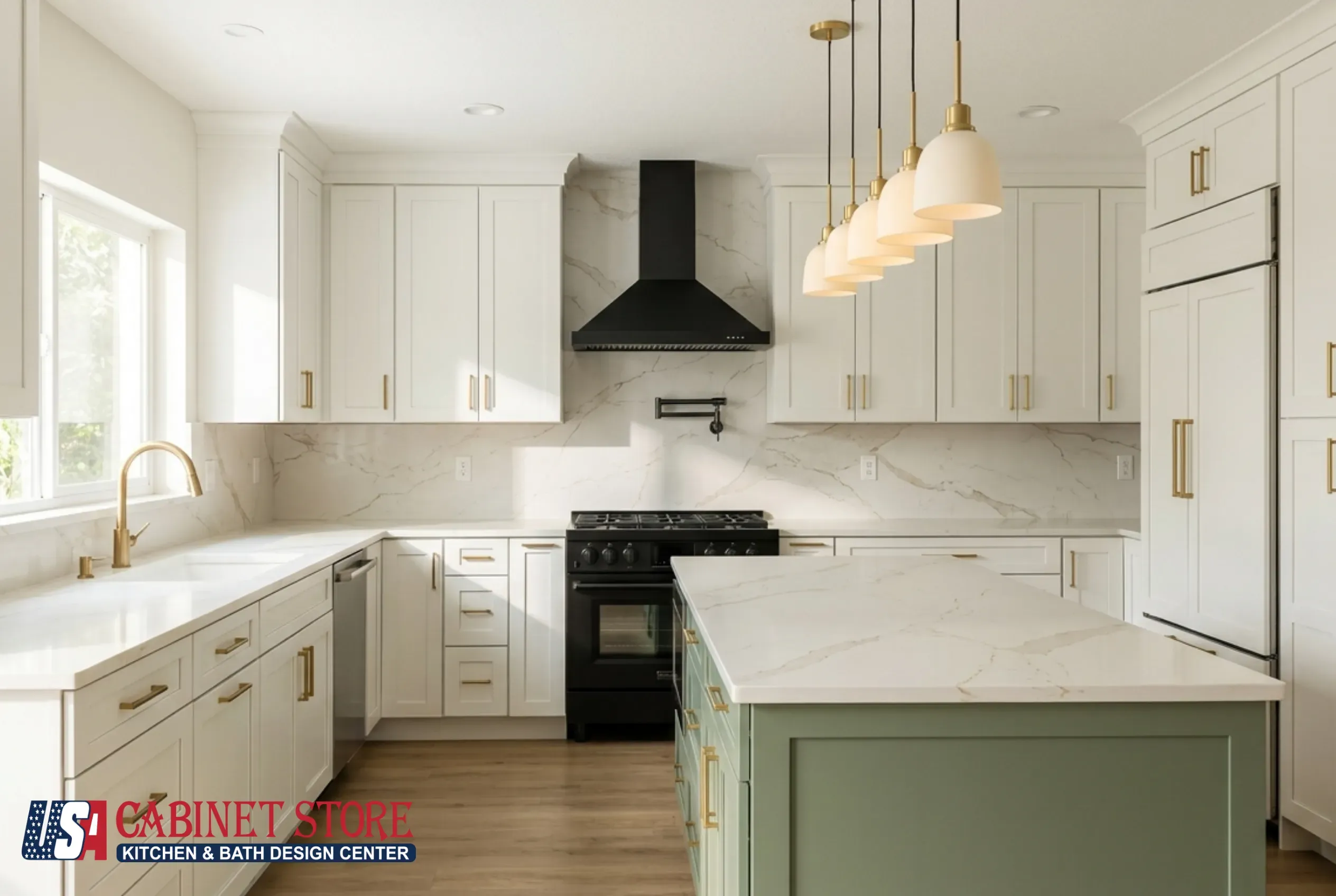
Design, measure, and sign-off: weeks 1 to 2. Cabinet manufacturing and freight: weeks 3 to 8. Install: 4 to 5 working days. Punch list and final walkthrough: 1 week. Total: roughly 8 weeks for most Orlando kitchens in the semi-custom tier.
Custom: 11–16 Weeks Total
Design, measure, render, and sign-off: weeks 1 to 3. Shop build time at the cabinet maker: weeks 4 to 13. Finish curing: 1 week. Install and trim-out: 5 to 7 working days. Punch list: 1 week. Total: roughly 14 weeks for a Windermere or Dr. Phillips custom kitchen.
Hurricane-Season Freight Risk (June–November)
The single most-ignored timeline factor for Orlando kitchens is hurricane freight. Most semi-custom cabinet lines ship into Florida through the Jacksonville port and rail yards. Storm warnings reroute freight by 3 to 10 days at a time. Ordering your cabinets in late May for an August install date is fine. Ordering in early August for an October install date is rolling the dice on a single named storm pulling your trucks off the I-95 corridor. The fix is to order earlier in the cycle and build 2 weeks of float into the schedule between the planned delivery and the planned demo day. The Wk1 Orlando kitchen remodel timeline covers this trade-off in more depth.
What the 3–7 Day “Install Week” Actually Looks Like
Day 1: Cabinets delivered, unwrapped, inventoried, and staged by elevation. Layout lines drawn on the wall. Old appliances pulled. Floor and counter protection installed.
Day 2: Upper cabinets installed first (easier to work without bases in the way), leveled with a laser, anchored into studs with structural cabinet screws.
Day 3: Base cabinets installed, leveled, and shimmed where needed. Plumbing and electrical confirmed to land in the correct cabinet bay.
Day 4: Crown, toe-kick, scribe pieces, fillers, and panel returns installed. Hardware drilled and mounted.
Day 5: Punch list. Doors aligned, drawers adjusted, soft-close tested cabinet by cabinet, touch-up paint, final cleanup.
Days 6 to 7: Countertop template, then countertop install 5 to 10 days after template. This is technically a separate trade visit.
Do You Need a Permit to Install Kitchen Cabinets in Orlando?
Under the Florida Building Code, 8th Edition (2023), a like-for-like cabinet swap that does not touch plumbing or electrical is generally exempt from permit. Most of the cabinet-only projects in the City of Orlando fall into that exempt zone. The minute your cabinet install pulls in a new electrical circuit, moves an outlet, or shifts the sink, you are inside the permitted-work zone.
Cabinet-Only Swap → No Permit
If the new cabinets land in the same footprint, the same sink stays in the same hole, no new under-cabinet lighting circuits are added, and no walls are touched, you do not need a permit from the City of Orlando Building Department. Verify with your installer; if you are uncertain, the Permitting Services Division line is 407.246.2271.
Adding Electrical or Moving a Sink → Permit
Adding a dedicated under-cabinet LED circuit, an outlet inside an island, a microwave-drawer circuit, or a new range hood vent run triggers an electrical permit. Moving the sink, even 8 inches sideways, triggers a plumbing permit. Both are processed through the Orange County Fast Track portal for unincorporated Orange County or the City of Orlando portal for properties inside city limits.
Notice of Commencement
Florida statute requires a Notice of Commencement (NOC) filed with the Orange County Comptroller before construction starts on any project over $2,500 for plumbing or electrical, or $5,000 for general building work. The NOC protects you against unrecorded liens later. Your installer should handle the filing as part of the contract; if they do not, you can file directly with the Orange County Comptroller’s office. Missing this step delays inspections and can leave you exposed to subcontractor lien claims if the contractor goes under during the job.
Permit Decision Quick Table
| Scope | Permit Type | Typical Cost |
|---|---|---|
| Cabinet swap, same layout, no electrical or plumbing change | None | $0 |
| Add under-cabinet LED circuit | Electrical | $50–$150 |
| Move sink or dishwasher line | Plumbing | $80–$200 |
| New island with sink and electrical | Combo (plumbing + electrical) | $150–$400 |
| Wall removed or structural change | Building (sealed plans required) | $300+ |
Designing Your Cabinet Layout to NKBA Standards
The National Kitchen and Bath Association publishes the planning rules every certified kitchen designer in the United States follows. If your installer cannot tell you the work-aisle minimum or the cooking-surface clearance, find a different installer. Here are the numbers that matter most for Orlando kitchens.
- Work triangle (sink, range, refrigerator): each leg 4 to 9 feet, total perimeter under 26 feet
- Work-aisle clearance: 42 inches for one cook, 48 inches for two cooks (Orlando families almost always want 48 inches)
- U-shape kitchen: minimum 60 inches between opposing arms
- Cooking-surface clearance: 24 inches above for a protected non-combustible surface, 30 inches above for an unprotected surface
- Doorway: 32 inches minimum, 36 inches for aging-in-place
- Countertop frontage: 158 inches of 24-inch deep counter, with at least 15 inches of clear landing space above
These rules are why semi-custom and custom shine in Orlando kitchens with odd dimensions. Stock cabinets force you to break NKBA clearances when wall lengths fight the catalog increments. Semi-custom lets you adjust 1 inch at a time to keep the work aisle at 48 inches and the U-shape opening at 60 inches.
How USA Cabinet Store Orlando Handles Installation?
USA Cabinet Store designs, supplies, and installs kitchen cabinets from one Orlando showroom. The same designer who draws your render is the same person who measures your kitchen, orders your cabinets, supervises delivery, and walks the install crew through the punch list. That is the answer to the Reddit pain point about not wanting to become your own general contractor: you stay involved in the decisions, we manage the details.
The process:
- Free consultation at the Orlando showroom or in your home
- Field measure visit by a USACS designer (catches the out-of-plumb wall, the load-bearing post, the offset water line)
- 3D render and itemized quote within 5 business days
- Final sign-off and cabinet order placement
- Cabinet manufacture (4 to 8 weeks semi-custom, 8 to 14 weeks custom)
- Pre-delivery site walk (verify electrical and plumbing are ready)
- Install (3 to 7 days)
- Punch list and final walkthrough with photo documentation
USA Cabinet Store earned the NKBA Innovative Showroom Award at KBIS 2026, which recognizes design-and-supply showrooms that bring innovative process and product education to homeowners. The Orlando location carries Fabuwood, Forevermark, Waypoint, and select custom lines, all built with 3/4-inch plywood boxes and KCMA-certified construction for Florida humidity.
The Tampa sister showroom serves the I-4 corridor and overlaps Orlando’s western suburbs (Winter Garden, Apopka). If your project is in Lake Nona or Winter Park, start at the Orlando showroom. If you are in Clermont or Winter Garden, the Tampa team can serve you out of either location.
Choosing Between Custom and Semi-Custom for Your Orlando Kitchen
If you remember nothing else from this guide, take this decision flow.
Question 1: Are your kitchen walls plumb (no more than 1/4-inch out over a 10-foot run) and your cabinet run a clean rectangle without odd corners?
- Yes → Semi-custom will fit and finish beautifully. Skip to Q3.
- No → Read Q2.
Question 2: Do you have an oddly shaped corner, a slanted ceiling, a non-standard wall length, or a layout you want to optimize down to the inch?
- Yes → Custom is worth the price premium and the longer lead time.
- No → Semi-custom with adjusted filler strategy will work fine.
Question 3: Are you remodeling for resale within the next 2 years?
- Yes → Semi-custom delivers the best ROI in the Orlando market. The 2025 Zonda Cost vs. Value Report shows mid-range kitchen remodels in the South Atlantic region recouping 70 to 82 percent at resale, while major upscale kitchens recoup 36.3 percent. Do not over-invest if you are selling.
- No → Read Q4.
Question 4: Are you staying 5+ years and do you want every inch of your kitchen optimized?
- Yes → Custom is worth it. The lifetime cost of a $75,000 custom kitchen over 25 years is $3,000 per year. The lifetime cost of replacing a $25,000 semi-custom kitchen twice over 25 years is $2,000 per year, plus two full demolitions and two months of takeout.
- No → Semi-custom is the right call.
Most Orlando homeowners land on semi-custom. The combination of KCMA-certified construction, plywood boxes, 1-inch width adjustability, soft-close hardware, and a 4 to 8 week lead time matches both the local home stock and the typical Orlando remodel budget. Custom is correct when the layout genuinely needs it or when you are building for the long term in a luxury neighborhood.
Frequently Asked Questions About Kitchen Cabinet Installation in Orlando
How much does kitchen cabinet installation cost in Orlando in 2026?
The average Orlando installation labor alone runs $3,657 to $5,383 per kitchen, based on 260 completed projects in the Orlando area through May 2026. Total cabinet line cost (cabinets plus install) lands at $4,000 to $13,000 for stock, $15,000 to $35,000 for semi-custom, and $35,000 to $90,000+ for custom in a typical 24 linear-foot kitchen.
What is the difference between stock, semi-custom, and custom kitchen cabinets?
Stock cabinets are mass-produced in fixed sizes, ship fast, cost less, and offer limited style choices. Semi-custom cabinets are factory-built but allow size adjustments in 1/4 or 1-inch increments and a wider catalog of finishes and door styles, with plywood box construction and dovetail drawers. Custom cabinets are built locally to exact specifications with unlimited design flexibility, premium materials, and 8 to 14 week lead times.
Do I need a permit to install kitchen cabinets in Orlando?
A like-for-like cabinet swap with no plumbing or electrical change is generally exempt from permit under the Florida Building Code, 8th Edition. Adding a new electrical circuit, moving the sink, installing under-cabinet lighting, or any structural change requires a permit from the City of Orlando Building Department or Orange County Fast Track portal. If your scope exceeds $2,500 for plumbing or electrical, file a Notice of Commencement with the Orange County Comptroller before work starts.
How long does kitchen cabinet installation take from order to finished?
Stock cabinets: 1 to 3 weeks total. Semi-custom: 6 to 10 weeks total. Custom: 11 to 16 weeks total. The install work itself is 3 to 7 days regardless of tier; the rest of the timeline is design, manufacturing, and freight. Hurricane season (June through November) can add 1 to 2 weeks of freight delay risk for any cabinet line shipped through Jacksonville.

Are plywood cabinets really better than particle board in Florida humidity?
Yes, and the gap matters more in Orlando than in drier climates. The Florida Climate Center records 88 percent average morning humidity. Studies in the Journal of Wood Science show particle board panels lose 50 to 80 percent of their stiffness across repeated humidity cycles, while plywood holds. Particle board cabinets under sinks typically fail within 2 to 3 years in Florida, and the rest of the kitchen starts to warp visibly within 3 to 5 years. Plywood boxes hold dimensional stability for 20 years or more.
What does KCMA certification on a kitchen cabinet actually mean?
KCMA A161.1 is the industry’s only performance-based cabinet testing standard. A KCMA-certified cabinet has survived 25,000 door cycles, 600 pounds of wall-cabinet loading over 7 days, 100,000 drawer cycles at 100 pounds, and chemical resistance tests against household cleaners, vinegar, mustard, and water. If you cannot find the KCMA mark on the inside of a sample cabinet, ask the supplier why. Most reputable semi-custom and custom lines carry the certification.
Can USA Cabinet Store install cabinets I bought somewhere else?
USA Cabinet Store specializes in design, supply, and install as one integrated service. Installing cabinets purchased elsewhere is possible but rare; the warranty and quality control benefits of buying and installing through the same supplier are why most Orlando homeowners use us for both. If you have already purchased cabinets, book a complimentary consultation and we can advise on whether your project is a fit.
Start Your Orlando Cabinet Installation the Right Way
Choose your cabinets and visit a showroom before you sign any contract. Cabinet dimensions drive plumbing rough-in, electrical placement, countertop cuts, lighting locations, and appliance specifications. Choosing your installer first and cabinets second is the most common reason Orlando kitchen projects run over budget and over schedule.
At USA Cabinet Store Orlando, you can see Fabuwood, Forevermark, Waypoint, and select custom lines side-by-side under one roof, with KCMA-certified construction and 3/4-inch plywood boxes built for Florida humidity. The Orlando designer who walks you through the showroom is the same person who measures your kitchen, places your order, supervises your install, and walks the punch list with you on the last day.
Book a complimentary consultation at the Orlando showroom, bring your floor plan or a few photos, and walk out the same afternoon with a designer-prepared scope and a real budget range. We also serve Tampa, Winter Park, Lake Nona, Dr. Phillips, Maitland, Baldwin Park, Windermere, and the rest of Central Florida from the Orlando location.
For broader context on the full kitchen remodel timeline, read the Orlando kitchen remodel guide. For national-average kitchen remodel pricing, see How much does a kitchen remodeling cost in 2026?. For deeper cabinet box comparisons, the framed vs frameless cabinet guide explains how construction affects fit and style.
When you are ready to start, USA Cabinet Store Orlando is the single source for design, semi-custom and custom cabinet supply, and professional installation in Central Florida. Kitchen cabinet installation in Orlando works best when one team handles it end to end, and that is what we do across 16 showrooms in 8 states, including Orlando and Tampa.
Book Your Free Design Consultation · Visit the Orlando Showroom