
Bathrooms destroy cheap materials. Steam from every shower, water splashing around the sink, humidity lingering for hours — all of it targets your cabinets. Pick the wrong wood and you’re staring at warped doors, peeling finish, and mold creeping into the grain within a few years.
Pick the right species, and your vanity will outlast two or three rounds of tile trends.
The NKBA’s 2026 Bath Trends Report confirms that wood-faced vanities now outsell painted alternatives, with white oak and walnut emerging as the dominant species for 2026. That’s a meaningful shift — and it changes which species deserve your attention.
We build and install bathroom cabinets across 14 showrooms in the US. Our cabinetry team has worked with every wood species on this list — and several that didn’t make the cut. Here’s what we recommend based on real performance in real bathrooms.
2026 Expert Guide
Best Wood for Bathroom Vanity & Cabinets
8 Species Compared by Moisture Resistance, Hardness & Price
Why it matters: Bathrooms expose cabinets to daily humidity spikes, steam, and water contact. The right wood species resists warping, mold, and decay for 20–50 years. The wrong one fails in under 5.
🏆 Top 3 Picks for 2026
Teak
Natural oil protection
Janka: 1,070 lbf
Moisture: ★★★★★
Price: $$$$
White Oak
Tyloses block water
Janka: 1,360 lbf
Moisture: ★★★★½
Price: $$–$$$
Walnut
Rich dark luxury
Janka: 1,010 lbf
Moisture: ★★★½
Price: $$$–$$$$
Full Comparison — All 8 Species
| Species | Janka (lbf) | Moisture | Price | Best For | Lifespan |
|---|---|---|---|---|---|
| 🌳 Teak | 1,070 | ★★★★★ | $$$$ | Luxury, spa, high-humidity | 30–50+ yr |
| 🌳 White Oak | 1,360 | ★★★★½ | $$–$$$ | Modern, Scandi, all-around | 25–40 yr |
| 🌳 Walnut | 1,010 | ★★★½ | $$$–$$$$ | Luxury, mid-century | 20–35 yr |
| 🌳 Hard Maple | 1,450 | ★★★ | $$–$$$ | Contemporary, painted cabs | 20–30 yr |
| 🌳 Cherry | 950 | ★★½ | $$–$$$ | Traditional, aging patina | 20–30 yr |
| 🌳 Birch | 1,260 | ★★★ | $–$$ | Budget builds, painted | 15–25 yr |
| 🌳 Hickory | 1,820 | ★★★ | $$ | Rustic, high-traffic family | 25–40 yr |
| 🌼 Bamboo | 3,000+ | ★★★½ | $–$$ | Eco-modern, Zen | 15–25 yr |
$ = $30–60/sq ft · $$ = $60–100 · $$$ = $100–150 · $$$$ = $150+
💪 Janka Hardness Scale — Visual Comparison
Bamboo
3,000+
Hickory
1,820
Hard Maple
1,450
White Oak
1,360
Birch
1,260
Teak
1,070
Walnut
1,010
Cherry
950
Janka hardness measures resistance to denting (lbf). Higher = harder surface. Note: Teak’s low Janka is offset by its natural oil protection.
🏠 Quick Pick by Bathroom Type
Master / Spa
Teak or Walnut
Kids / Family
Hickory or White Oak
Budget Remodel
Birch
Modern / Minimalist
Hard Maple
Eco-Conscious
Bamboo
Guest Bath
Cherry or Maple
⚠️ Material Hierarchy — What to Use & What to Avoid
Solid hardwood (doors/frames) + Marine-grade plywood (cabinet boxes) — 20–50 year lifespan
Moisture-resistant MDF (green core, painted doors only, well-ventilated baths) — 10–15 year lifespan
Standard MDF — swells on contact with moisture. 3–7 year lifespan in bathrooms.
Particle board — absorbs water rapidly, swells irreversibly, cannot be repaired. Walk away.
The Proven Formula
Hardwood door fronts + plywood cabinet boxes + quality sealant on all surfaces = a bathroom vanity that handles moisture, looks premium, and lasts 20+ years.
Source: NKBA 2026 Bath Trends Report · Janka Hardness Scale (Osborne Wood) · USA Cabinet Store cabinetry team
Why wood species matters in a bathroom
The concept that matters here is equilibrium moisture content (EMC) — the point where wood’s internal moisture balances with ambient humidity. Species with low EMC variation (teak, white oak) expand and contract less, which means less warping and cracking over time.
Three factors determine how any wood performs in your bathroom: density (measured by the Janka hardness scale), grain structure (open vs. closed pores), and natural oil or resin content. A species strong in all three — like teak — handles moisture almost effortlessly. A species weak in one area needs compensating via finish quality and ventilation.
Regardless of species, always specify kiln-dried lumber for bathroom cabinetry. Kiln-dried wood achieves a more uniform EMC that matches indoor conditions and reduces microbial growth risk. Air-dried lumber retains too much moisture for bathroom use.
Keep your bathroom between 40–60% relative humidity for maximum cabinet longevity. Run the exhaust fan during and after showers. Without proper ventilation, even teak will struggle.
At a glance: 8 wood species for vanities and cabinets compared
| Wood Species | Janka (lbf) | Moisture | Price | Best For | Rating | Style Match | Lifespan |
|---|---|---|---|---|---|---|---|
| Teak | 1,000–1,070 | ★★★★★ | $$$$ | Luxury High humidity |
🏆 Best overall | Spa Tropical |
30–50+ yr |
| White Oak | 1,360 | ★★★★½ | $$–$$$ | Modern Scandi |
🏆 2026 trend | Modern Transitional |
25–40 yr |
| Walnut | 1,010 | ★★★½ | $$$–$$$$ | Luxury Mid-century |
✅ Premium | Mid-century Luxury |
20–35 yr |
| Hard Maple | 1,450 | ★★★ | $$–$$$ | Contemporary Painted |
✅ Workhorse | Minimalist Modern |
20–30 yr |
| Cherry | 950 | ★★½ | $$–$$$ | Traditional Patina |
⚠️ Needs care | Traditional Warm |
20–30 yr |
| Birch | 1,260 | ★★★ | $–$$ | Budget builds | ✅ Best value | Painted Neutral |
15–25 yr |
| Hickory | 1,820 | ★★★ | $$ | Rustic Family baths |
✅ Toughest | Farmhouse Rustic |
25–40 yr |
| Bamboo | 3,000+ | ★★★½ | $–$$ | Eco-modern Zen |
✅ Sustainable | Zen Eco-modern |
15–25 yr |
Cost key: $ = $30–60/sq ft · $$ = $60–100 · $$$ = $100–150 · $$$$ = $150+
Species deep dives
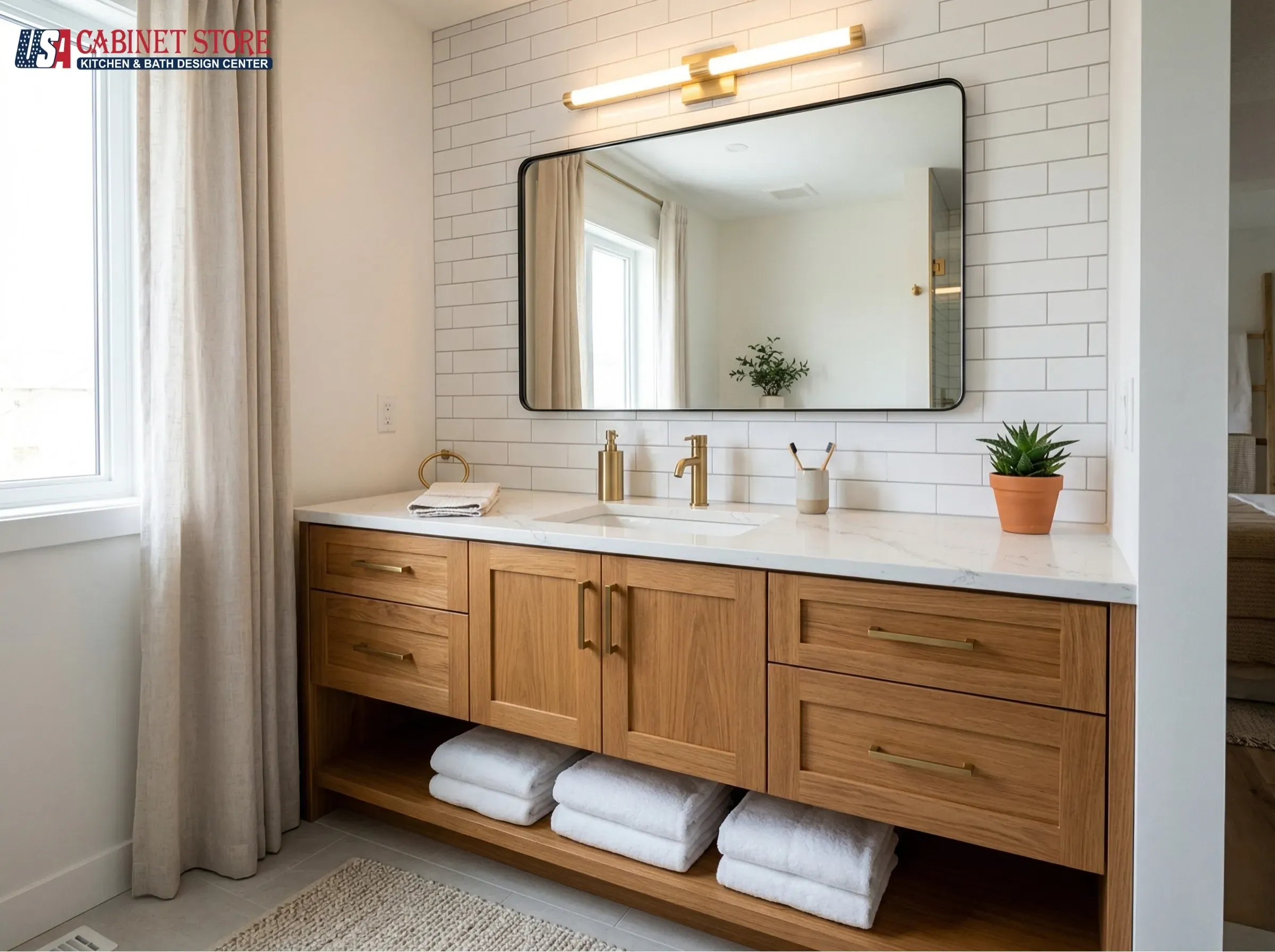
1. Teak — the gold standard for humidity
If moisture resistance is the only criterion, teak wins outright. No debate.
Teak heartwood is saturated with natural oils that actively repel water and inhibit decay. Shipbuilders have relied on this property for centuries. Those same oils protect against insect damage, scratches, and rot — giving teak a level of inherent protection no other hardwood matches without artificial treatment.
The grain is tight and even, with a warm golden-brown color that deepens into honey tones over the years. Left unoiled, teak develops a silvery-grey patina. Most homeowners prefer to apply teak oil annually to maintain the original warmth.
The catch is price and supply. Teak costs 2–3x more than oak or maple, and sustainability is a real concern. Always verify FSC-certified sourcing. Counterfeit teak products are common in the cabinet market — if the price seems too good, it probably is.
Best finish: Penetrating teak oil. Avoid film-forming finishes (polyurethane, lacquer) — they can peel off teak’s oily surface.
Best for: Master bathrooms with poor ventilation, steam showers, spa-inspired designs, coastal homes.
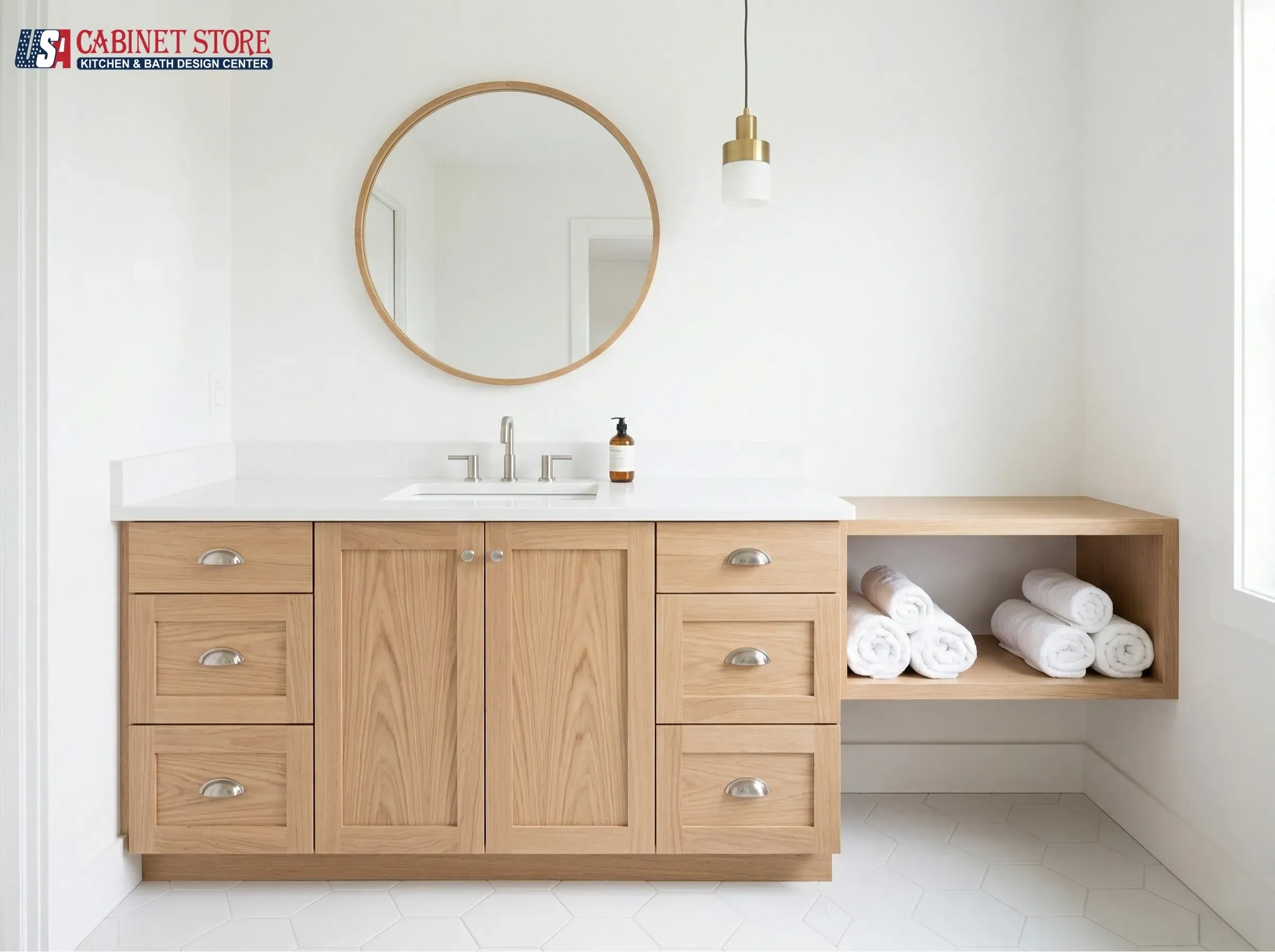
2. White oak — the 2026 standout
White oak is the #1 trending species for bathroom vanities in 2026, driven by Scandinavian and modern design aesthetics. But the trend isn’t just about looks — white oak has a biological advantage that makes it genuinely superior in wet environments.
The reason: tyloses. These are microscopic blockages within the wood’s vessels that physically limit water penetration at the cellular level. Red oak lacks these blockages — its open pores actively absorb moisture, making it prone to staining, swelling, and rot in bathrooms.
At 1,360 Janka, white oak is harder than red oak (1,220) and very resistant to everyday denting and scratching. The light, neutral tone and visible cathedral grain complement stone countertops and metallic fixtures — exactly the spa-like aesthetic dominating 2026 bathroom design.
Important: Avoid red oak for bathroom cabinet boxes. Its reedy, open pore structure absorbs moisture readily. Red oak belongs in dry interior spaces.
Best for: Modern, Scandinavian, transitional bathrooms. Pairs beautifully with quartz countertops and brushed brass fixtures.
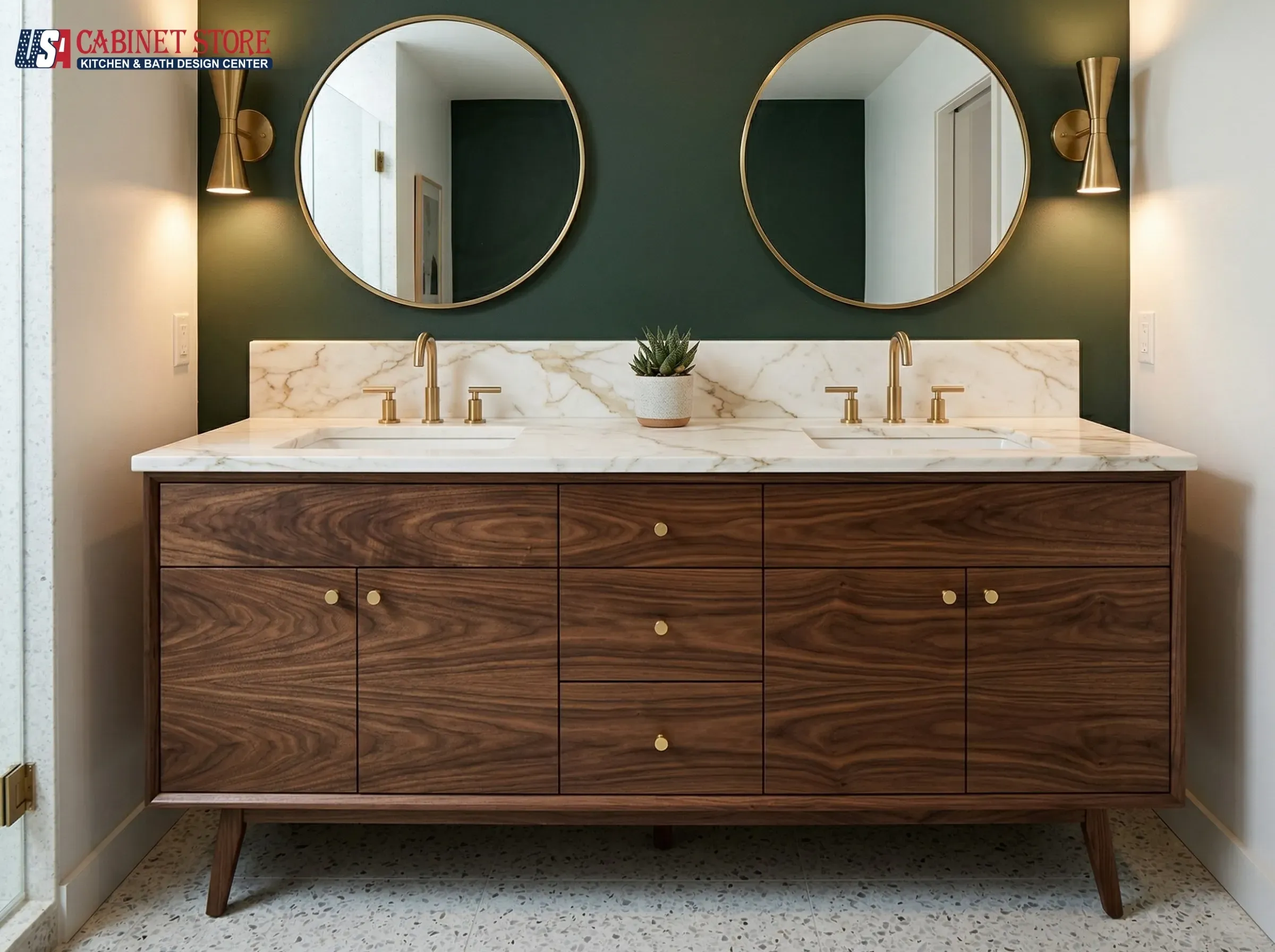
3. Walnut — luxury meets warmth
American black walnut is the second-leading 2026 bathroom trend species, prized for its rich chocolate-brown tones and sweeping grain. If you want your bathroom to feel like a high-end hotel, walnut delivers that mood instantly.
As a dense hardwood (1,010 Janka), walnut withstands dents, dings, and scratches effectively — meaningful in family bathrooms with heavy daily use. It stains and polishes exceptionally well, and you can refinish it multiple times over its lifespan.
Walnut is not inherently waterproof. Proper sealing is non-negotiable in bathroom environments. The other vulnerability is sunlight — prolonged UV exposure bleaches walnut’s characteristic dark tones. Position your vanity away from direct window light, or use UV-filtering glass.
Best for: Luxury master baths, mid-century modern design, dark/moody color schemes, powder rooms.
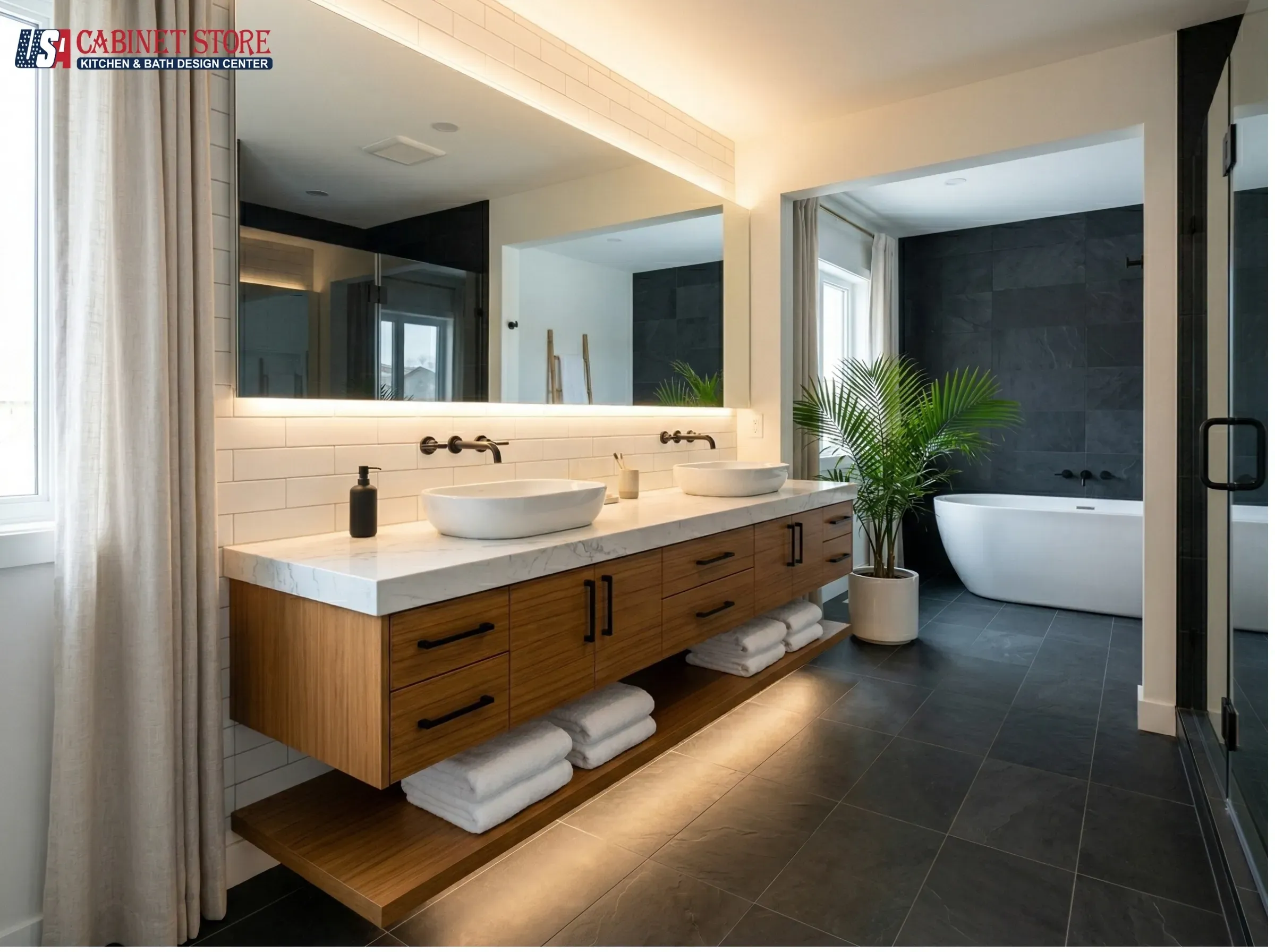
4. Hard maple — the hardest domestic workhorse
At 1,450 Janka, hard maple is one of the hardest domestic North American hardwoods — harder than white oak, cherry, and walnut. If durability against physical impact is your priority, maple delivers.
The tight, consistent grain produces an exceptionally smooth surface. That smoothness makes maple the top choice for painted bathroom cabinets. If you want white, grey, or any solid-color cabinet finish, maple gives you the cleanest, most uniform result.
Maple’s fine closed grain reduces moisture absorption compared to open-grained species, but it lacks teak’s or white oak’s inherent moisture resistance. Quality sealing is essential. And one critical finishing note: maple stains unevenly without pre-conditioning. If you want a stained maple vanity, use a wood conditioner first or expect blotchy results.
Best for: Contemporary and minimalist bathrooms, painted cabinets, homeowners who want a smooth uniform look.
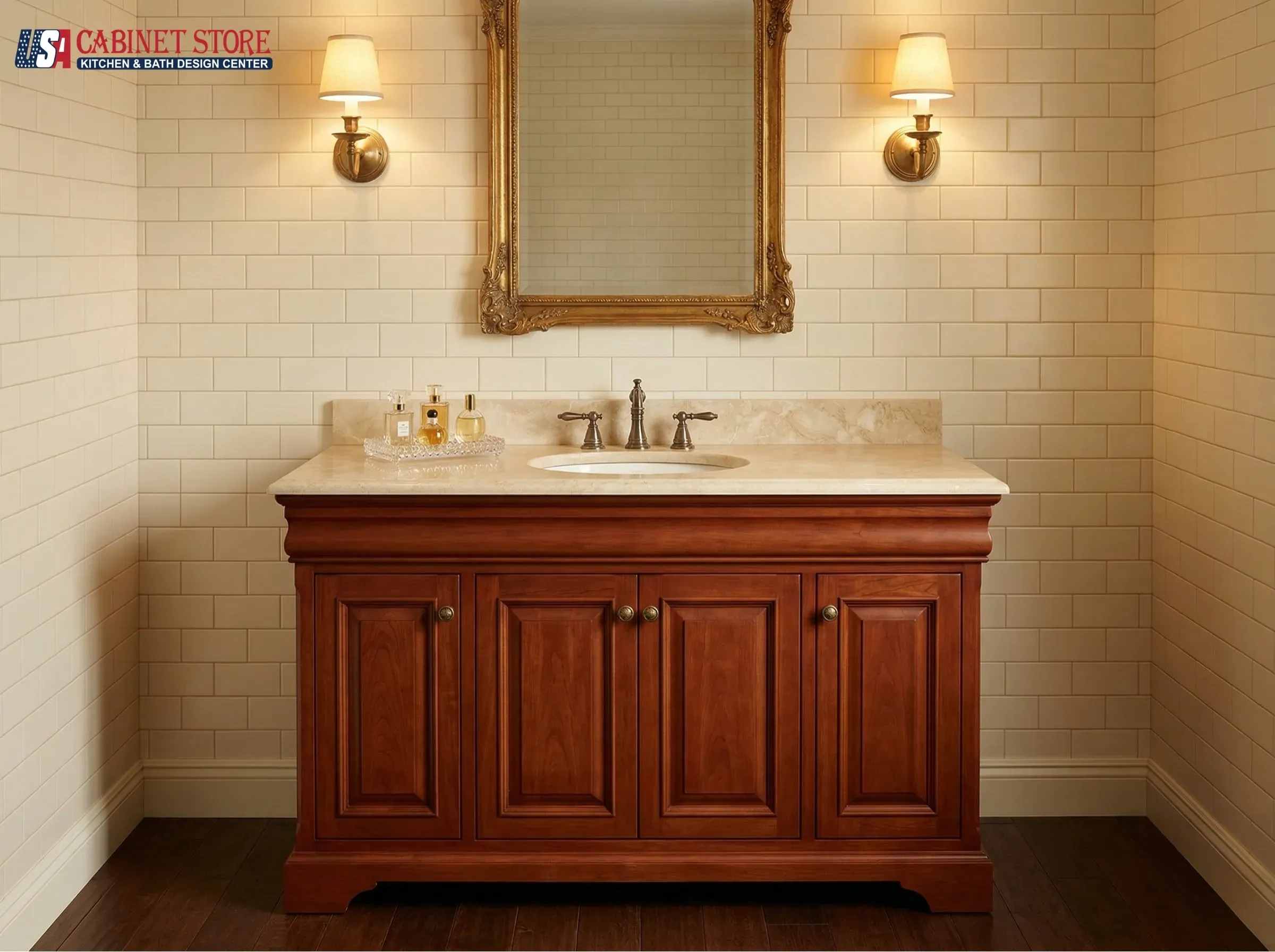
5. Cherry — high beauty, high maintenance
American black cherry is the most aesthetically coveted domestic hardwood for cabinetry. Its defining characteristic is a living patina: cherry starts pinkish-red and deepens over years into a rich, warm reddish-brown that no stain can replicate. For a bathroom you’ll use for decades, that evolving color is genuinely special.
The trade-offs are real. Cherry is not waterproof and will warp without thorough sealing. It fades under direct sunlight. Regular polishing and careful moisture management are required. At 950 Janka, it’s the softest hardwood on this list — adequate for a primary bath, but not ideal for a kids’ bathroom.
For primary baths with good ventilation and no direct sun exposure, cherry is beautiful. But it demands commitment that other species don’t.
Best for: Traditional bathrooms, homeowners who appreciate natural aging and patina, guest baths with lighter use.
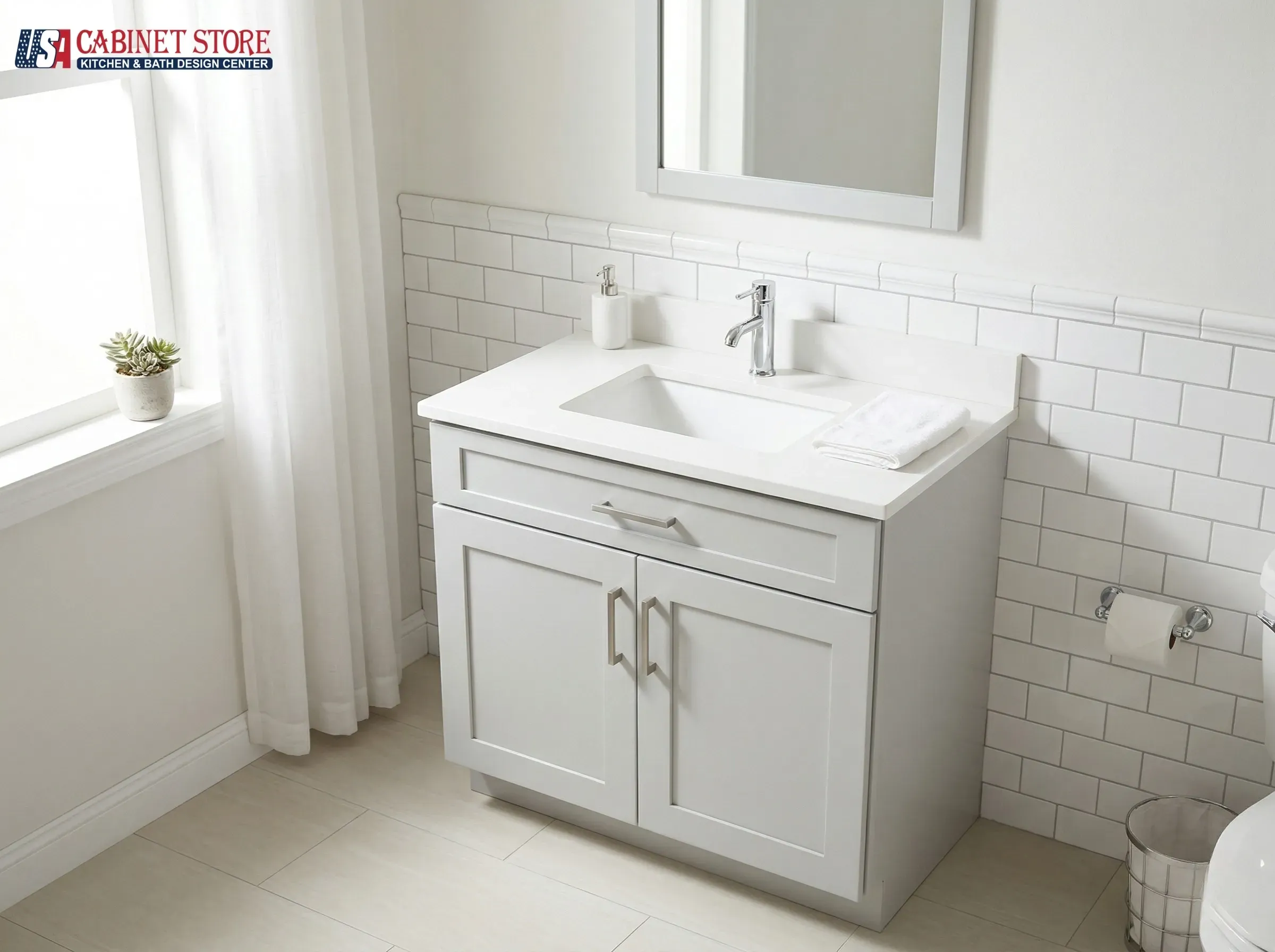
6. Birch — the smart budget pick
Not everyone needs teak or walnut. If you want genuine hardwood bathroom cabinets without a premium price tag, birch deserves serious consideration.
At 1,260 Janka and with a closed grain structure, birch is notably warp-resistant — a meaningful advantage in humid bathrooms. The pale, neutral color and smooth surface make it one of the best paint-grade woods available alongside maple.
The weaknesses: birch scratches more easily than denser species, and its porosity causes blotchy staining. If you’re staining birch, use a pre-stain conditioner. Better yet, paint it — birch takes paint beautifully and costs significantly less than cherry, walnut, or teak.
Best for: Budget renovations, guest baths, rental properties, painted or whitewashed vanity designs.
7. Hickory — the toughest wood in the room
At 1,820 Janka, hickory is the hardest domestic hardwood available for cabinetry. Nothing dents it. Nothing scratches it easily. For high-traffic family bathrooms where doors get slammed and products get dropped daily, hickory will shrug it off.
The look is distinctive: bold, high-contrast grain with dramatic color variation from creamy white to dark brown, often within the same board. You either love it or you don’t. Hickory doesn’t do subtle. It works beautifully in farmhouse and industrial-style bathrooms, but feels out of place in minimalist or Scandinavian designs.
Moisture resistance is moderate rather than exceptional, so proper sealing remains important. The price sits in the mid-range, though availability varies by region.
Best for: Farmhouse and rustic bathrooms, high-traffic family baths, homeowners who prioritize maximum scratch resistance.
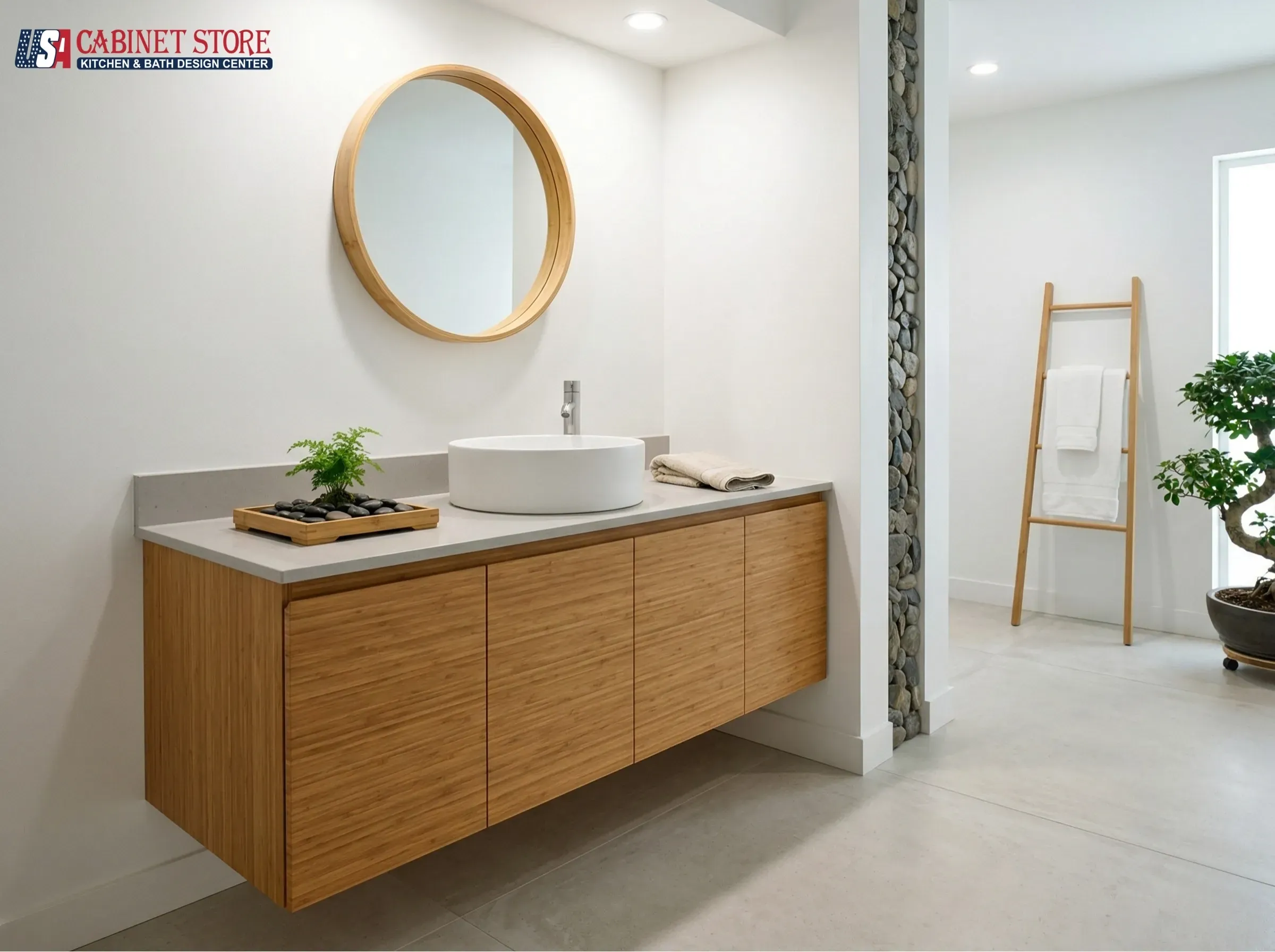
8. Bamboo — the eco-modern alternative
Technically a grass, not a wood. But strand-woven bamboo performs comparably to hardwood in cabinet applications and deserves a spot on this list — especially for eco-conscious projects.
Strand-woven bamboo achieves extraordinary hardness, often exceeding 3,000 Janka in manufacturer testing. The tight, compressed structure resists humidity-driven warping better than many open-grained woods. As a fast-growing material (harvested every 3–5 years vs. 40–80 years for hardwoods), its environmental footprint is dramatically smaller.
The limitation: bamboo is a glue-laminated product (individual strips bonded together). Extended standing water exposure can compromise the bond lines. It’s moisture-resistant, not waterproof. Bamboo suits well-ventilated bathrooms without chronic splash exposure, and pairs naturally with Zen, eco-modern, and nature-inspired design schemes.
Best for: Eco-conscious builds, modern/Zen bathrooms, homeowners who prioritize sustainability without sacrificing hardness.
Moisture performance by finish type
The right finish amplifies any species’ natural moisture performance. For bathroom vanities, finishing choices matter as much as species selection:
| Finish Type | Protection | Appearance | Best Species Pairing |
|---|---|---|---|
| Oil-based polyurethane | ★★★★★ Best | Amber tint Adjustable sheen |
All species Maple, birch, cherry |
| Water-based polyurethane | ★★★★ Excellent | Crystal clear Natural tone |
White oak Walnut, maple |
| Penetrating / teak oil | ★★★½ Good | Natural Matte, breathable |
Teak Walnut, white oak |
| Oil + wax blend | ★★★ Moderate | Accentuates grain | Oak Cherry, walnut |
| Marine varnish | ★★★★ Strong | Glossy Hard film |
All species High-humidity baths |
Apply 2–3 coats, allowing full dry time between each. Inspect and touch up annually in high-use bathrooms. Maintain 40–60% RH via exhaust fans or dehumidifier.
Solid wood vs. plywood vs. MDF — which should you actually use?
Most bathroom “wood” cabinets aren’t 100% solid wood. Here’s how professional cabinet construction works in practice:
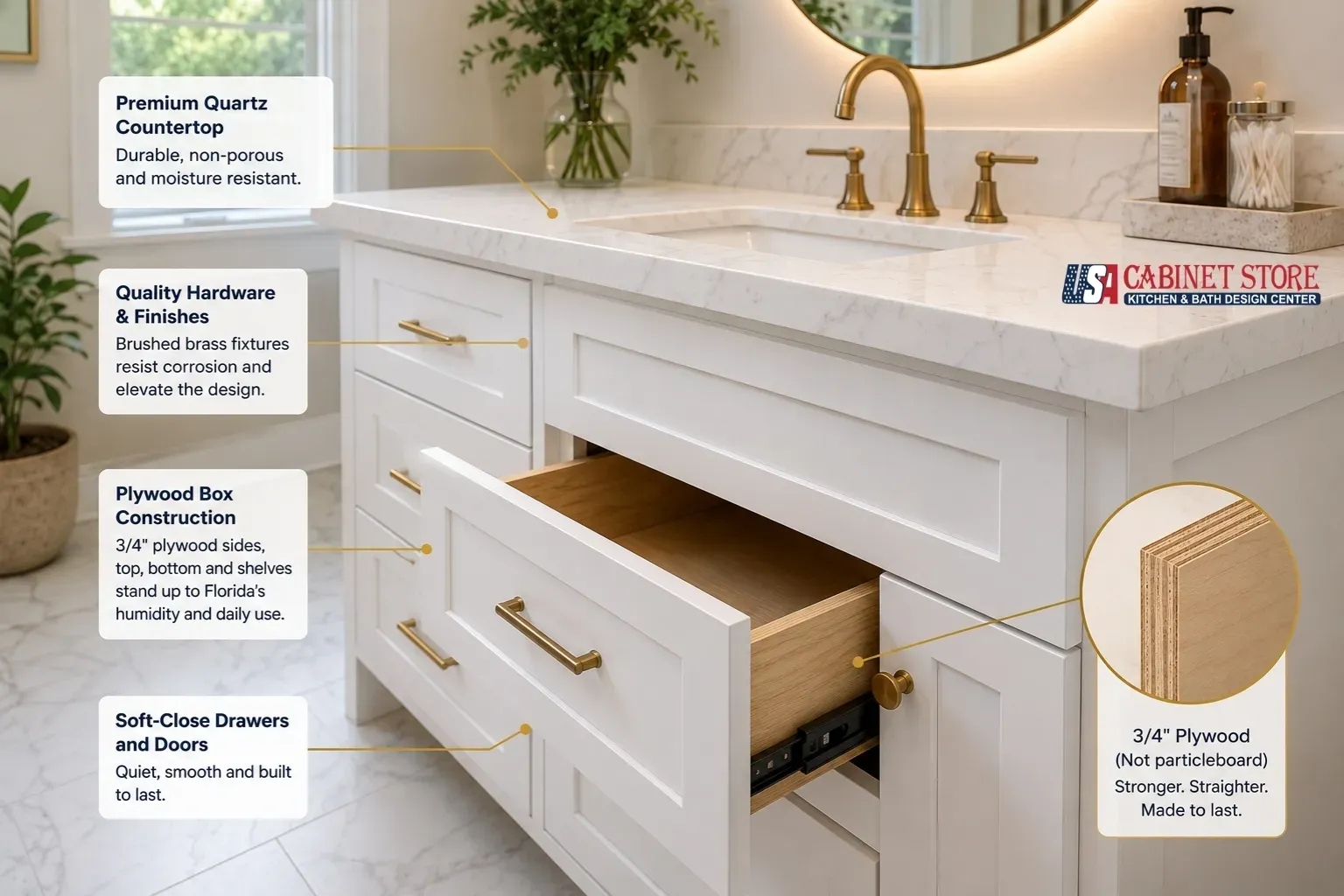
Solid hardwood goes on the visible surfaces — door fronts, drawer faces, and face frames. The cabinet box (sides, back, shelves) is almost always plywood. This isn’t a shortcut. It’s better engineering. Plywood’s cross-layered grain structure resists expansion and contraction more effectively than solid wood in humid environments.
Plywood quality matters enormously. Furniture-grade or marine-grade plywood is essential for bathroom use. Baltic birch plywood has natural moisture resistance and consistent density. Construction-grade plywood does not belong in a bathroom.
MDF (Medium-Density Fiberboard) comes in two forms. Standard MDF swells on contact with moisture — avoid it in bathrooms entirely. Moisture-resistant MDF (green core) handles humidity better and takes paint beautifully, making it viable for painted cabinet doors in well-ventilated baths. It’s the most affordable option for a smooth painted finish.
Particle board: never. It absorbs water rapidly, swells irreversibly, and cannot be repaired. If a vanity manufacturer uses particle board in any structural component, walk away.
| Material | Moisture Resist. | Durability | Cost | Lifespan | Best Use |
|---|---|---|---|---|---|
| Solid hardwood (doors/frames) |
★★★–★★★★★ | Excellent | $$–$$$$ | 20–50+ yr | Visible surfaces |
| Marine-grade plywood (boxes) |
★★★★½ | Very Good | $$ | 15–25 yr | Cabinet boxes |
| Baltic birch plywood | ★★★★ | Good | $$ | 15–25 yr | Shelves Interiors |
| Moisture-resistant MDF | ★★★ | Good | $ | 10–15 yr | Painted doors only |
| Standard MDF | ★ | Poor | $ | 3–7 yr | Avoid in bathrooms |
| Particle board | ✗ | Very Poor | $ | 1–3 yr | Never use |
The proven combination for most bathroom vanities: hardwood door fronts + plywood cabinet boxes + quality sealant on all surfaces. This handles moisture, looks premium, and lasts 20+ years.
Species selection by bathroom type
Different bathroom contexts call for different priorities:
- Master bath / spa luxury: Teak or walnut. Premium aesthetics, best long-term performance.
- Guest bath (light use): Cherry or maple. Beauty over brute durability; manageable maintenance.
- Kids’ / family bath: Hickory or white oak. Maximum scratch and dent resistance.
- Small bath (minimalist): Hard maple. Smooth, uniform appearance; highest paint-grade quality.
- Eco-conscious build: Sustainable, durable, affordable.
- Budget remodel: Warp-resistant hardwood at a fraction of the cost.
- Rental / investment property: Birch or maple plywood. Practical durability without premium spend.
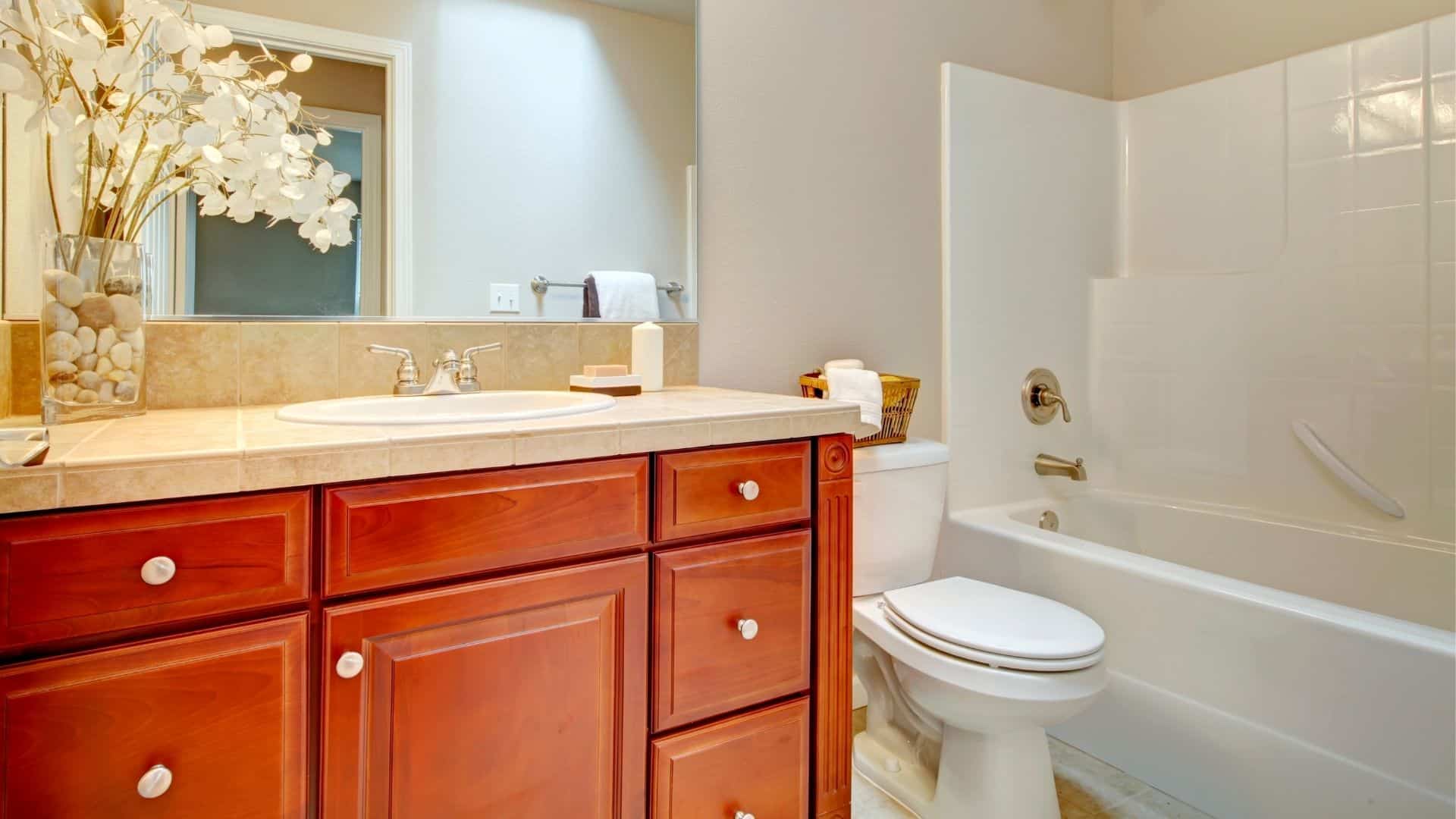
How to protect wood cabinets in your bathroom
Seal all surfaces. Not just the visible faces. The inside of the cabinet box, the bottom shelf, the back panel, every edge — moisture enters from all directions. Apply polyurethane, lacquer, or marine-grade finish on every exposed surface.
Ventilate. Run the exhaust fan during and after every shower. Bathrooms without mechanical ventilation are the #1 cause of premature cabinet damage, regardless of wood species. Target 40–60% relative humidity.
Wipe up standing water. Don’t let water pool on countertops or drip down cabinet faces. A quick towel-dry after heavy use adds years to your vanity.
Refinish on schedule. Most bathroom cabinets benefit from a fresh sealant coat every 3–5 years. Check around handles and the sink area annually for finish deterioration.
Specify kiln-dried lumber. Always verify kiln-dried specification when purchasing bathroom cabinetry. Kiln-dried achieves a more uniform EMC and reduces microbial risk compared to air-dried.
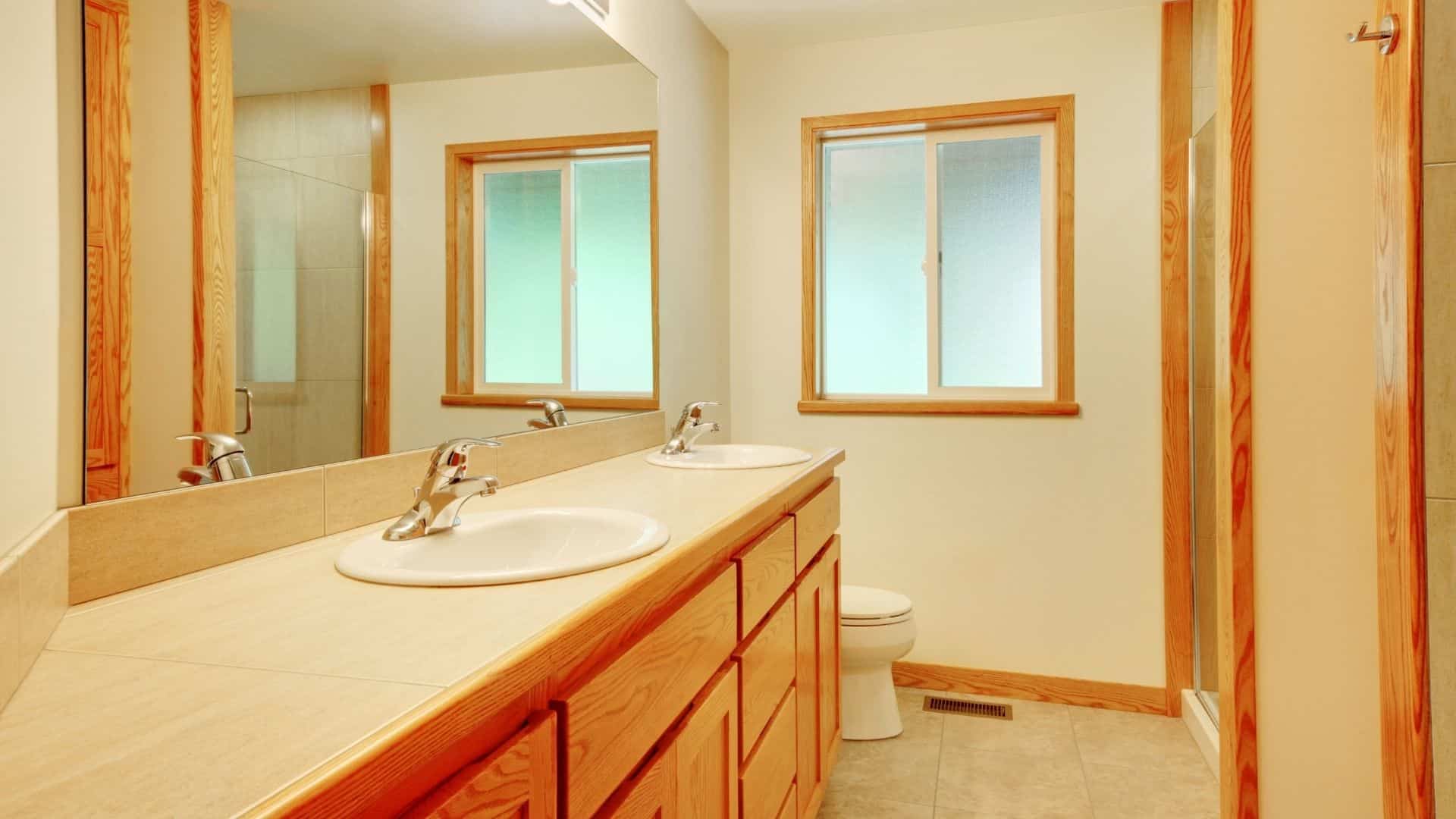
How to tell if a bathroom vanity is good quality?
A few checks that separate quality vanities from disposable ones:
- Open a drawer. Quality vanities use dovetail joints or dowel construction, not staples or hot glue. Pull the drawer out and look at the sides — plywood or solid wood is good. Particle board is a dealbreaker.
- Check the back panel. Cheap vanities use thin hardboard (cardboard-like material) for the back. Quality uses 1/4” or thicker plywood.
- Look at door edges and hinges. Soft-close hinges, solid wood or HDF door construction, and well-applied edge banding all signal quality. Exposed raw edges are moisture entry points.
- Ask about finish. Sealed on all faces (including inside)? Multi-coat catalyzed finish or just spray paint? A reputable manufacturer will tell you exactly what finish system they use.
- Verify country of manufacture. Bathroom vanities made in the USA typically use higher-grade lumber, better adhesives, and more stringent quality control than imported alternatives. Ask the manufacturer directly.
Frequently Asked Questions for Best Wood for Bathroom Vanity
What type of wood is best for a bathroom vanity?
For most bathrooms, white oak offers the strongest balance of moisture resistance, durability, aesthetics, and price. Its tyloses physically block water absorption at the cellular level. If budget isn’t a constraint and you want maximum moisture protection, teak is the top choice — its natural oils provide unmatched water resistance without relying on artificial finishes.
What is the trend for bathroom vanities in 2026?
The NKBA’s 2026 Bath Trends Report shows wood-faced vanities outselling painted alternatives, with white oak and walnut as the dominant species. Floating vanity designs continue gaining popularity. Earth tones, warm metals (brushed brass, matte gold), and spa-inspired naturalism drive the aesthetic direction. Warm wood grain paired with quartz countertops is the signature look of 2026.
Is MDF or solid wood better for a bathroom vanity?
Solid hardwood is better for bathroom vanity doors and face frames — it’s more durable, refinishable, and longer-lasting. Standard MDF should be avoided in bathrooms because it swells when exposed to moisture. Moisture-resistant MDF (green core) can work for painted doors in well-ventilated bathrooms but cannot be refinished if damaged. The ideal approach: solid hardwood doors with plywood cabinet boxes.
What wood is the most moisture resistant?
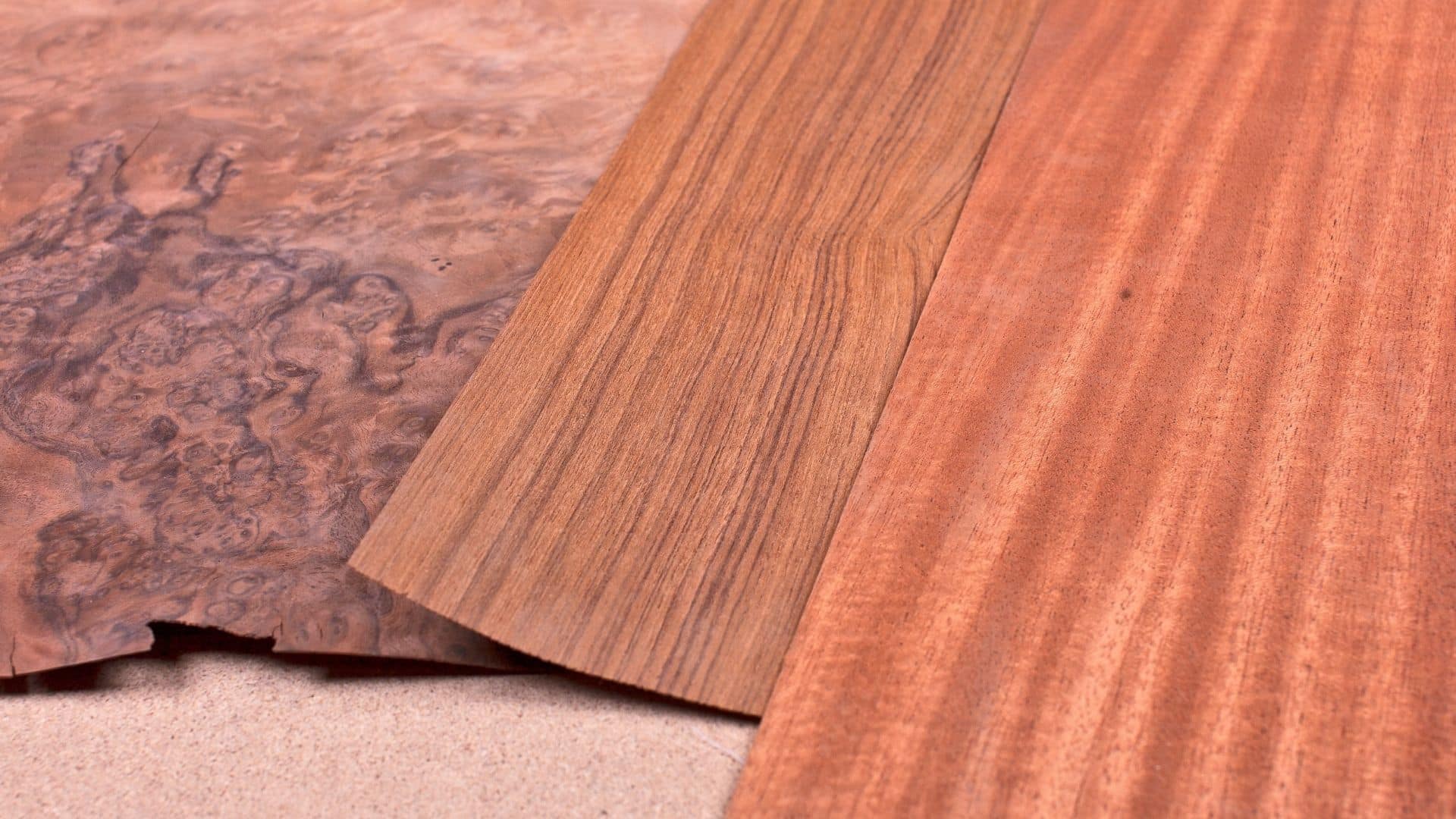
Teak, thanks to its natural oil content. Among common domestic species, white oak ranks highest due to its tyloses structure that blocks water penetration. Birch’s closed grain also provides good moisture resistance at a lower price point.
Who makes the highest quality bathroom vanities?
Look for manufacturers who use solid hardwood door fronts (not particle board or thermofoil), furniture-grade plywood boxes, dovetail drawer construction, soft-close hardware, and multi-coat catalyzed finishes. Vanities made in the USA typically meet higher material and construction standards. Ask to see the cabinet box material and joinery before purchasing.
Are there bathroom vanities made in the USA?
Yes. Several manufacturers build bathroom vanities domestically using North American hardwoods. USA-made vanities generally use higher-grade lumber, better adhesives, and more stringent quality control. At USA Cabinet Store, we source and install American-made cabinetry across our 14 showroom locations.
How much should a quality bathroom vanity cost?
A quality solid-wood bathroom vanity typically ranges from $800 to $3,500+ depending on species, size, and customization. Birch and maple vanities sit at the lower end; walnut and teak at the premium end. Custom vanities with specialty finishes can exceed $5,000. The cost per square foot of material ranges from $30 (birch) to $150+ (teak/walnut).
What makes a bathroom look tacky?
Mismatched finishes (gold fixtures with chrome accents), particle board vanities that have started to swell, visible peeling laminate, and dated materials like honey oak from the 1990s. Investing in a quality wood vanity with consistent hardware and stone countertop avoids most of these traps.
What makes a bathroom look outdated?
Ornate raised-panel cabinet doors, golden honey oak stain, cultured marble countertops, and builder-grade chrome fixtures. The 2026 direction is clean lines, natural wood grain, matte or brushed metal hardware, and stone countertops — understated rather than ornamental.
What color cabinets are in style for 2026?
Natural wood tones dominate — particularly white oak’s light tan and walnut’s rich chocolate brown. For painted cabinets, warm whites, soft sage green, and muted navy are trending. The 2026 palette leans warm: beige, honey, and earthy tones over the cool greys that dominated the previous decade.
How long do wood bathroom vanities last?
With proper sealing, ventilation, and periodic maintenance, solid wood bathroom vanities last 20–50+ years depending on species. Teak and white oak are the longest-lasting options. The finish typically needs refreshing every 3–5 years, but the wood structure holds up for decades. MDF vanities typically last 10–15 years; particle board, 3–7.
How to tell if a bathroom vanity is good quality?
Open a drawer and check the joinery (dovetail = quality, staples = cheap). Look at the box material (plywood = good, particle board = avoid). Check the back panel thickness (1/4” plywood minimum). Verify the finish system — sealed on all faces, including inside. Ask about the wood species and country of manufacture.
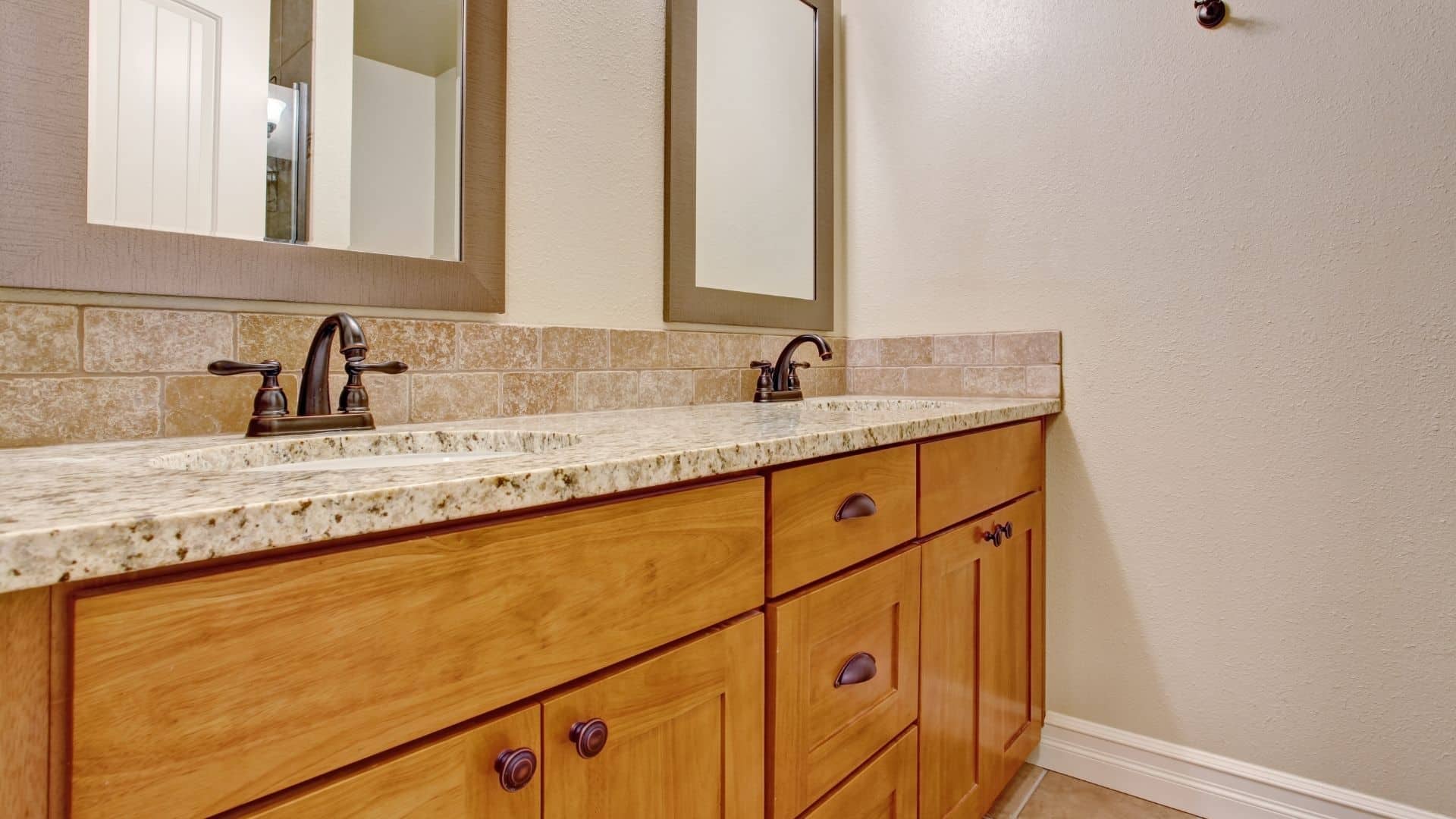
Ready to choose the right wood for your bathroom?
Our design team can walk you through species samples, finish options, and layout planning at any of our 14 showrooms nationwide. We carry solid hardwood and premium plywood vanities built for bathroom conditions — with the finish quality to prove it.
→ Schedule a complimentary consultation (usacabinetstore.com/complimentary-consultation/)
→ Find your nearest showroom (usacabinetstore.com/showrooms/)
Our design team can walk you through species samples, finish options, and layout planning at any of our 14 showrooms nationwide. We carry solid hardwood and premium plywood vanities built for bathroom conditions — with the finish quality to prove it.
→ Schedule a complimentary consultation (usacabinetstore.com/complimentary-consultation/)
→ Find your nearest showroom (usacabinetstore.com/showrooms/)
Related articles:
- Bathroom Vanity Types: The Complete 2026 Guide (/bathroom-vanity-types/)
- How Much Does a Bathroom Remodel Cost in 2026? (/bathroom-remodeling-cost/)
- 22 Walk-In Shower Ideas for Your Remodel (/22-walk-in-shower-ideas/)