
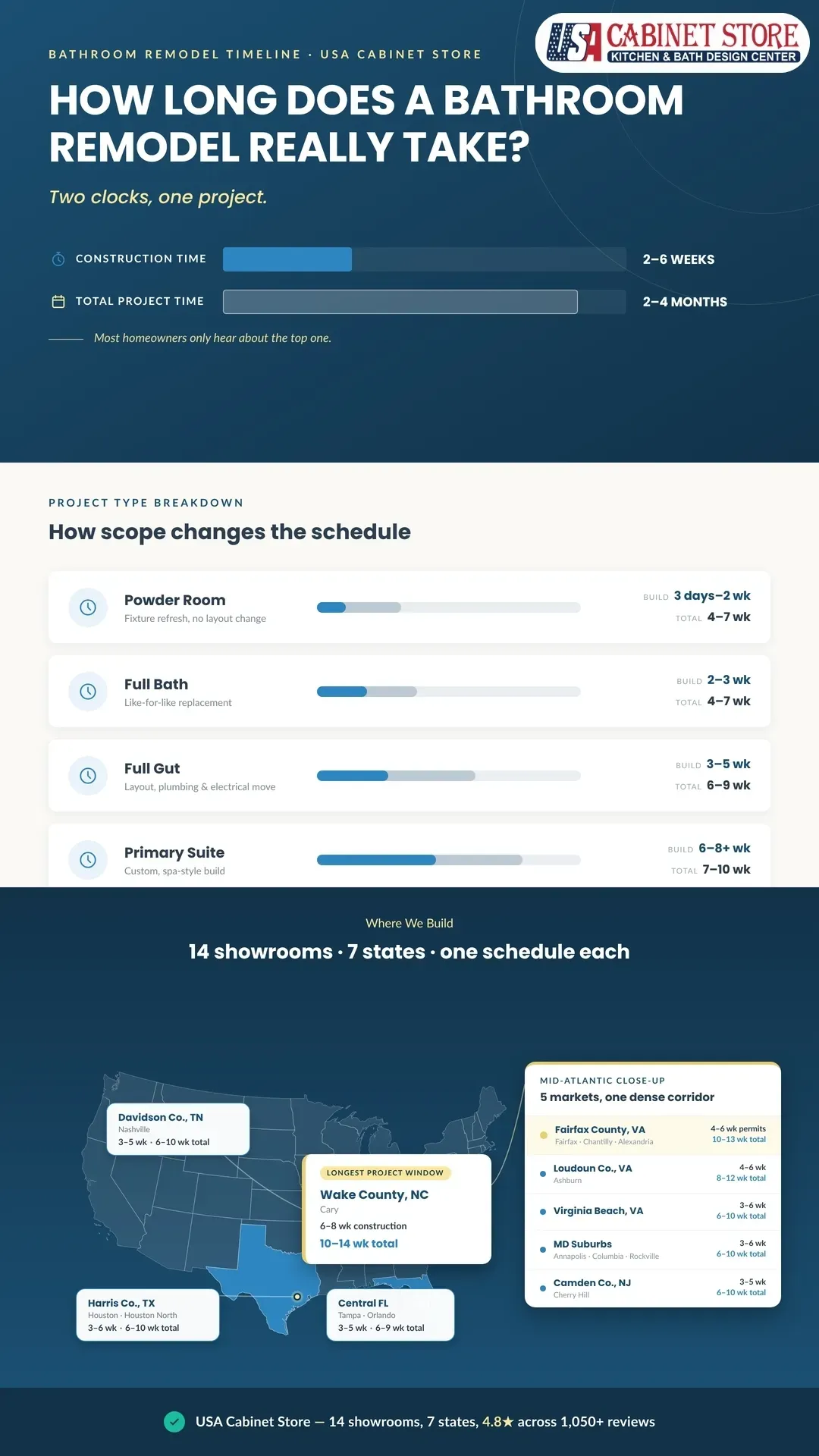
A bathroom remodel takes 2 to 6 weeks of active construction for most projects. A powder room can be done in a week, a full gut in 3 to 5 weeks, a custom primary suite in 6 to 8 weeks or more. But construction is only part of the calendar.
Add design, material ordering, and permits, and the whole project usually runs 2 to 4 months from signed contract to final walkthrough.Those two numbers aren’t a contradiction. They’re two different clocks running on the same project, and mixing them up is the biggest reason a “quick” bathroom job feels like it dragged into its third month.
Want a completion date in writing, not a guess?
One designer, one schedule, from first sketch to final walkthrough.
Construction time vs. total project time
Here’s the distinction most timeline guides skip: construction time is the days a crew is physically in your bathroom. Total project time is everything stacked around it, including the weeks before a single tile gets cut and the days after installation spent waiting on an inspector or a punch list item.
Construction time runs 2 to 6 weeks. That’s what most contractors quote when you ask how long a job will take. A pull-and-replace bath runs 2 to 3 weeks, a standard full gut 3 to 5 weeks, a custom primary suite 6 to 8-plus weeks.
Total project time runs 2 to 4 months. That figure adds design and selections (2 to 4 weeks), material lead times on anything custom, since tile, vanities, and glass can run 3 to 12 weeks depending on the item, and permit review, which varies a lot by jurisdiction (more on that below).
A 2022 thread shows the confusion firsthand. A homeowner whose contractor promised a small primary-bath gut “by early July” was warned by friends it would get dragged out. The replies split almost exactly along the construction/total-time line. Some answered based on construction days alone: “10 working days tops.” Others answered based on total elapsed time once inspections and backordered materials entered the picture: “2 to 6 weeks, could be longer, as supply chain issues are ongoing and many finish materials have 6 to 12 week lead times.” Both answers were right. They were answering two different questions.
A more detailed breakdown makes the split even clearer. One homeowner tracking a custom gut renovation logged it phase by phase: design, 3 to 6 weeks; permits, weeks to months depending on the county; material lead time, 4 to 8 weeks (with a hard rule not to demo until materials arrive); construction itself, about 15 to 16 working days including tile, vanity, glass, and trim; and punch list, 1 to 2 additional weeks. Their bottom line: without a working bathroom for at least 3 weeks, but workers in the house for 5 to 8 weeks total once every phase is counted. That’s the construction-vs-total-project gap in one homeowner’s own numbers.
Bathroom remodel timeline by project type
| Project type | Construction time | Total project time |
|---|---|---|
| Powder room / half bath | 3 days – 2 weeks | 4–7 weeks |
| Full / hall bath (like-for-like) | 2–3 weeks | 4–7 weeks |
| Full gut (layout unchanged) | 3–5 weeks | 6–9 weeks |
| Primary / master bath (custom) | 6–8+ weeks | 7–10 weeks |
The total-project-time column reflects USA Cabinet Store’s own scheduling data across 1,000+ kitchen and bath projects since 2011: a powder or hall bath typically runs 4 to 7 weeks from signed contract to final walkthrough, and a primary bath 7 to 10 weeks, with permit review adding another 6 to 8 weeks on top when a jurisdiction requires it. Northern Virginia counties are the main reason that permit number runs long; more on that below.
Week-by-week bathroom remodel schedule
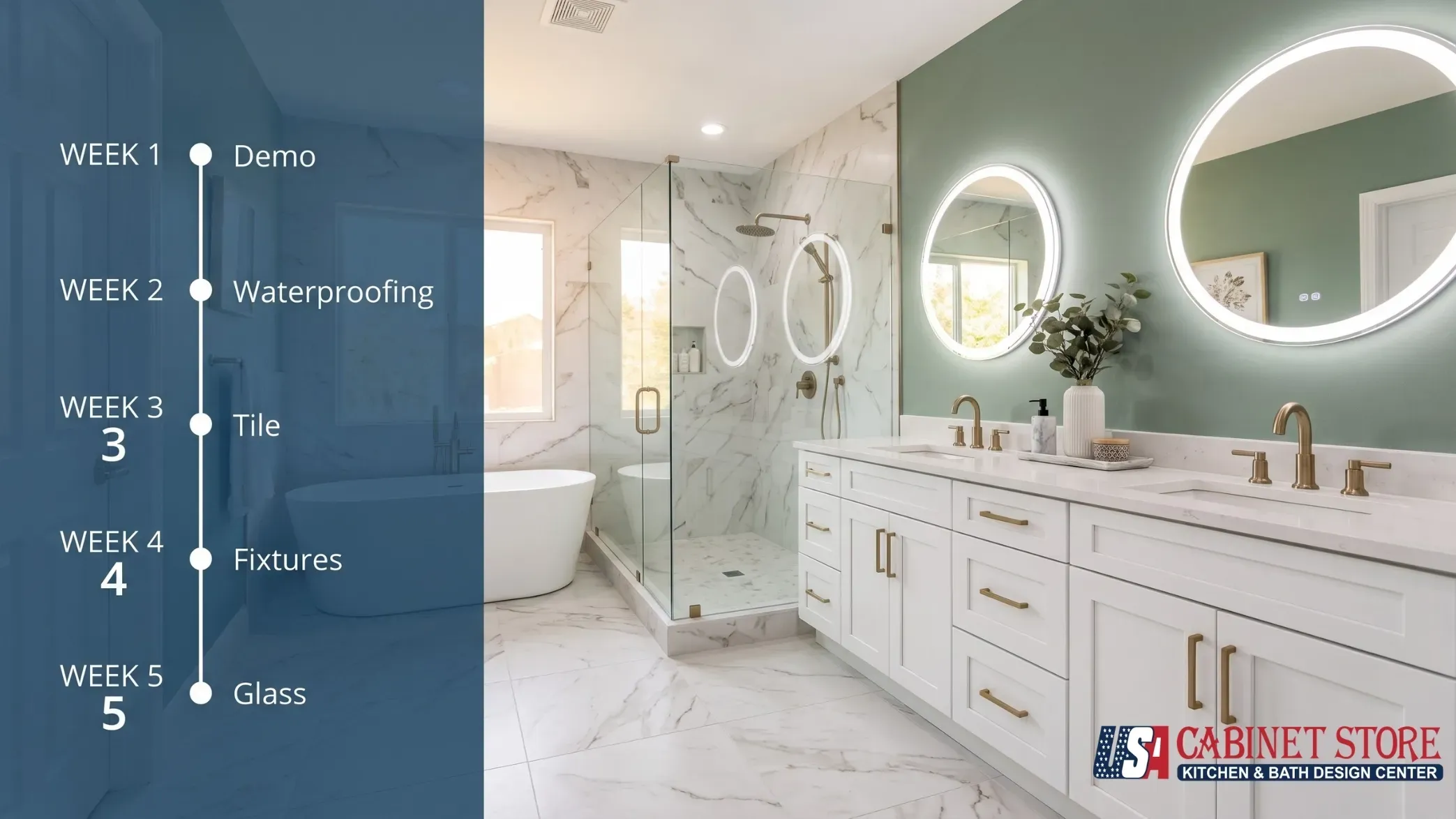
Once material is on-site and the crew starts, a standard full bathroom gut generally follows this order:
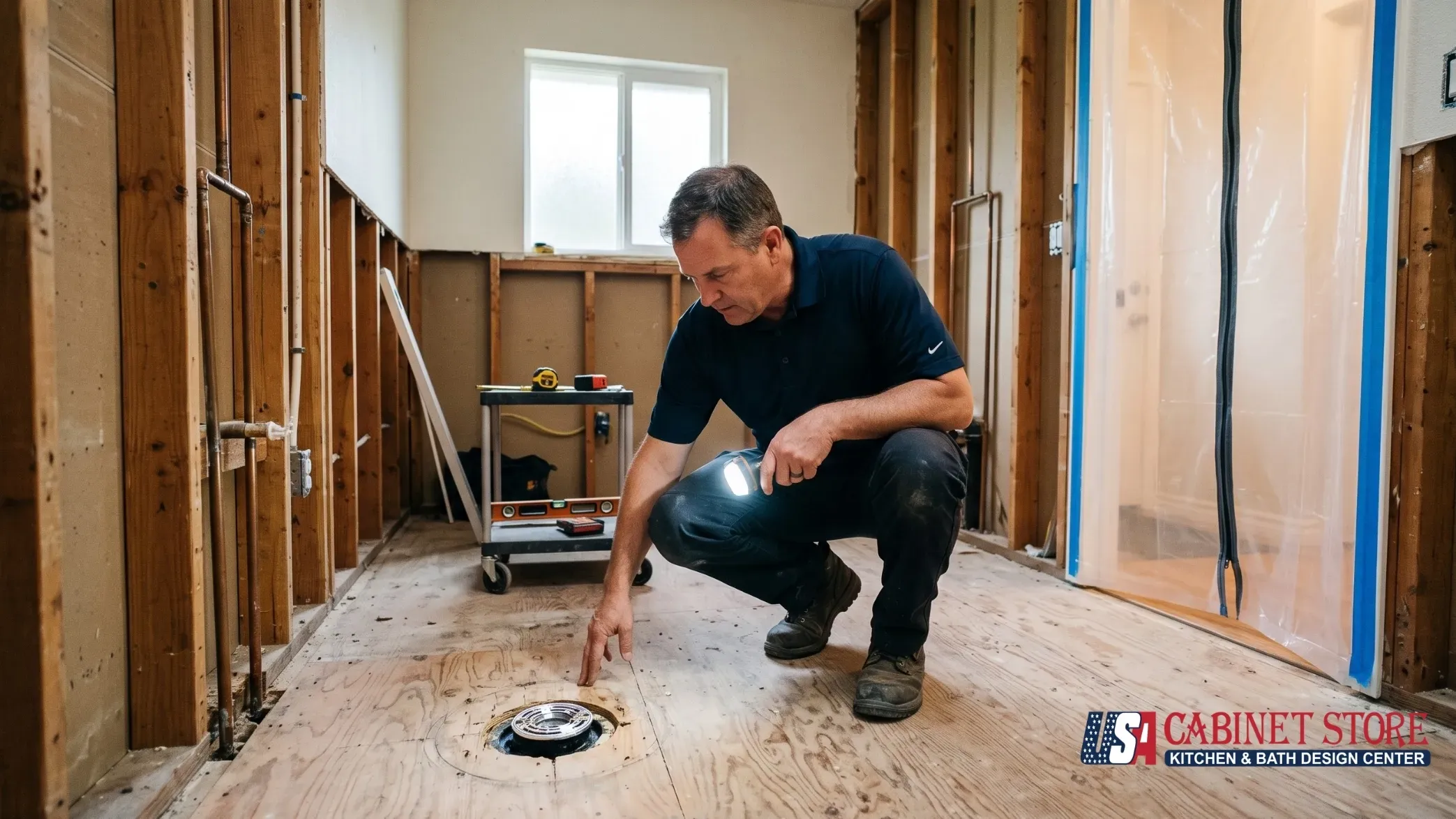
Week 1 is demo and rough-in. Site protection (half a day, laying down floor coverings and plastic sheeting so torn-out material and new deliveries don’t damage the rest of the house) comes first, then demolition (half a day to a full day), then plumbing and electrical rough-in (2 to 3 days): new supply lines, drain routing, and circuits, with no fixtures or switches yet, just the “canvas.” A subfloor inspection for rot, mold, or sagging joists happens alongside demo. This is the loudest, dustiest week, and the one most likely to turn up a surprise, since old houses hide things behind the wall nobody can see until it’s open.
Week 2 brings inspection and framing. A rough-in inspection (about an hour on-site, though scheduling it can take days) confirms the plumbing and electrical before anything closes up. Framing and blocking for grab bars, glass, and shelving follows, then drywall repair (1 to 2 days). The waterproofing membrane goes in around the shower before the shower pan itself, and a second inspection, the shower pan flood test, checks that it holds water overnight without leaking.
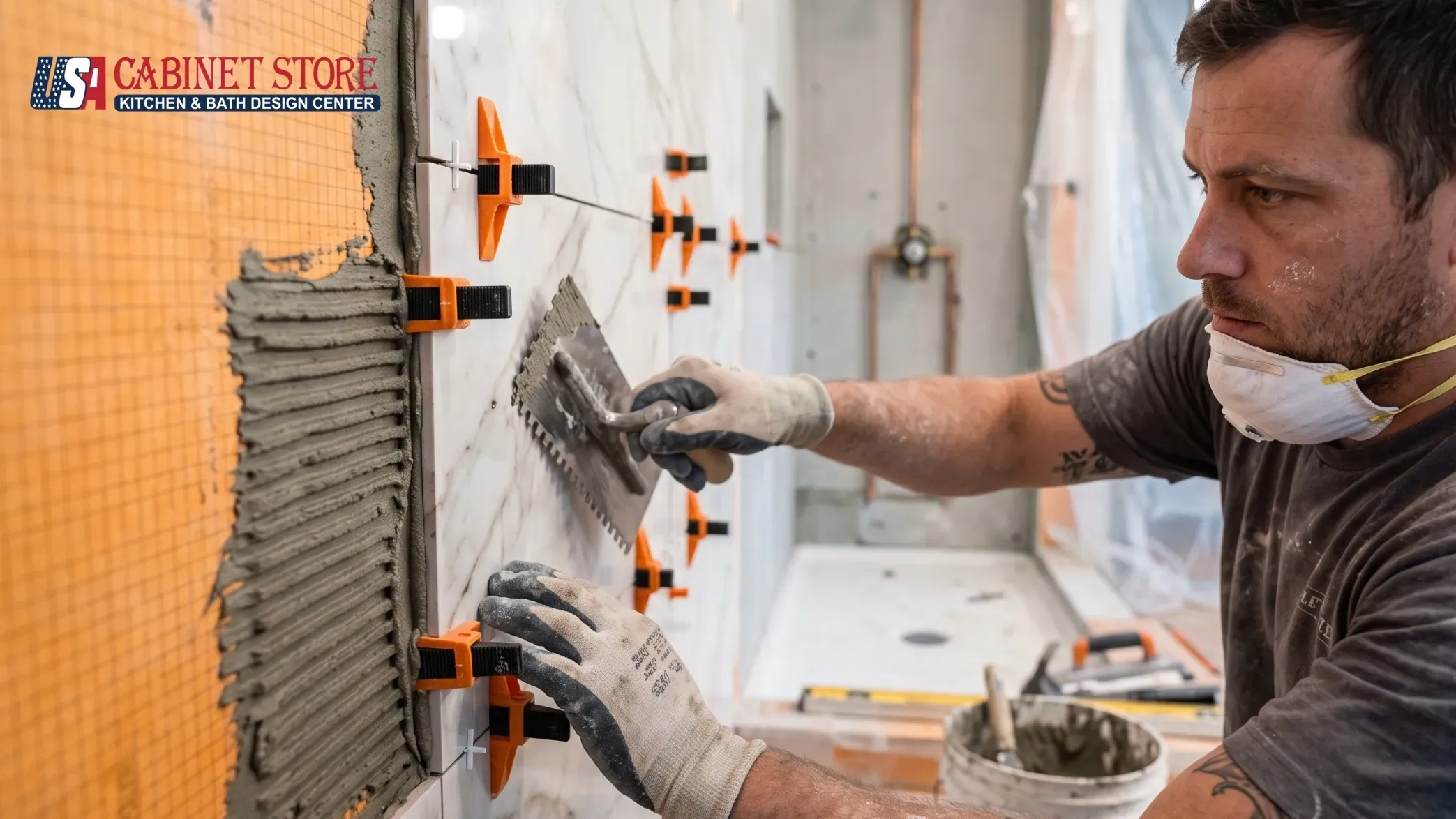
Week 3 is tile, usually the single longest phase. Substrate and mortar go down first, then the tile itself, then grout. Small-format or mosaic tile takes noticeably longer than large-format tile since there’s more of it to set and level; a straightforward 12″x12″ floor might take a day, while a custom mosaic shower can eat the rest of the week.
Week 4 covers fixtures and finish: vanity, toilet, shower glass, mirror, and lighting go in, followed by trim, caulk, and paint.
Week 5 is the punch list: a final walkthrough, a documented list of anything that needs touching up, and sign-off.
A powder room compresses this into 3 to 5 working days since there’s no wet-area waterproofing or full plumbing rough-in. A primary suite stretches it, usually because tile coverage doubles and custom vanities or freestanding tubs add their own lead time.
Compare that against what actually gets watched online. Search “bathroom remodel timeline” on YouTube and the top results skew toward one-person, one-week gut jobs with millions of views, the kind of content that makes a 5-week professional schedule look slow by comparison. Those videos are usually real, but they’re also usually one person working solo, on a house with no permit requirement in their jurisdiction, skipping the cure time between tile setting and grout, and without a rough-in or shower-pan inspection to schedule around. A crew that’s licensed, permitted, and waiting on an inspector isn’t slower because they’re less skilled; they’re on a different schedule than a weekend warrior with a camera.
The stages of a bathroom renovation, in order
The stages themselves don’t change. Only how long each one takes does.
| # | Stage | What happens | Typical duration |
|---|---|---|---|
| 1 | Demolition & subfloor inspection | Everything comes out down to the subfloor; pre-1978 homes get lead-paint testing | 0.5–1 day |
| 2 | Plumbing rough-in | Supply lines, drain relocation, valve placement | 2–3 days |
| 3 | Electrical | GFCI circuits, exhaust fan wiring, vanity/mirror lighting | 1 day |
| 4 | Framing & blocking | In-wall blocking for grab bars, glass, shelving | 1 day |
| 5 | Waterproofing | Membrane behind the tile, then shower pan flood test | 1–2 days |
| 6 | Tile | Substrate, layout, cuts, grout — usually the longest stage | 3–7 days |
| 7 | Fixtures & glass | Toilet, vanity, shower door, mirror | 1–2 days |
| 8 | Finish carpentry & paint | Trim, caulk, moisture-resistant paint, then punch list | 2–4 days |
A full bathroom touches six to eight specialists in that sequence, each waiting on the one before it, all working in a footprint that’s often under 50 square feet. That’s most of why a “small” room takes real time to do properly.
The 8 Trades of a Full Bath, in Sequence
1 Demolition + subfloor check
1–3 days · rot, mold, joists
2 Plumbing rough-in
1–3 days · supply, drains, valves
3 Electrical rough-in
1–2 days · GFCI, fan, lighting
4 Framing + blocking
1–2 days · grab bars, glass anchors
5 Waterproofing
2–3 days incl. cure · the leak insurance
6 Tile prep + install
3–10 days · longest phase
7 Fixtures + glass
2–4 days + glass fabrication wait
8 Finish carpentry + paint
1–3 days · trim, caulk, touch-ups
What happens before demo day
The stretch before anyone picks up a hammer is where most of the calendar actually lives, and it’s the phase people searching “how long does a bathroom remodel take” almost never budget for.
It starts with a consultation on goals, budget, and style, so the scope is clear from day one. Then comes measurements and discovery, flagging layout constraints and what stays, moves, or changes. A 3D design phase follows, letting you see the vanity, shower, and tile laid out before anything is ordered. Material selection comes next: vanities, tops, tile, and fixtures, chosen with a designer rather than guessed at alone. Then scope, estimate, and approval, meaning an itemized estimate rather than a ballpark, signed off before ordering starts.
The last step, ordering, is the one that quietly eats weeks. Stock vanities ship fast. A custom vanity or a backordered tile pattern can take 3 to 12 weeks, which is why materials are often ordered before demo starts at all, so the crew isn’t standing around waiting on a truck.
Do you need a permit, and how long does it take?
In most jurisdictions, yes. Moving plumbing or electrical, changing the shower pan, or altering the room’s footprint typically requires a permit, even though a simple like-for-like fixture swap usually doesn’t.
Permit review timelines vary more than almost anything else in this process. Nationally, a standard bathroom permit often clears in 1 to 2 weeks. But in parts of Northern Virginia and Montgomery County, MD, review can run 6 to 8 weeks, largely because of how backlogged county portals get. Fairfax County’s PLUS system and Loudoun’s permitting office are two of the more commonly cited bottlenecks. That’s not a knock on the counties; it’s a real scheduling variable a homeowner in Ashburn or Chantilly deals with in a way a homeowner in Houston or Tampa usually doesn’t.
Two inspection points come up on almost every gut job: a rough-in inspection after plumbing and electrical are roughed in but before walls close up, and sometimes a shower pan flood test, where the pan is filled with water and left overnight to confirm it doesn’t leak before tile goes over it. Both are scheduled around the inspector’s calendar, not the contractor’s, which is exactly why “the crew didn’t show up” is sometimes actually “the inspector hasn’t been out yet.”
Timeline by location: why some counties run longer
Permit backlogs aren’t the same everywhere USA Cabinet Store builds, and the gap between markets is big enough to plan around.
| Showroom | County served | Construction time | Total project time |
|---|---|---|---|
| Fairfax, Chantilly, Alexandria, VA | Fairfax County | 5–6 weeks | 10–13 weeks |
| Ashburn, VA | Loudoun County | 4–6 weeks | 8–12 weeks |
| Cary, NC | Wake County | 6–8 weeks | 10–14 weeks |
| Virginia Beach, VA | Virginia Beach City | 3–6 weeks | 6–10 weeks |
| Annapolis, Columbia, Rockville, MD | Anne Arundel / Howard / Montgomery Co. | 3–6 weeks | 6–10 weeks |
| Cherry Hill, NJ | Camden County | 3–5 weeks | 6–10 weeks |
| Houston, Houston North, TX | Harris / Montgomery Co. | 3–6 weeks | 6–10 weeks |
| Tampa, Orlando, FL | Hillsborough / Orange Co. | 3–5 weeks | 6–9 weeks |
| Nashville, TN | Davidson County | 3–5 weeks | 6–10 weeks |
Fairfax County is the outlier for a specific reason: permit processing alone can add 4 to 6 weeks before anyone picks up a tool, which pushes Fairfax, Chantilly, and Alexandria projects toward 10 to 13 weeks total. Wake County, NC runs a similarly multi-step permit and inspection process, which is why Cary jobs tend to land at 10 to 14 weeks. Houston, Tampa, and Orlando move faster mostly because permit review is quicker and there’s less cold-weather scheduling risk, and they typically land at 6 to 10 weeks total.
None of this is a reason to skip a permit or rush an inspection. It’s a reason to ask your contractor, up front, what your specific county’s review process actually looks like, since the answer changes your realistic move-back-in date by a month or more depending on where you live.
See real bathroom projects and timelines
Browse finished bathrooms from USA Cabinet Store showrooms across 7 states, or talk to a designer about your own project scope.
What delays a bathroom remodel
Delays cluster around a handful of repeat offenders, and real accounts from homeowners mid-project confirm the pattern. In one r/HomeImprovement thread about a master bath gut, a homeowner described losing days waiting on an electrician, then discovering their bathroom, attic, primary bedroom, and part of the living room were all sharing a single 15-amp circuit, a fix that had to happen before inspection could even be scheduled. Another commenter summed up material delays bluntly: custom tubs were running three-week backorders, and unless you’d made the mistake of ordering from a slow online vanity brand, a two-week schedule was realistic.
The recurring causes:
- Hidden damage. Rot, mold, or old wiring found only once the wall is open. This is why a contingency budget matters more than a fixed schedule.
- Material backorders. Custom tile, stone vanity tops, and specialty vanities are the most common holdups, often adding 3 to 12 weeks if ordered late.
- Change orders. Deciding mid-project to upgrade a fixture or shift a layout resets part of the schedule.
- Permit and inspection queues. Especially in Northern Virginia counties, as above.
- Single point of failure. When the vanity comes from one company, the tile from another, and the installer is a third, a delay on any one of them stalls the whole job, and nobody’s clearly on the hook for fixing it.
That last one is the most avoidable delay, and it’s the one a single-source remodeler is built to prevent. When design, materials, and installation all come from the same company, there’s one schedule instead of three, and one point of contact instead of a group chat of subcontractors pointing at each other.
“When the cabinet company and the contractor are two different businesses, the homeowner is left managing the gap between them. We built USA Cabinet Store to remove that gap. You work with one dedicated designer who owns your project from the first 3D rendering to the final walkthrough — the vanities, the tile, and the construction are all ours. That’s what single-source accountability really means: one team you can hold responsible for the whole bathroom.”
Two real bathrooms, and what actually stretched the schedule
Tables and averages only go so far. USA Cabinet Store’s own project walkthroughs show the scope-versus-timeline math in practice, and both happen to sit in the same slow-permit market flagged above.
In Ashbrook Commons, near Ashburn (Loudoun County), designer Miyuki reworked a builder-grade bathroom for clients Karen and Jay. The boxy corner tub came out, the back wall moved roughly three feet to fit a full double vanity, and the shower grew substantially. That wall move, not the tile or the fixtures, is what pushes a job like this from a 2-to-3-week like-for-like refresh into full-gut territory, because relocating a wall means re-running plumbing and framing behind it before anything visible even starts. The couple, a physician assistant working 12-hour shifts and a police officer, made deliberate trade-offs to keep the schedule and budget sane elsewhere: an affordable Wolf Classic cabinet line instead of a custom vanity, and LVP flooring instead of full tile through most of the room, since it’s waterproof, has no grout lines to maintain, and doesn’t add a tile-cure-time trade to the schedule.
A second project in Leesburg, also Loudoun County, tells the same story from a different angle. The previous bathroom had a built-in tub platform that was hard to climb into, a shower boxed in by two walls and a narrow door, and two cramped, separate vanities. Designer Gina’s fix moved the shower across the room to face the windows, replaced it with a curbless walk-in behind a single glass panel, and combined the two vanities into one. Every one of those changes, relocating a shower, removing a curb, combining plumbing runs, is a rough-in decision, which is exactly why “just redo my bathroom” and “move my shower across the room” are different timelines even in the same square footage.

How to keep your remodel on schedule
The homeowners who avoid the worst delays tend to do a few things consistently. They order long-lead materials before demo starts, not after, which is the single biggest lever on the calendar. They get the completion date and scope in writing, including what happens if it slips; a vague verbal estimate is the number-one reason “a few weeks” turns into a few months with no accountability on either side. They ask who documents damage found behind the walls, and how it’s priced, before it happens, not after the wall is already open. They ask how often they’ll hear from their project manager, because weekly written updates catch small slips before they become big ones. And they confirm the punch-list process up front: what gets documented at the final walkthrough, and whether final payment is held until it’s closed out.
USA Cabinet Store’s process is built around exactly these checkpoints: an itemized estimate before ordering, materials ordered ahead of demo, one designer and one project manager as the single point of contact from first sketch to final walkthrough, a written weekly update during construction, and a documented punch list with payment held until every item is signed off. When water damage turns up behind an older wall, the standard is to open carefully, photograph what’s found, and price the repair before continuing, so the contingency budget covers a real, itemized cost instead of an open-ended guess.
It shows up in how projects actually go. One Fairfax homeowner, mid-renovation while still living in the house, described the installation team as “efficient, detail-oriented, and incredibly respectful of our home,” and said added upgrades came with “very fair and transparent pricing” mid-project rather than a surprise on the final invoice. A Houston customer whose project began after unplanned water damage described her project manager stopping by after each day’s work “to inspect and confirm that things were done correctly,” and said that months after completion, when two cabinet issues turned up, “they did not try to avoid me or try to turn me away.
They answered the phone and listened.” Not every project stays perfectly on schedule; one Chantilly review notes a piece “took a little longer than expected.” But across USA Cabinet Store’s 1,000+ completed kitchen and bath projects, rated 4.8 stars from more than 1,050 verified Google and Houzz reviews, the pattern is staying in communication when a schedule shifts rather than going quiet. The company is BBB accredited and an NKBA member and NKBA Design award winner, for what that’s worth as a baseline, though the review pattern above is the better predictor of how your own project will actually go.
✓ The On-Schedule Checklist
☐ Freeze the design before demo. Mid-project changes are the most expensive words in remodeling.
☐ Keep the layout if it works. Same-location fixtures save 2–6 weeks.
☐ Order everything first, then demolish. Never the other way around.
☐ Decide fast during construction. A three-day grout question is a three-day delay.
☐ Hire one accountable team. One company owning design, supply, and install means one owner for the schedule.
☐ Pad any estimate by 20–30%. Including ours. Written milestones narrow the gap; they don’t repeal hidden plumbing.
Timeline by bathroom size
Size changes the math more than almost any other variable. A powder room and a primary suite aren’t the same project scaled down; they’re different jobs with a different number of trades involved. For a full breakdown of how square footage, layout changes, and fixture count affect the schedule specifically for smaller bathrooms, see How Long Does It Take to Remodel a Small Bathroom.
How timeline affects cost of bathroom remodel?
Timeline and cost move together more than most people expect. The national average bathroom remodel runs about $16,500, with most projects landing between $8,000 and $45,000 over 5 to 8 weeks, and the projects that run longer are almost always the ones with a layout change, custom tile, or a backordered vanity: the same three things that stretch the schedule. For the full cost breakdown by project tier, see the Bathroom Remodeling Cost Guide.
What Homeowners Report for Bathroom Remodel Timeline vs. What We Do About It
The most common timeline complaints from r/HomeImprovement, r/Renovations, and r/DIY, paired with the process step that prevents each one, and what our clients say in their Google reviews.
HOMEOWNER BATH REMODEL PAIN #1
“The contractor said 2–3 weeks. It took 6–8.” Materials ordered after demo, gutted bathroom sitting idle for weeks.
OUR PROCESS
Every material is ordered, delivered, and staged on-site before demolition begins. The schedule is committed in writing before you sign.
“They completed the job within two weeks which was perfect timing!” — Google review, Chantilly (4.7★, 93 reviews)
HOMEOWNER BATH REMODEL PAIN #2
The vanishing contractor. Deposit paid, demo done, then unreturned calls and dead days between trades.
OUR PROCESS
A named project manager from contract to closeout, weekly written status updates, and payment milestones tied to completed work, with retention held until the punch list closes.
“Deniz acted as project manager and stopped by on a regular basis to check installation progress.” — Google review, Fairfax (4.6★, 98 reviews)
HOMEOWNER BATH REMODEL PAIN #3
Hidden water damage at demo: rotted subfloors, mold, leaking pans. Homeowners report losing 1–2 weeks before new work could start.
OUR PROCESS
Documented subfloor and framing inspection at demolition, photographed findings, and a priced fix before work continues. Contingency guidance up front: 10–20% for pre-1990 homes. Unused contingency stays yours.
HOMEOWNER BATH REMODEL N #4
Living through it: dust everywhere, workers in the home for 5–8 weeks, one bathroom for the whole family.
OUR PROCESS
Dust barriers before demo, cleanup at the end of every workday, and advance notice of every water shutoff.
“Recognizing we were living in the house, [they] did an excellent clean up every evening.” — Google review, Fairfax
FAQs for How Long Does It Take to Remodel a Bathroom?
How long does it take to remodel a bathroom?
Most bathroom remodels take 2 to 6 weeks of construction and 2 to 4 months from contract to final walkthrough once design, ordering, and permits are included.
How long should it take a contractor to remodel a bathroom?
For a standard full bath, 3 to 6 weeks of construction is typical. Under 2 weeks is possible for a small, non-custom bath if materials are on hand and no layout changes are needed; over 8 weeks usually signals a custom or primary-suite scope.
What is the fastest a bathroom remodel can be done?
A powder room or simple fixture swap with no layout changes can be done in 3 to 5 working days. Full gut jobs rarely go faster than 2 weeks even with a large crew, because waterproofing and tile need cure time between steps.
Do I need a permit to remodel my bathroom?
Usually, if you’re moving plumbing or electrical, changing the shower pan, or altering the layout. A like-for-like fixture swap with no layout change often doesn’t require one. Check with your local building department.
How long does a bathroom permit take?
Nationally, 1 to 2 weeks is typical. In parts of Northern Virginia and Montgomery County, MD, it can run 6 to 8 weeks, so factor that in before setting a completion date.
What is the order of a bathroom renovation?
Demolition and subfloor inspection, plumbing rough-in, electrical, framing and blocking, waterproofing, tile, fixtures and glass, then finish carpentry and paint.
Can you shower during a bathroom remodel?
Not in the bathroom being remodeled once demo starts. If it’s your only bathroom, ask your contractor about a temporary shower plan before signing; a good remodeler will build ordering and scheduling around minimizing how long you’re without one.
What causes bathroom remodel delays?
Hidden damage found during demo, backordered custom materials (tile and vanities most often), permit and inspection queues, and mid-project change orders are the most common causes.
Can a bathroom remodel be done in stages?
Yes. A cosmetic phase (paint, hardware, lighting) can be separated from a full wet-area gut, though splitting plumbing work across phases usually costs more in the long run than doing it once.
Is it worth remodeling a bathroom before selling?
A mid-range full bath remodel is one of the more reliably value-adding renovations, particularly replacing a dated tub-shower combo with a walk-in shower. A rushed remodel with a visibly compressed timeline (skipped waterproofing, no permit) can hurt more than it helps at inspection.
What’s the best time of year to remodel a bathroom?
Late fall through winter often means more contractor availability and a faster start date, though material lead times don’t change much by season.
How do I choose a bathroom remodeling contractor who won’t blow the schedule?
Ask for a written scope and completion date, ask how often you’ll get updates, and ask who’s accountable if a subcontractor causes a delay. A single-source remodeler who designs, supplies, and installs under one team has one schedule to manage instead of three.
Find your nearest showroom
14 showrooms across 7 states — compare real vanities, tile, and countertops in person, then have your project built by our local crew.
Book a Free Consultation
Find a Showroom
Ashburn VA · Chantilly VA · Fairfax VA · Tysons Corner VA · Virginia Beach VA · Annapolis MD · Columbia MD · Cherry Hill NJ ·
Cary NC · Nashville TN · Houston TX · Houston North TX · Orlando FL · Tampa FL