By the USA Cabinet Store Design Team | Updated May 2026
The 2026 kitchen looks different from the one we were all building five years ago. The cold, all-white “laboratory” look is on its way out. What is replacing it is warmer and more livable, what designers call warm minimalism: clean lines, but softened with natural wood, stone, and grounded neutral colors.
The data backs this up. The NKBA 2026 Kitchen Trends Report, which surveyed 634 kitchen and bath professionals, found that 76% expect kitchen footprints to grow over the next three years even as overall home sizes shrink. Forbes reported the same figure. The kitchen is quietly becoming the biggest, most personal room in the house.
Martha Stewart calls it “an era of layered kitchens, where the performance happens behind the scenes and the experience happens in front.” Walk-in pantries, prep kitchens, and hidden utility zones are turning into standard requests. Italian designers have a name for it: cucine a scomparsa, the disappearing kitchen.
This guide pulls together data from the NKBA, Houzz, and the design press (Homes & Gardens, Decorilla, BHG, Real Simple) and pairs it with what our team has learned across 1,000+ kitchen projects in the DMV area. We update it through the year as the trend data, regional cost figures, and homeowner feedback evolve, this version reflects spring 2026 conditions. Whether you have $500 or $150,000 to spend, the ideas below are organized by budget so you can find your starting point fast. And because the hardest part of a remodel is rarely the inspiration, we have built in honest answers to the cost, timeline, contractor, and regret questions real homeowners actually ask before they commit.
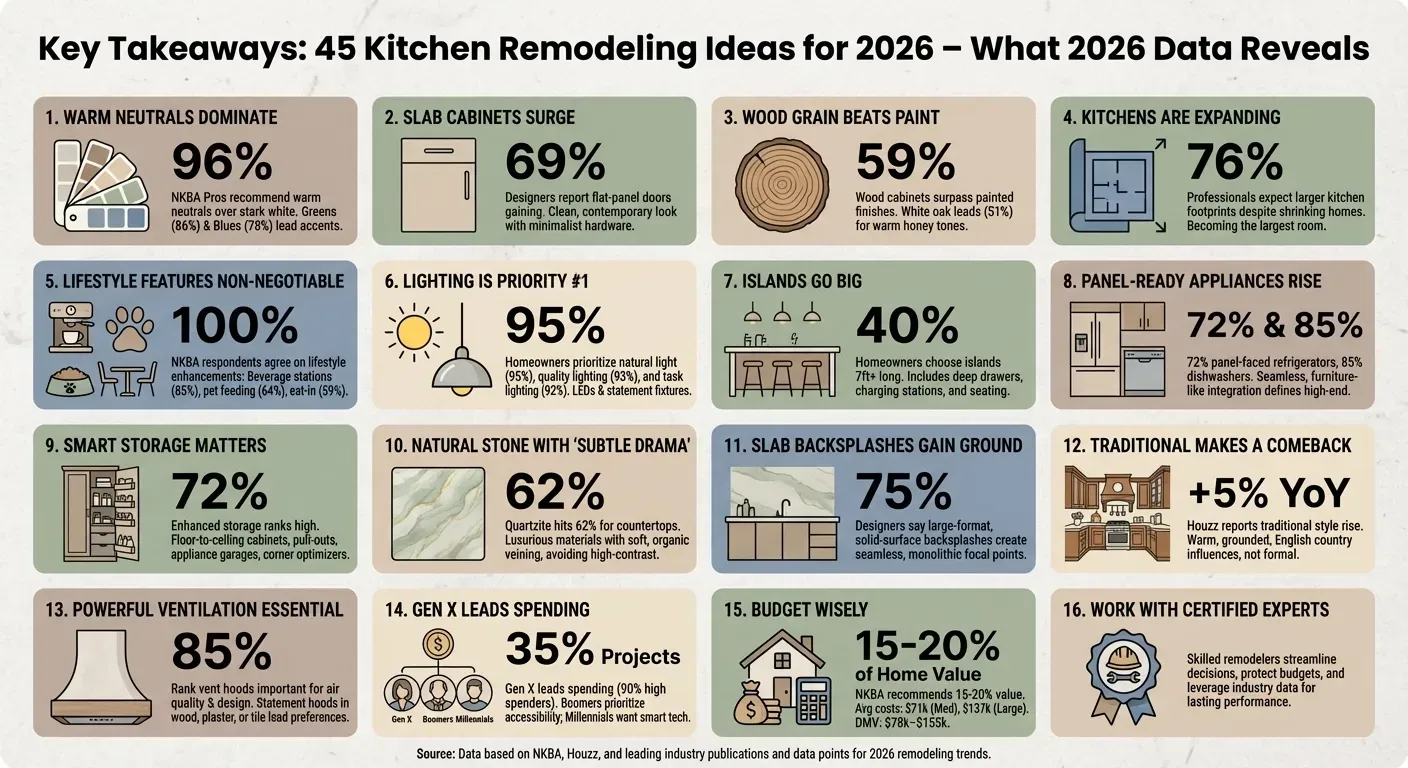
Key Takeaways for 45 Kitchen Remodeling Ideas for 2026 — What 2026 Data Reveals
- Neutrals dominate, but warmer. 96% of NKBA professionals recommend neutrals, but the shift is from stark white to warm tones (putty, mushroom, oatmeal). Greens (86%) and blues (78%) lead accent colors.
- Slab cabinets surge. 69% of designers report flat-panel doors gaining popularity. Pair with minimalist hardware for the clean, contemporary look that defines 2026.
- Wood grain beats paint. 59% say wood cabinets are surpassing painted finishes. White oak leads at 51%, valued for visible grain and warm honey tones.
- Kitchens are expanding. Despite shrinking home sizes, 76% of professionals expect kitchen footprints to grow over the next three years. The kitchen is becoming the home’s largest, most personalized room.
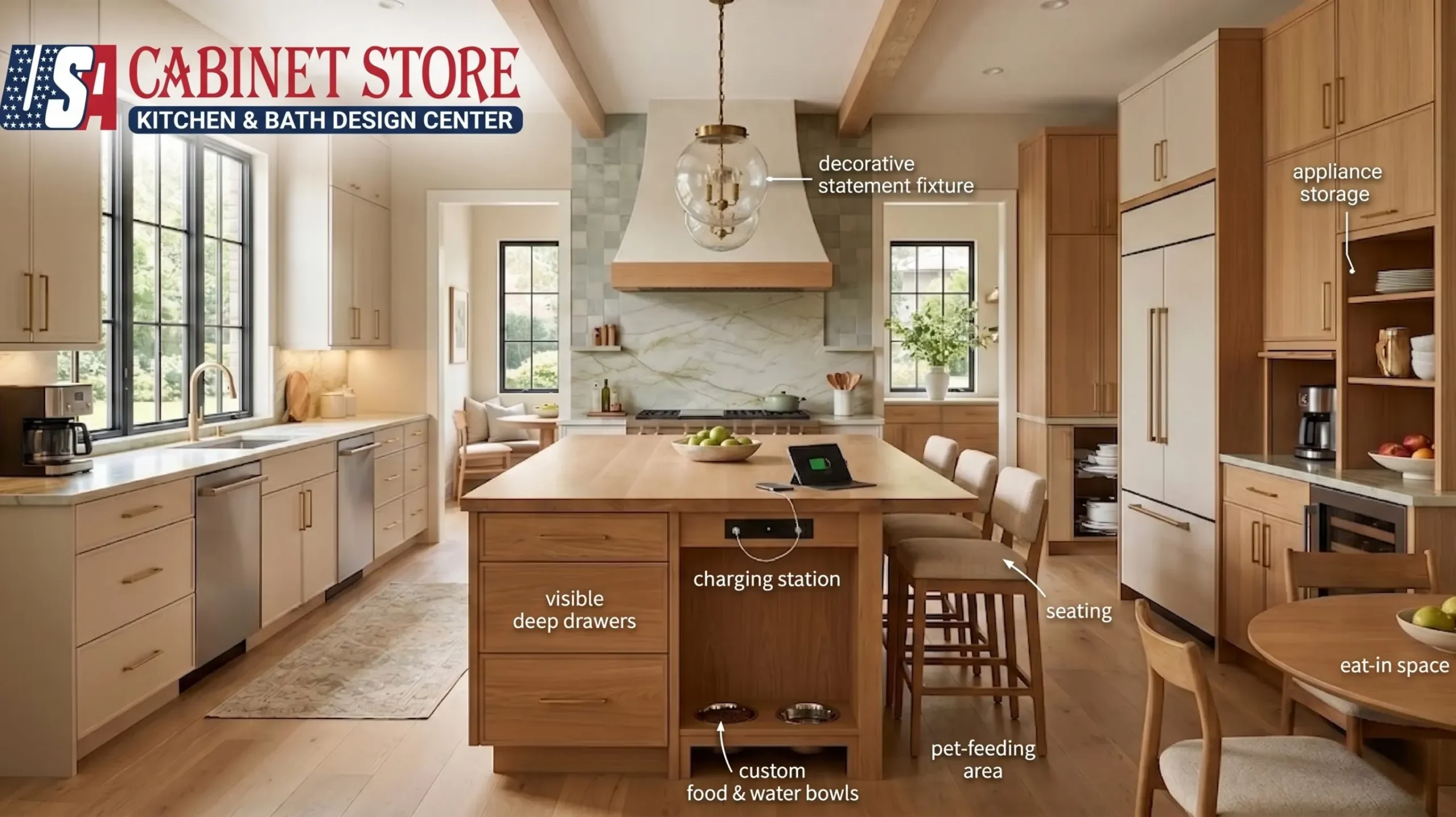
- Lifestyle features take center stage. Nearly all designers expect lifestyle enhancements to keep growing, with beverage stations (85%), pet-feeding areas (64%), and eat-in spaces (59%) leading the trend.
- Lighting is priority #1. 95% of homeowners prioritize natural light, 93% value quality lighting, and 92% want task lighting. Under-cabinet LEDs (82%) and decorative statement fixtures (87%) are must-haves.
- Islands go big. 40% of homeowners now choose islands 7 feet or longer. Include deep drawers, charging stations, and seating for multi-functional use.
- Panel-ready appliances rise. 72% report panel-faced refrigerators trending, and 85% say the same for dishwashers. Seamless, furniture-like integration defines high-end kitchens.
- Smart storage matters. Enhanced storage ranks at 72% importance. Go vertical with floor-to-ceiling cabinets, and add pull-outs, appliance garages, and corner optimizers to maximize every inch.
- Natural stone with “subtle drama.” Quartzite hits 62% for countertops, with soft, organic veining in greens and golds. Homeowners want luxurious materials without high-contrast boldness.
- Slab backsplashes gain ground. 75% of designers say large-format, solid-surface backsplashes are gaining popularity, creating seamless, monolithic focal points.
- Traditional makes a comeback. Houzz reports traditional style rose 5 percentage points year over year. The 2026 version is warm and grounded with English country influences, not formal or stuffy.
- Powerful ventilation is essential. 85% rank vent hoods as important for both air quality and design impact. Statement hoods in wood, plaster, or tile lead 2026 preferences.
- Gen X leads spending. Gen X drives 35% of kitchen projects, with 90% qualifying as high spenders. Boomers (32%) prioritize accessibility; Millennials want smart tech and entertaining space.
- Budget wisely. NKBA recommends 15–20% of home value for kitchen remodels. Typical national ranges run $45,000–$71,159 for a medium kitchen and $95,000–$137,228 for a large one. In the DMV area, expect $45,000–$95,000 (medium), up to $155,293 (large), and $155,000+ for upscale.
- Work with certified experts. Skilled remodelers streamline decisions, protect budgets, and leverage industry data to deliver kitchens that perform for decades.
Jump to what you’re planning
Costs & budget
Cabinets
Islands
Countertops & backsplash
Lighting & color
Cabinet quality
How a project runs
Regrets to avoid
Why us
FAQ
The 45 ideas are grouped by budget below. Use these tags to jump to a theme instead.
See these ideas in real DMV kitchens
Every idea here is one we have actually built. Browse a few recent projects across Northern Virginia, Maryland, and DC, then explore the full
kitchen project gallery for more.
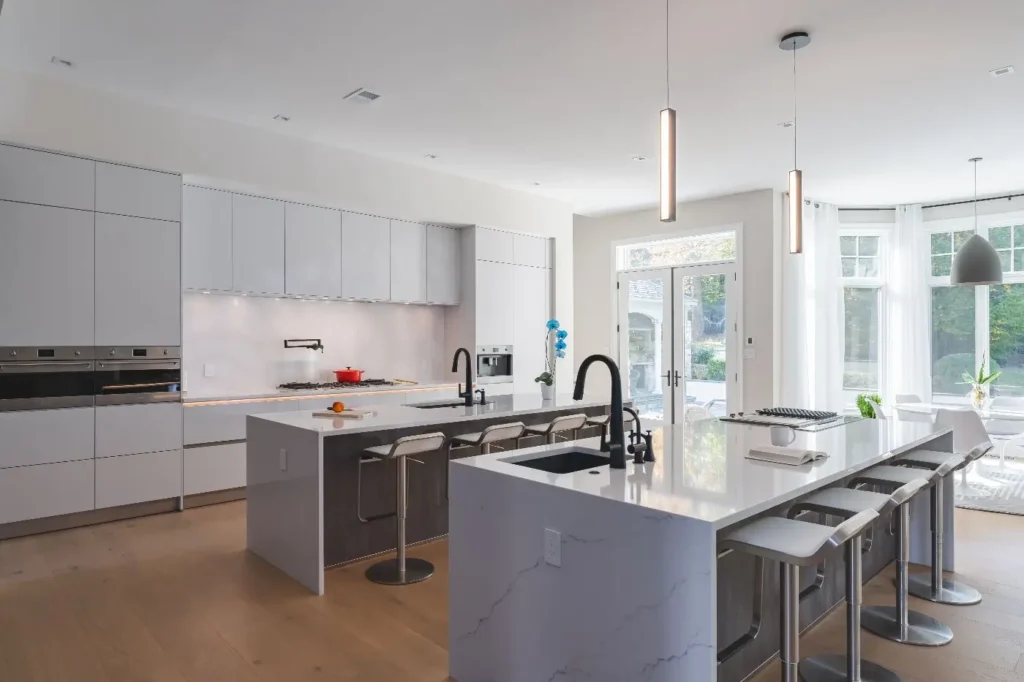
Islands & Waterfall Edge
Bright Elegance: White & Stone
McLean, VA

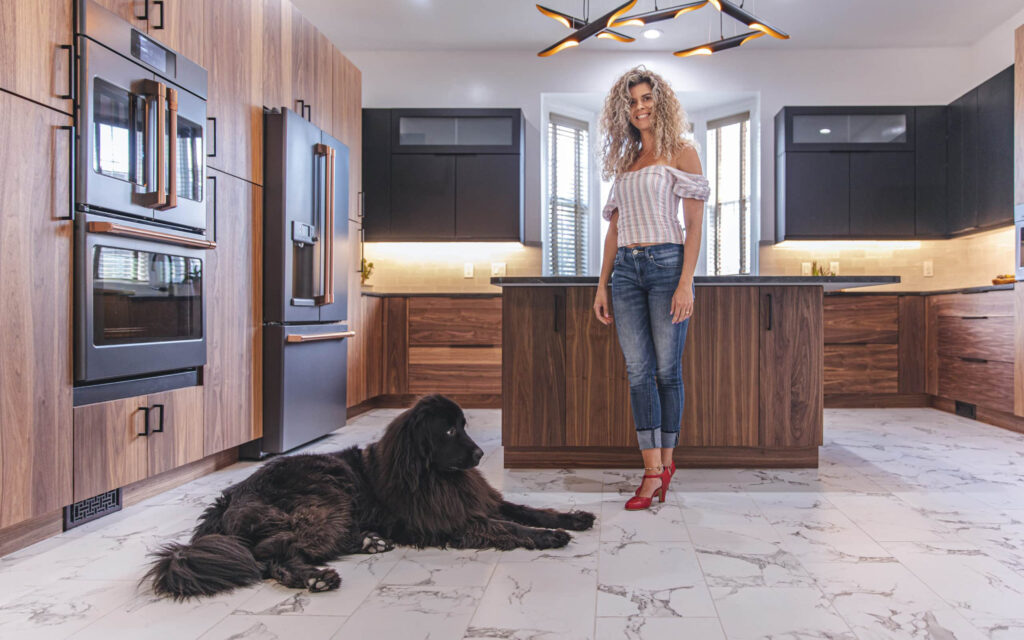
Wood-Grain Cabinets
Luxury Contrast: Walnut & White
Great Falls, VA
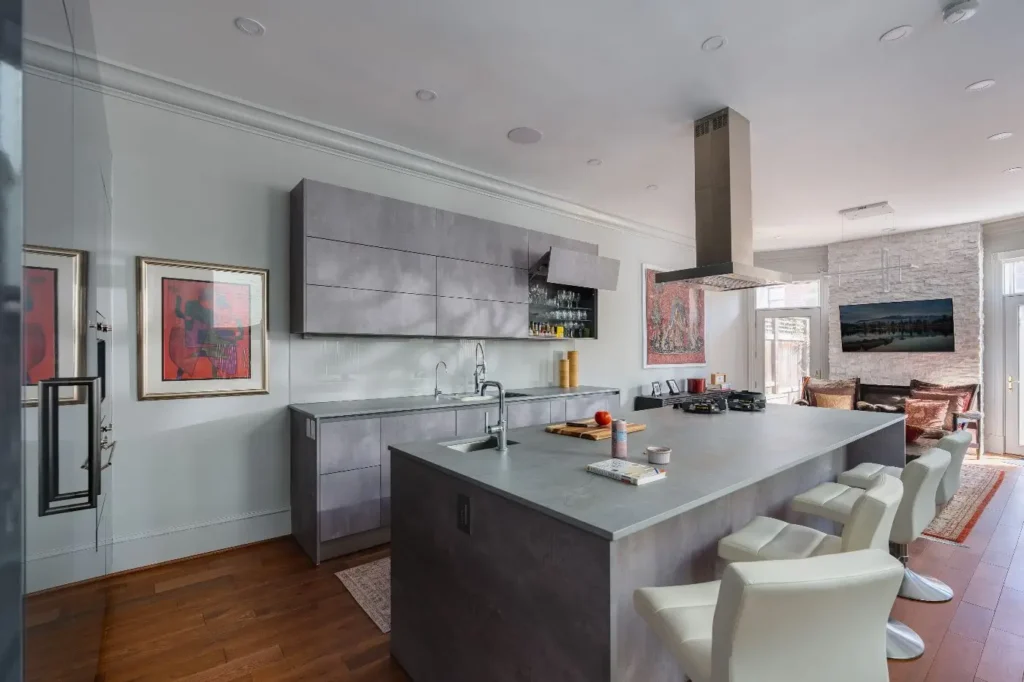
Slab & Panel-Ready
Sleek Modern Bauformat
Georgetown, DC
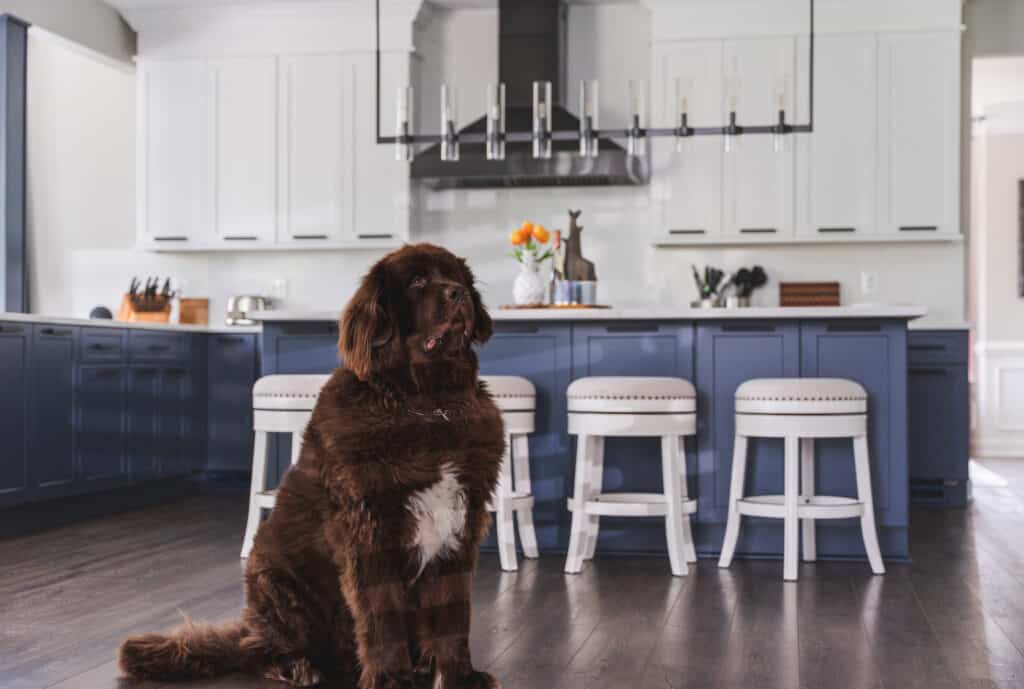
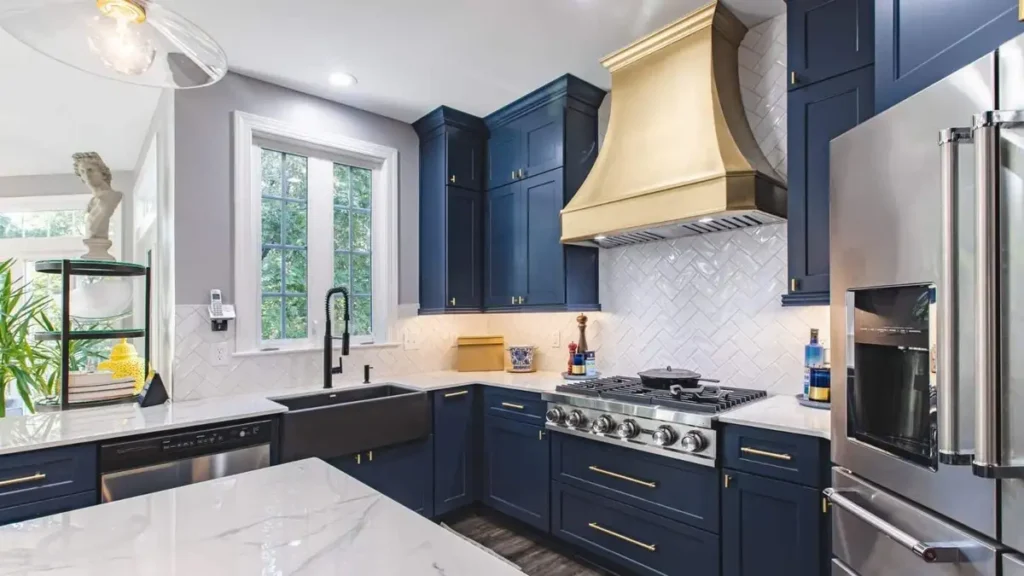
Color: Navy & White
A Navy Blue & White Dream
Leesburg, VA
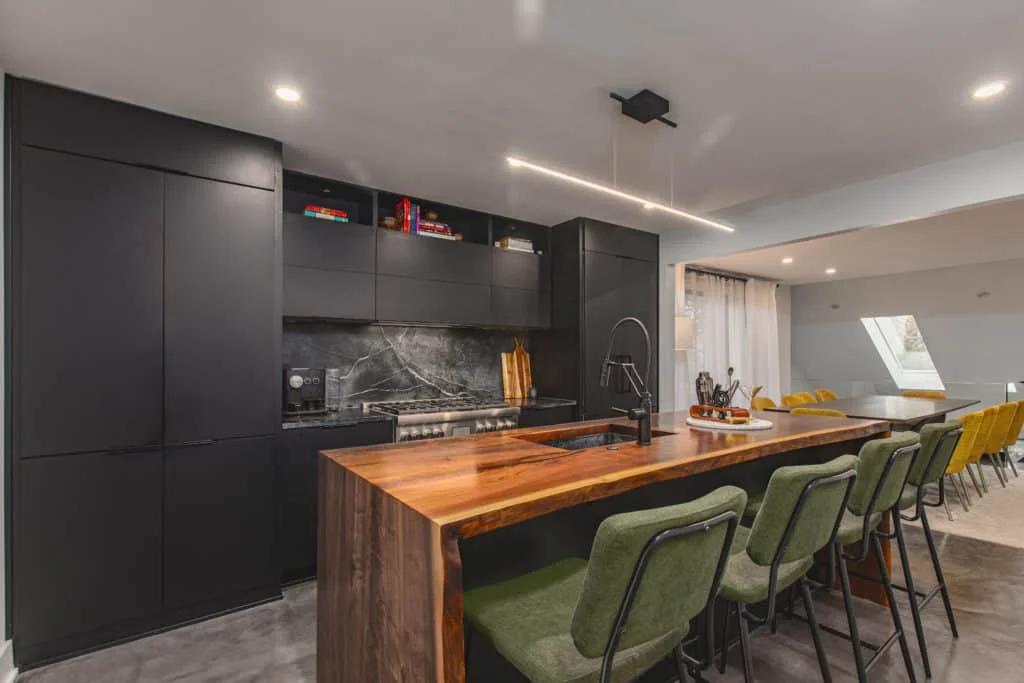
Black & Contemporary
Modern Black Kitchen
Washington, DC
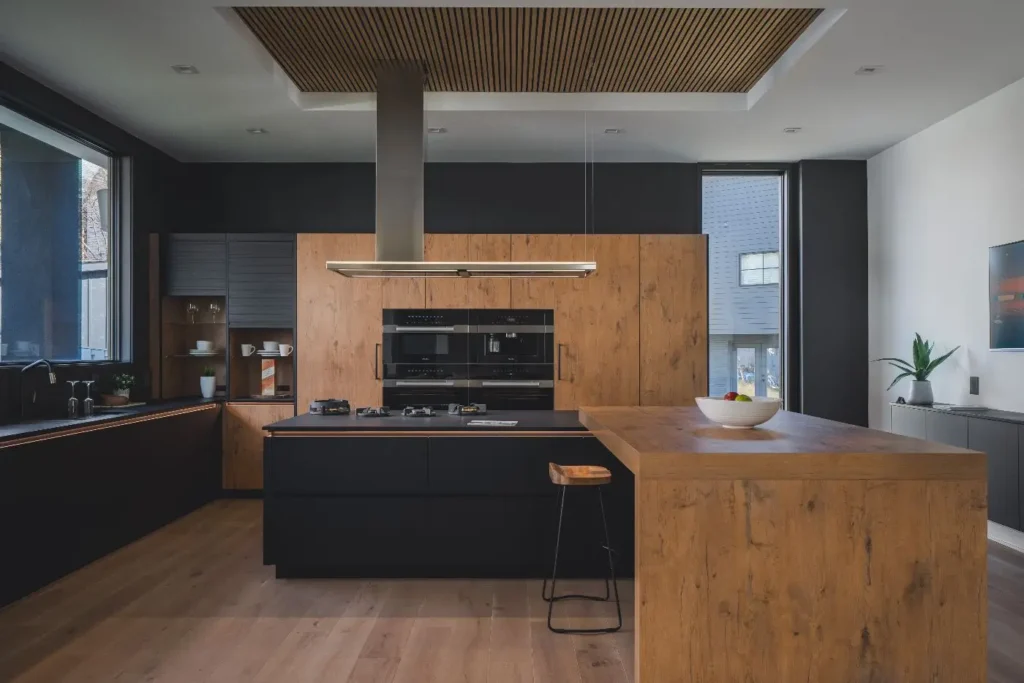
Wood & Matte Black
Bold Warmth: Wood & Black
Arlington, VA
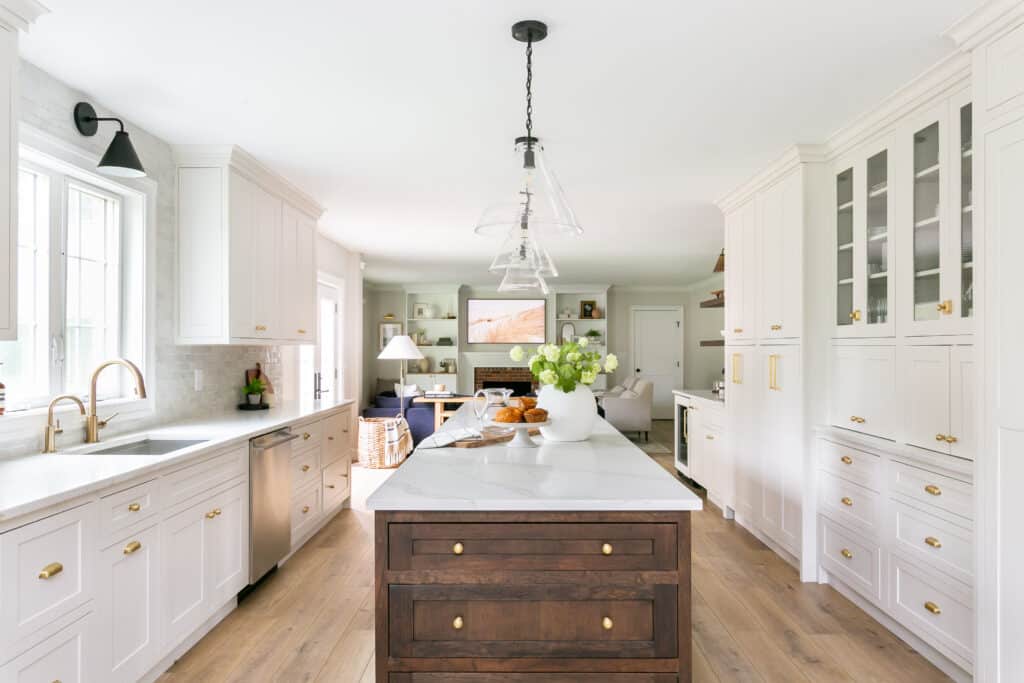
Double Island
Park Creek Dual Islands
Northern Virginia

Before & After
Brown-to-White Remodel
Fairfax, VA
View the Full Kitchen Project Gallery
What the 2026 data actually says
of pros recommend neutrals, but warmer ones: putty, mushroom, oatmeal. Greens (86%) and blues (78%) lead accents.
report slab (flat-panel) doors gaining ground. Pair with minimal hardware for the clean 2026 look.
say wood grain is passing painted finishes. White oak leads at 51%.
expect kitchens to get bigger over three years, even as homes shrink.
of homeowners prioritize natural light; 93% value quality lighting; 92% want task lighting.
now choose islands 7 feet or longer, with deep drawers, charging, and seating.
name quartzite a top countertop pick, just behind quartz, for soft green-and-gold veining.
of home value is the NKBA budget guide. National average: $71,159 (medium), $137,228 (large).
2026 kitchen remodel costs, and why two quotes for the same kitchen can differ by $30k
Here is the first thing people get wrong, and it is the most common worry we hear: they assume a “kitchen remodel” has one price. It does not. Homeowners regularly get one bid at $45,000 and another at $78,000 for what looks like the same job, then spend weeks wondering who is padding the number. Usually neither is. The spread comes from scope (are you moving plumbing or just swapping cabinets?), cabinet construction quality, countertop material, and what the demo uncovers behind the walls.
| Project type | National average | DMV area (VA/MD/DC) |
|---|---|---|
| Minor remodel | $18,000 – $27,492 | $20,000 – $30,000 |
| Medium kitchen (full) | $45,000 – $71,159 | $45,000 – $95,000 |
| Large kitchen (full) | $95,000 – $137,228 | $140,000 – $155,293 |
| Upscale major remodel | $120,000 – $158,530 | $155,000 – $300,000+ |
Sources: NKBA 2025/2026 Kitchen Trends Reports, Houzz Kitchen Trends Study, Remodeling Magazine Cost vs. Value Report, and in-house designer evaluation. For the full cost breakdown, see our pillar guide: how much does a kitchen remodel cost.
Budget for overage, because it is normal. Most renovations run at least 25% over the original number, not because someone failed, but because demo exposes old wiring, hidden water damage, or out-of-level floors, and because homeowners make upgrades mid-project. Build a 15-25% contingency into your plan from day one. A quote that does not mention contingencies at all is the one to question, not the one that does.
Not sure which tier your kitchen falls into?
A 15-minute conversation will get you a realistic range for your specific space, before anyone steps inside your home.
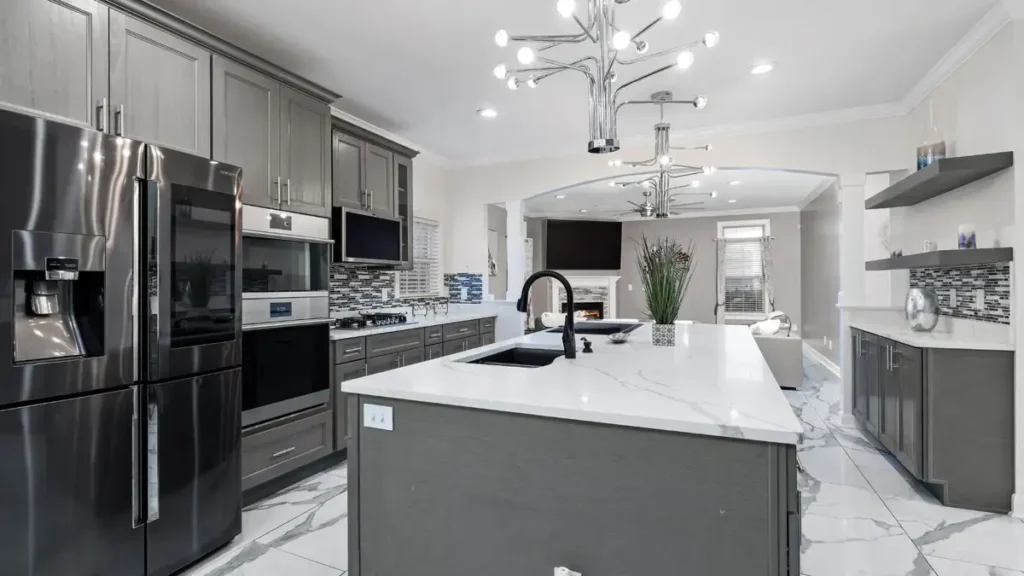
Category A: Quick refreshes ($500 – $5,000)
Best for renters, DIYers, and anyone testing a direction before committing real money.
1. The “living finish” hardware swap ($50 – $500)
Swap plain stainless pulls for unlacquered brass or oil-rubbed bronze. These metals patina over time, which is the point. Kitchen & Bath Design News notes that warmer finishes like brass, bronze, and champagne are replacing cooler silvers and chromes.
2. Paint cabinets in the new neutrals ($200 – $600 DIY / $1,500 – $4,000 pro)
96% of NKBA pros recommend neutrals, but not white. Naked Kitchens describes the shift toward taupes, mushrooms, and stony greiges as the new foundation tones. BHG points to grounding shades like mushroom, stone, and putty with brown or green undertones.
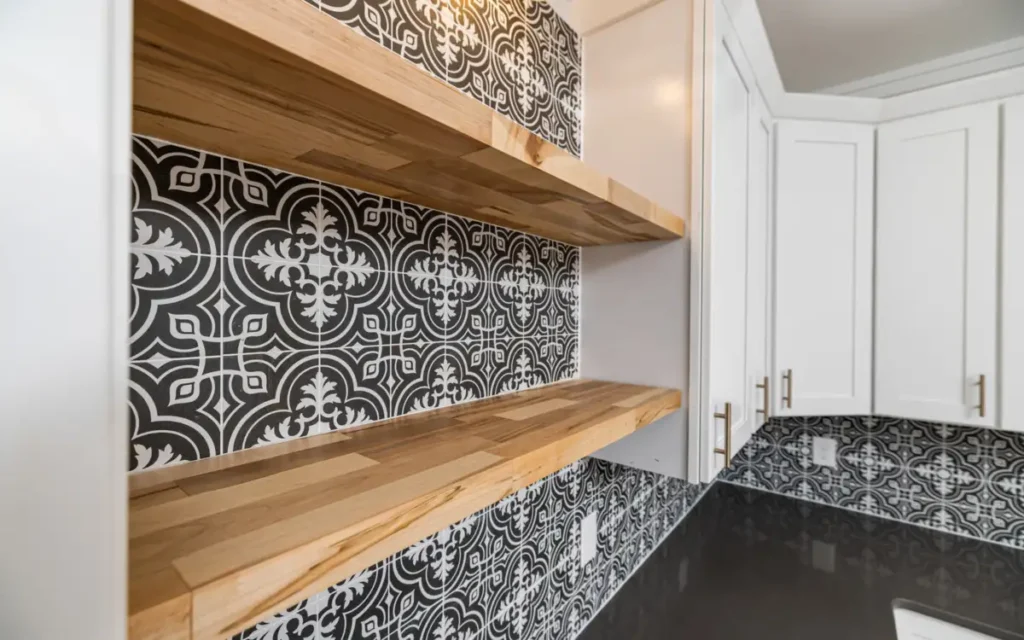
3. Architectural vinyl cabinet wrap ($300 – $1,500)
Apply architectural film (3M DI-NOC or Bodaq) to flat cabinet fronts. It comes in realistic wood grains and matte solids and gives a factory-like finish with no sanding dust. A budget route to the wood-grain trend.
4. Fluted glass film ($50 – $200)
Reeded or fluted glass film on existing cabinet doors adds high-end millwork texture and hides clutter. House Beautiful calls this century-old glass detail one of 2026’s defining looks.
5. Color-drench a pantry or nook ($100 – $400)
Painting walls, ceiling, trim, and shelves one moody color creates what Decorilla calls a “jewel box” effect. Try deep olive or rich navy in a butler’s pantry or scullery.
6 – 15. More quick wins
- Layered lighting upgrade ($200 – $2,000): Four layers. Task (under-cabinet LEDs), ambient (cove), accent (cabinet interior), decorative (statement pendants). Rechargeable motion LED bars need no electrician.
- Smart faucet adapter ($50 – $150): A touchless sensor on your existing faucet brings 2026 tech with no plumbing work.
- Toe-kick drawers ($100 – $400): Push-to-open drawers in the toe-kick store flat baking sheets. Enhanced storage ranks at 72% importance with the NKBA.
- Coffee station zone ($100 – $500): A tray, a floating mug shelf, dedicated storage. 85% of designers cite beverage stations as a top lifestyle feature.
- Countertop herb garden ($100 – $300): A compact hydroponic unit keeps basil and mint going year-round.
- Vintage rug runner ($50 – $200): Covers dated tile, adds warmth, washable.
- Matte switch plates ($20 – $100): Black, stone-texture, or brushed metal instead of plastic.
- Bamboo drawer organizers ($50 – $200): “Beauty on the inside” is a real 2026 theme.
- New pantry door ($200 – $800): Reclaimed wood or a frosted-glass insert turns functional into architectural.
- Curated open-shelf styling ($0 – $200): A collected look beats a matched set.
Category B: Moderate updates ($5,000 – $30,000)
Best for homeowners ready to hire trades for specific upgrades without gutting the room.
16. The “countersplash” ($3,000 – $10,000)
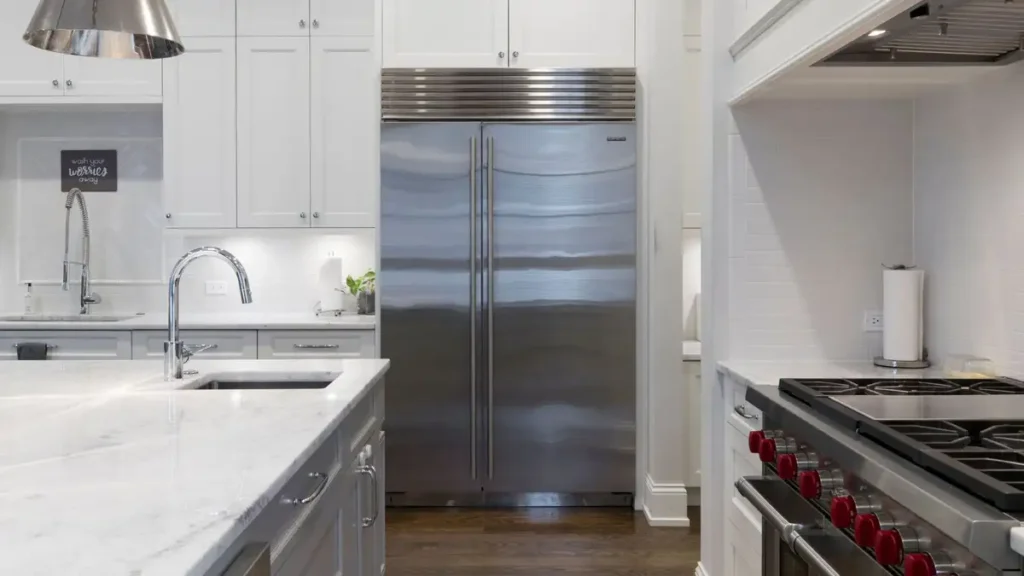
The defining surface move of 2026: countertop material running uninterrupted up the wall. 75% of NKBA pros say slab backsplashes are gaining ground. Decorilla describes the seamless counter-to-wall flow as calm and expansive, with no grout lines.
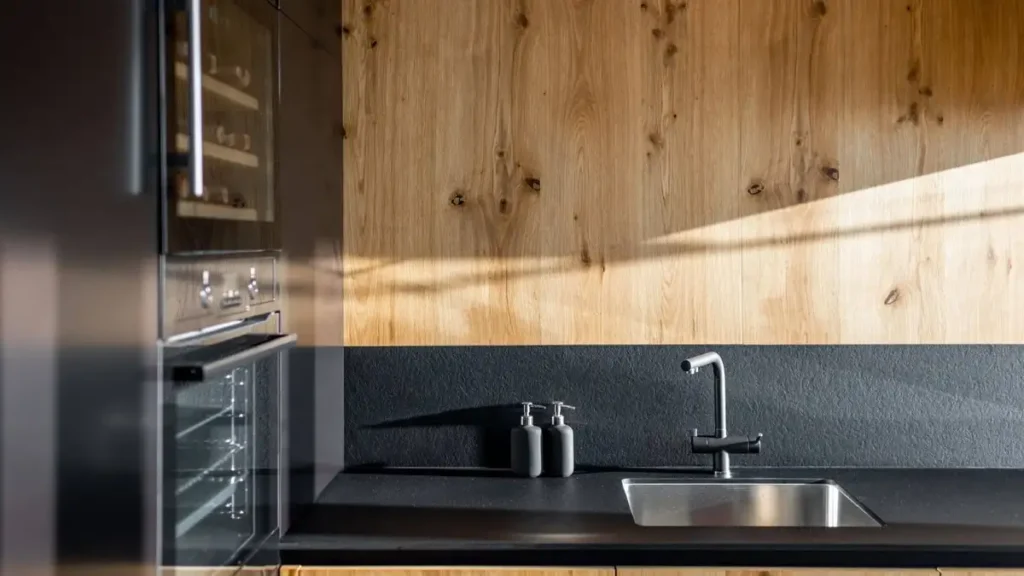
17. Wood-grain cabinets or refacing ($8,000 – $25,000)
59% of pros report wood grain passing painted finishes, and white oak leads at 51%. Homes & Gardens notes walnut, mahogany, and dark-stained oaks are replacing pale Scandinavian woods for a more lived-in feel. See it in our Great Falls walnut-and-white project.
18. Slab (flat-panel) cabinet doors ($8,000 – $20,000)
69% of NKBA members report slab doors gaining popularity. Houzz says they are showing up even in traditional kitchens, kept warm with wood tones and matte finishes. They clean easily (no grooves) and usually run 10-15% less than detailed door styles. Our Georgetown Bauformat kitchen shows the look.
19. Panel-ready integrated appliances (+$2,000 – $8,000)
72% say panel-faced refrigerators are trending; 85% say the same for dishwashers. Hiding the fridge behind cabinet panels is the single most effective step toward the “un-kitchen” look. We have watched guests spend a minute hunting for the refrigerator because it vanished into the run of cabinetry.
20 – 30. More moderate updates
- Workstation sink ($800 – $3,000): Deeper basins with cutting boards and racks that slide on built-in ledges turn the sink into a prep zone. It is consistently one of the most-loved upgrades homeowners mention after the fact.
- Appliance garage ($500 – $2,000): Lift-up or pocket doors keep the toaster and mixer ready but out of sight. See why an appliance garage works.
- Statement range hood ($1,000 – $6,000): Vent hoods rank at 85% importance, for air quality and looks. Wood, plaster, or stone-clad hoods lead 2026. Size the hood to the range, an underpowered hood is a daily annoyance, especially over gas.
- Induction cooktop retrofit ($1,500 – $5,000): Martha Stewart calls induction the future, even skeptics are converting. Flush installation, easy to clean, safer.
- Waterfall-edge island ($3,000 – $8,000): Stone cascading down the sides makes a focal point and protects the island edges. See island styles and ideas.
- Fluted island cladding ($1,000 – $4,000): Reeded panels in deep navy, forest green, or charcoal turn an island sculptural.
- Ceiling beams ($1,500 – $5,000): Faux or reclaimed wood for a modern-cottage feel.
- Beverage nook ($2,000 – $6,000): A wine fridge and small prep sink in an alcove for self-serve guests.
- Docking drawers ($200 – $600): In-drawer outlets keep devices charged and counters clear.
- Soft-close and push-to-open hardware ($500 – $2,000): Upgrade hinges and slides for a quieter, longer-lasting kitchen.
- Wallpaper the ceiling ($300 – $1,500): Grasscloth or subtle prints draw the eye up.
Category C: Full renovations ($30,000 – $150,000+)
Best for major remodels, extensions, and builds that need structural changes.
31. The “broken-plan” glass wall ($8,000 – $25,000)
2026 steps back from fully open-concept toward broken-plan layouts. Homes & Gardens explains that noise, cooking smells, and visual clutter in open spaces are pushing demand for subtle separation. Steel-and-glass partitions keep the light but block the noise, useful in a work-from-home house.
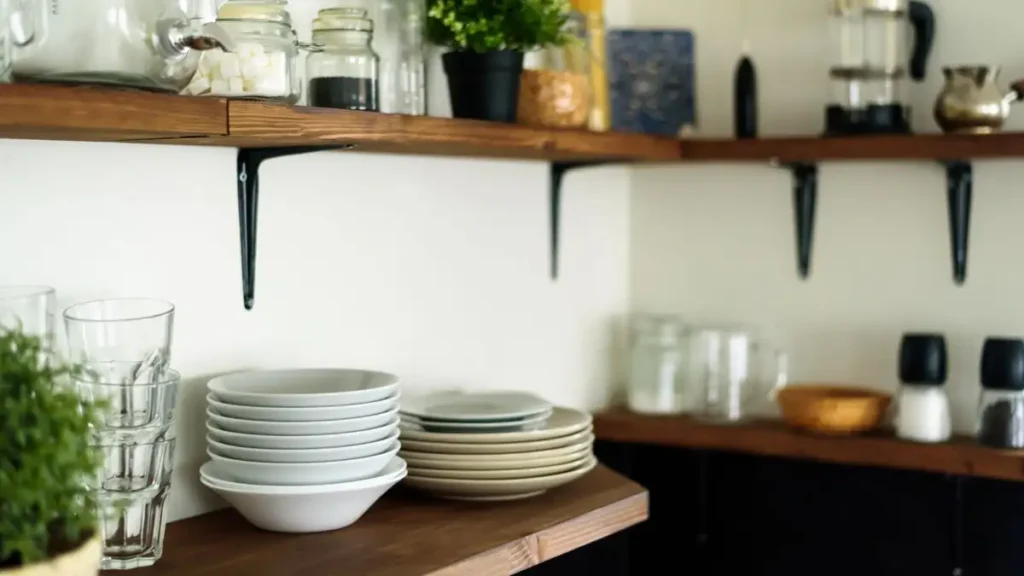
32. The hidden scullery ($15,000 – $40,000)
Martha Stewart reports walk-in pantries and prep kitchens becoming standard. Put the main sink, a second dishwasher, and the countertop appliances behind a cabinet-integrated door. The show kitchen stays pristine while the messy work happens out of view.
33. Furniture-style joinery ($25,000 – $60,000)
Cabinetry with legs, molding, and varied depths that reads like freestanding furniture. Unique Builders Texas notes bespoke cabinets with hidden storage and handcrafted finishes are now expected at this level.
34. The curved island ($10,000 – $30,000)
Homes & Gardens sums up 2026 as “curves, curves, and more curves.” A rounded or kidney-bean island improves flow and softens the room. Martha Stewart sees the same with edge profiles on counters and backsplashes.
35 – 45. More full-renovation ideas
- Double island ($20,000 – $50,000): One for prep, one for gathering. See our Park Creek dual-island project.
- Integrated hydroponic wall ($5,000 – $15,000): A plumbed vertical farm as living art and fresh produce.
- Radiant heated stone floors ($15,000 – $35,000): Warm underfoot, pairs with herringbone or low-contrast checkerboard.
- Pass-through window ($3,000 – $10,000): A bi-fold opening to an outdoor bar links inside and out.
- Breakfast larder ($8,000 – $20,000): Floor-to-ceiling cupboard with pocket doors and outlets hides the toaster and coffee gear.
- Architectural cove lighting ($3,000 – $10,000): Soffit-integrated LEDs that mimic skylights.
- Sintered stone flooring ($15,000 – $40,000): Large-format slabs flowing kitchen to patio.
- Acoustic ceiling treatment ($5,000 – $15,000): Wood-slat or acoustic plaster stops the echo-chamber effect.
- Smart composter drawer ($500 – $2,000): A powered pull-out for a Lomi or Reencle.
- Whole-home water conditioning ($3,000 – $8,000): Filtration that protects fixtures and improves cooking water.
- AI cooking suite ($10,000 – $30,000): Samsung Bespoke AI ovens and Thermomix-style systems.
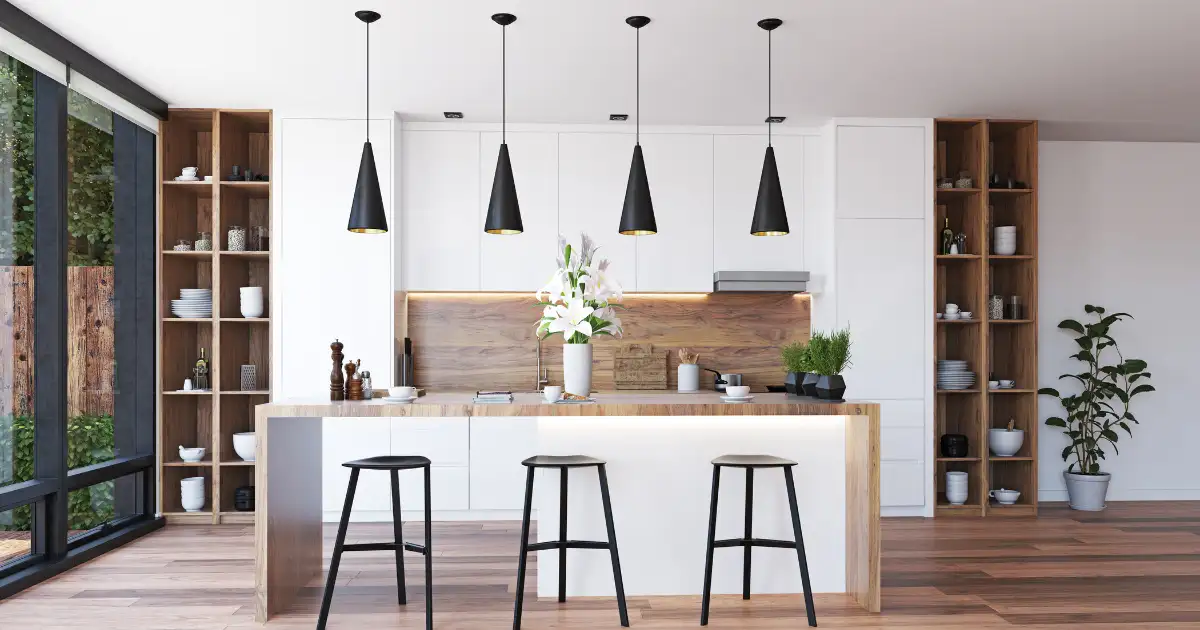
2026 countertop comparison
Martha Stewart reports clients are drawn to stones that tell a story: expressive veining, depth, natural movement. The NKBA puts natural quartzite at 62% popularity, just behind engineered quartz.
| Material | Cost / sq ft | Heat resistance | Sealing | 2026 status |
|---|---|---|---|---|
| Quartzite | $70 – $150 | Excellent | 1 – 2x / year | Top luxury pick (62%) |
| Quartz | $55 – $120 | Good | Never | Standard choice |
| Sintered stone | $75 – $150 | Fireproof | Never | Rising for indoor/outdoor flow |
| Marble | $75 – $150 | High | 2 – 4x / year | Niche, aging-in-place look |
| Butcher block | $40 – $75 | Low | Monthly | Rising with wood-grain trend |
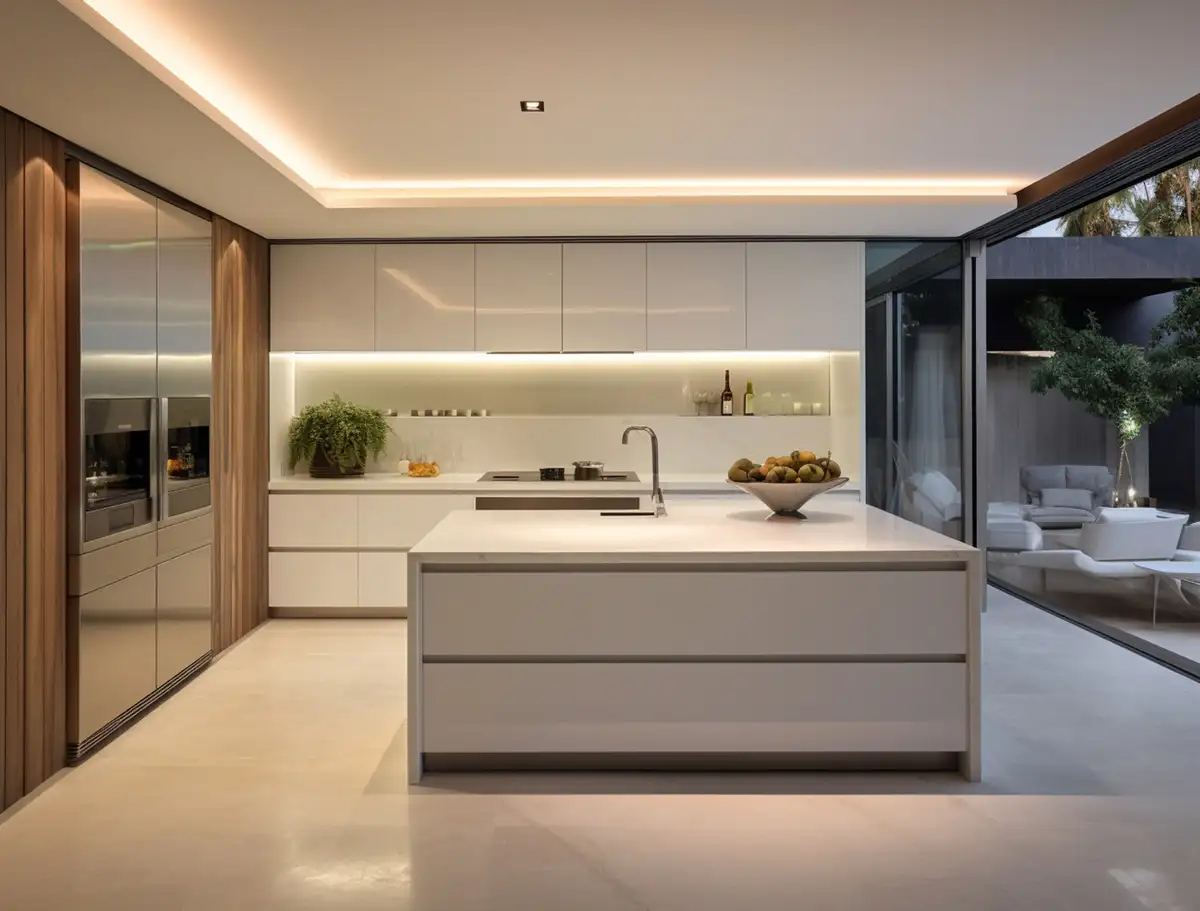
Before you buy cabinets: how to avoid the quality trap
Cabinets are usually the single biggest line item, and they are where the most painful surprises happen. Two patterns come up constantly from homeowners who have been burned: cheap online or builder-grade boxes that arrive as thin particleboard with tracks that jam, and semi-custom orders that show up in the wrong color or with visible flaws after the deposit is already paid. A little knowledge upfront prevents both.
| What to check | Why it matters |
|---|---|
| Box construction | Plywood boxes hold up to moisture and weight far better than particleboard. Ask what the box is made of, not just the door. |
| Drawer hardware | Full-extension, soft-close, dovetailed drawer boxes are the durability tell. Stapled boxes are not. |
| What “semi-custom” includes | Confirm sizes, finishes, and modifications in writing. “Semi-custom” means different things at different suppliers. |
| Order matches quote | Get the exact door style, color code, and box spec on the order. Check the delivery against it before install begins. |
We carry quality lines (Fabuwood, Showplace, Ultracraft, Bertch, Bauformat, Mantra, and others) for exactly this reason. The cheapest cabinet is rarely the least expensive once you factor in how soon you replace it.
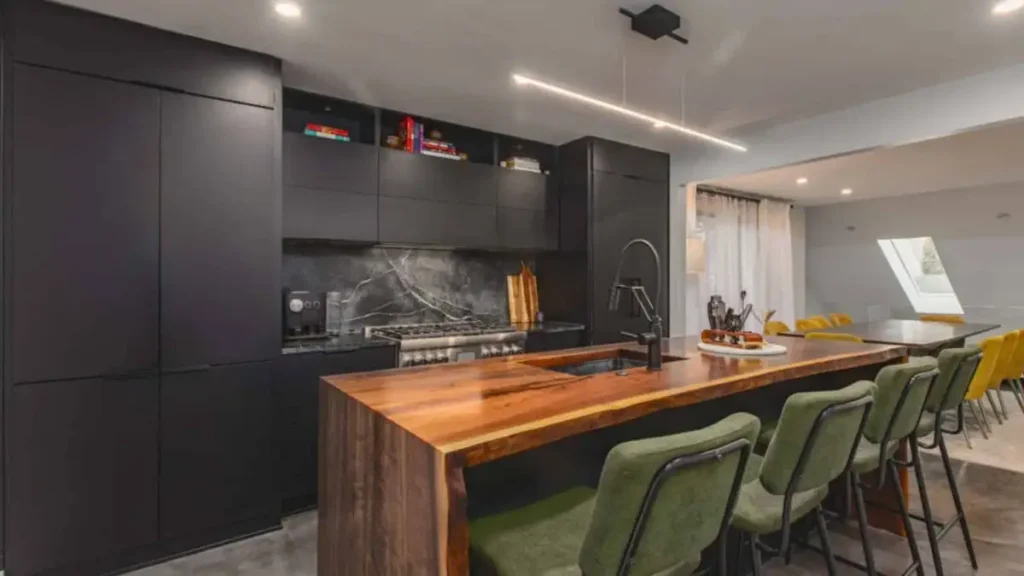
How a project actually runs (and how to avoid the disappearing-contractor nightmare)?
Ask anyone who has remodeled and you will hear the same two fears: the contractor who stops answering the phone, and the six-week job that turns into six months. Both are real. The fix is not luck, it is structure. Here is what a well-run project looks like and what to insist on from anyone you hire.
- A single point of contact. You should know the name of the person managing your project and how to reach them. Silence is the number-one complaint in remodeling forums, and it is avoidable.
- A written timeline with milestones. Not “a few weeks.” Dated stages: demo, rough-in, inspections, cabinets, countertop template and install, finishing.
- Scheduled check-ins. A standing update, even a quick one, beats wondering whether anyone is coming back.
- Honest delay causes named upfront. The usual culprits are custom cabinet lead times (4 – 8 weeks), countertop templating (2 – 4 weeks), inspection scheduling, and hidden issues found at demo. Knowing these in advance turns a “nightmare” into a plan.
| Project type | Quoted timeline | Realistic timeline |
|---|---|---|
| Cosmetic refresh | 1 – 2 weeks | 2 – 4 weeks |
| Mid-range remodel | 4 – 6 weeks | 8 – 12 weeks |
| Full gut renovation | 6 – 8 weeks | 3 – 6 months |
Want a kitchen team that picks up the phone?
See materials in person and get a written plan with real dates. Across the DMV and beyond.
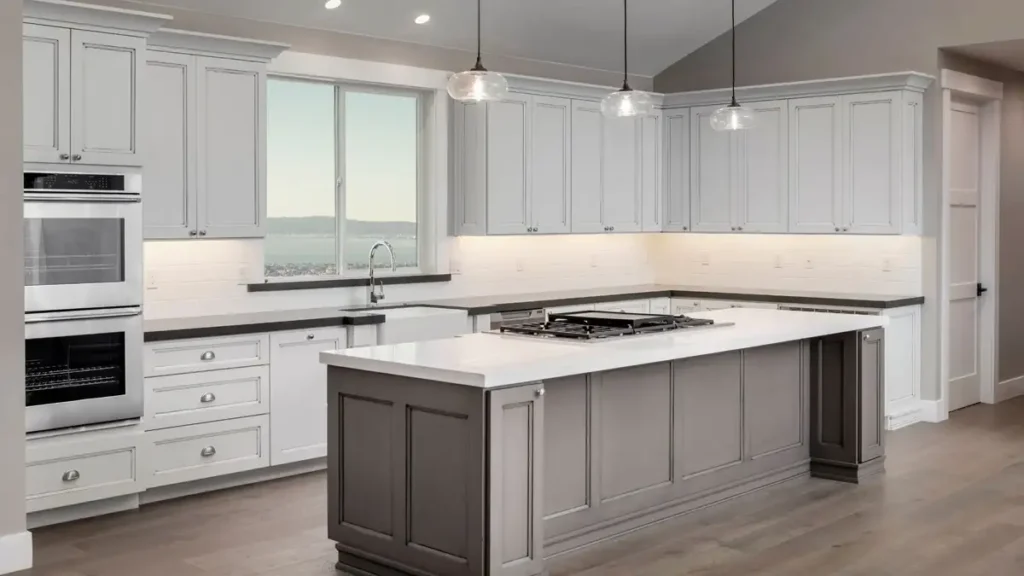
The regrets homeowners mention most (so you can skip them)
We pay attention to what people say after the dust settles, not just before. Across hundreds of homeowner discussions, the same regrets surface again and again, and they are nearly always functional, not aesthetic. They are cheap to avoid in planning and expensive to fix later. In rough order of how often they come up:
- Doors where drawers belonged. This is the number-one regret. The overwhelming consensus is that lower cabinets should be drawers, not doors. Reaching into the dark back corner of a base cabinet for a heavy pot gets old fast. If a full drawer-base swap is out of budget, retrofit pull-out shelves into the cabinets you keep, the access is almost as good for a fraction of the cost.
- Too few outlets, and the wrong wiring. Whatever number of outlets you think you need, add more. One specific, costly mistake people regret: putting the small-appliance circuit on the same circuit as the lights, so the lights dim every time the air fryer or microwave kicks on. Keep appliance circuits separate from lighting, and plan dedicated circuits for the heavy draws.
- Expensive designer appliances that fail early. A common, painful one: homeowners talked into top-dollar appliances that disappoint within four or five years, ice makers that quit, ovens slow to preheat, dishwashers that trap mold around the seal. Buy on reliability and serviceability, not just the badge.
- Cheaping out on the countertop. People report visible damage within months on bargain surfaces. This is the one place not to cut the budget.
- An island that is too big. Anything you cannot reach from a comfortable arm’s length becomes wasted center space. Bigger is not automatically better.
- A deep “black hole” pantry. Very deep fixed shelves swallow cans and boxes until they expire unseen at the back. Shallow shelves or pull-outs, plus a light that comes on when the door opens, fix it.
- A double sink instead of one large basin. When you do hand-wash, it is usually something big, a sheet pan, a stockpot, a cutting board. A single large basin (ideally a workstation sink) handles that far better than two half-size bowls.
- Weak ventilation and not enough upper-cabinet height. Size the hood to the range, and take cabinets to the ceiling for the storage rather than leaving a dust-collecting gap.
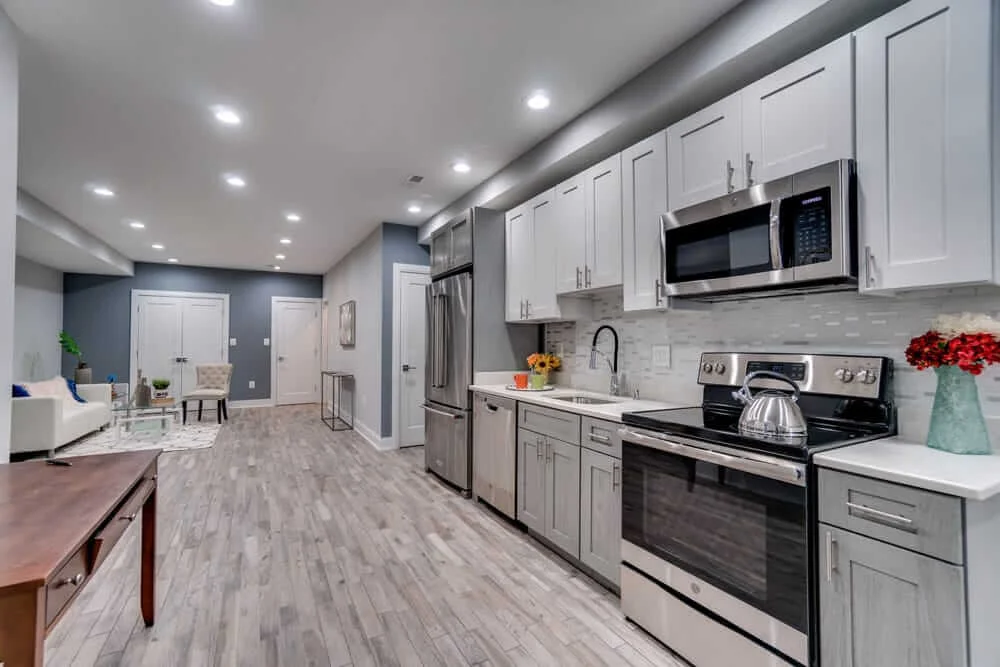
Trends to approach with your eyes open
Not everything that photographs well lives well. These are not “never do them,” they are “know the tradeoff first”:
- All-white kitchens. Still classic, but the 2026 mood has moved to warmer neutrals and wood. If you love white, ground it with a wood island or warm hardware so it does not read clinical.
- Handleless and push-to-open cabinets. They give the cleanest slab look (see our Georgetown project above), and we install them often. The honest tradeoff: matte and dark finishes show fingerprints, and push-latches see more wear. Choose a fingerprint-resistant finish if you cook a lot, and they hold up beautifully.
- Heavy two-tone contrast. Striking now, but high-contrast pairings can date faster than tonal ones. Keep contrast moderate if you want longevity.
- Industrial concrete finishes. Great in the right modern home, cold in the wrong one. Match it to your architecture.
- Single-use luxury features. A built-in that serves one rare function can cost prime cabinet space. Make sure the frequency justifies the footprint.
Timeless advice: choose for your home’s architecture and how you actually cook, not for a feed.
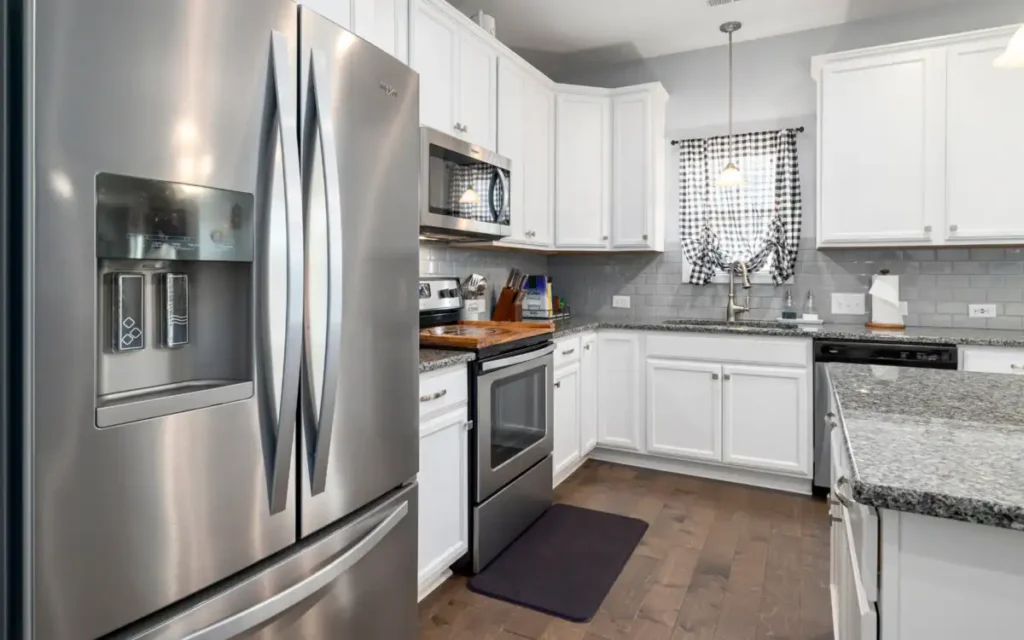
What USA Cabinet Store adds to all of the above?
Everything above is what we have learned from data, real projects, and the regrets people share once the work is done. Here is how we actually answer those pain points on our own jobs, and the reasons we get the kind of homeowner feedback we do. Across our 16 locations we have collected more than 600 Google reviews at a 4.8-star average, including 240+ at our Houston Upper Kirby showroom and 230+ across our Northern Virginia and Maryland showrooms, with several stores rated 4.9 or 5.0 stars. The patterns in those reviews track closely with the pain points in this guide:
- Budget discipline by design. When a client tells us their ceiling, we work the layout to get more out of the budget rather than upselling around it. Homeowners regularly mention designers who repositioned a stove or fridge to add usable counter space while staying on the original number.
- One project manager who actually answers. Every job gets a named manager you can reach by call or text. The single most repeated phrase in our reviews is some version of “always available” and “prompt to respond” — directly addressing the disappearing-contractor fear.
- Cabinet quality you can spec. Our default cabinet standard is ¾-inch KCMA-certified plywood boxes, not particleboard, with dovetailed soft-close drawers on quality lines like Fabuwood, Showplace, Ultracraft, Bertch, Bauformat, and Mantra. That is the difference between a cabinet that holds up for decades and the bargain-bin online cabinets that homeowners regret.
- Design that fits how you actually cook. Our designers do not run a template. They walk your space, ask how you use it, and tailor the plan, which is why “she studied every inch and every corner” and “doesn’t use a cookie-cutter design” come up so often in reviews.
- Free 3D design and consultation. Before you commit, you see your new kitchen rendered in 3D so the choices are real, not abstract. No design fee, no obligation.
- 14 showrooms and 13+ years of experience. Across Virginia, Maryland, DC, Texas, Tennessee, North Carolina, New Jersey, and Florida since 2011. NKBA, NARI, and Better Business Bureau accredited, with multiple Best of Houzz and Angi Super Service Award years on the record.
What clients tell us, in their own words:
“Our USA Cabinet Store designer created a plan that gave us more counter space while keeping us on budget. Her suggestion to move the stove out of the island and reposition the fridge completely transformed the layout into something more functional and efficient… Dennis, the manager, was always available via text or call and made sure everything ran smoothly.”
— Francesca Maniscalco, Google review
“From start to finish (design to kitchen remodel completion) Miyuki, Tarik, Eric & the construction team paid attention to every detail. They completed the project on target and communicated with us every step of the way.”
— Kim Edwards, Google review
“Not only do they have better quality and workmanship with their products, they are also affordable and willing to work within your budget… Project designer Pam studied every inch, every corner, to see which one works and looks better. And when she said it doesn’t work, you better believe it.”
— Ruben Joco, Google review
Frequently asked questions for 45 Kitchen Remodeling Ideas for 2026
How much does a kitchen remodel cost in 2026?
A medium kitchen averages $45,000 – $71,159 nationally and a large kitchen $95,000 – $137,228, per NKBA data. In the Virginia/Maryland/DC area, expect a full remodel of $45,000 – $95,000, with large and upscale projects reaching $140,000 – $155,293 and beyond. Minor cosmetic updates that keep the layout typically run $18,000 – $27,492. Two quotes for the same kitchen can differ by tens of thousands because of scope, cabinet quality, and what demo uncovers, so build in a 15-25% contingency. For the full cost breakdown, see our pillar guide: how much does a kitchen remodel cost.
How long does a kitchen remodel actually take?
A cosmetic refresh runs 2 – 4 weeks in reality, a mid-range remodel 8 – 12 weeks, and a full gut 3 – 6 months. The biggest delay drivers are custom cabinet lead times (4 – 8 weeks), countertop templating (2 – 4 weeks), inspections, and hidden issues found during demo. Plan for 30-50% more time than the rosiest estimate.
What kitchen style is most popular in 2026?
Transitional/timeless leads at 72% (NKBA), then contemporary minimalism at 60%. Houzz reports traditional rose 5 points year over year with English country influences. The overall direction is warm minimalism: clean lines softened by natural materials and warmer neutrals.
Are white kitchens still in style?
Mostly no. Real Simple reports stark white cabinets are on the way out. 96% of designers still recommend neutrals, but the move is to warmer taupes, mushrooms, putty, and stony greiges, with light wood now the leading cabinet finish.
What color is replacing gray in kitchens for 2026?
Cool gray is the big loser in 2026 — designers across Houzz, BHG, and Apartment Therapy’s surveys agree it’s the cabinet color most likely to date a kitchen now. What’s replacing it: warm neutrals (mushroom, putty, oatmeal, warm whites, creamy off-whites) and natural wood tones, particularly white oak (which 51% of designers name as their top finish). If you want color rather than neutral, deeper greens (sage, forest, olive) and inky blues are where designers are pointing. The pattern is clear: warmer, more organic, less corporate.
What is the best color for a kitchen in 2026?
There isn’t one “best” color, but the safest current choices fall into three buckets. For a neutral base that will age well, warm whites, cream, and light mushroom lead. For a warm wood look, white oak is the runaway favorite. For color, sage or forest green and deep navy are the most-cited 2026 picks; both pair beautifully with brass hardware and white oak. The unifying principle: choose warm undertones over cool ones, and pick natural-feeling finishes (matte, honed) over high-gloss. Picking for your actual kitchen’s light, layout, and architecture matters more than picking the “trend” color — a designer can walk you through that in a free consultation.
Are two-tone kitchen cabinets still in style for 2026?
Yes — two-tone is one of the strongest cabinet trends going into 2026, with industry surveys putting it at around 24% of new kitchens. The current playbook: lighter uppers (warm white, cream, light wood) paired with a darker base or island in navy, sage, forest green, charcoal, or matte black. Natural wood paired with a painted color is another rising combination — white oak uppers with a sage or navy island, for example. Two cautions: keep countertops and backsplash quieter so the cabinets stay the focal point, and avoid heavy high-contrast pairings that may date faster than tonal ones. Done well, two-tone is a low-risk way to add color without committing the whole kitchen to it.
What countertops are in style for 2026?
Quartzite leads at 62% (NKBA), with soft organic veining in greens and golds. Engineered quartz remains the most-installed material, but the look has shifted toward natural-stone mimics rather than uniform patterns. The two surface moves defining 2026: warmer neutrals (creamy off-whites with taupe, beige, and sandy gold veining instead of cool grays) and matte, honed, and leathered finishes replacing high-gloss, because they hide fingerprints and feel less clinical. Houzz and KBIS 2026 reporting also notes a rise in expressive “statement” stones with bold movement, full-height slab backsplashes (75% of designers say these are gaining), and waterfall island edges in the same material. Sintered stone is rising for indoor-outdoor flow, and butcher block is finding its way back in alongside the wood-grain trend. For the full material comparison, see the countertop section above.
Is granite out of style in 2026?
Granite as a material is not out of style, but certain looks are. What aged badly: the busy speckled “salt-and-pepper” granites and the warm cream-and-brown tones (Baltic brown, Santa Cecilia, Venetian Gold) that dominated early-2000s kitchens. What is current: granites with soft movement, subtle veining, and neutral palettes (whites and soft grays like Bianco Antico or White Ice), plus honed and leathered finishes instead of high gloss. Industry reporting in early 2026 actually points to a quiet granite resurgence as homeowners look for genuine natural stone over engineered surfaces. So if you love granite, choose a slab with calmer veining and a non-glossy finish, and skip the heavily speckled patterns. The material is fine; the pattern is what dates a kitchen.
What order should a kitchen be remodeled in?
The usual sequence: design and plan, estimate, permits, demo, plumbing and electrical rough-in, framing and flooring, inspections, cabinets, countertops, appliances, then backsplash and finishing. On flooring versus cabinets, install flooring first in tight kitchens; with custom cabinets, many installers set cabinets first for precise fit. Confirm the order with your contractor before demo starts.
How do I avoid a contractor who disappears or goes silent?
Insist on three things before signing: a named project manager you can reach, a written timeline with dated milestones, and a set schedule for updates. Poor communication is the single most common complaint in remodeling forums, and these three safeguards prevent most of it. Be cautious with very large upfront deposits tied to no clear schedule.
How do I make sure I get the cabinets I actually ordered?
Get the exact door style, color code, box material, and any modifications written on the order. Ask whether boxes are plywood or particleboard and whether drawers are dovetailed and soft-close. When the cabinets arrive, check them against the order before installation begins. Wrong-color and defective deliveries are a common and avoidable headache.
Is a kitchen remodel worth it? What’s the ROI?
Typical ROI is 50-60%, so a $75,000 remodel adds roughly $37,000 – $45,000 in home value. A badly outdated kitchen can return more by restoring market competitiveness. Remodel mainly for daily enjoyment; if you are selling within two years, focus on cosmetic updates for the best return per dollar.
Do I need permits for my kitchen remodel?
Usually no permit for cabinet and countertop swaps, flooring, paint, hardware, or light fixtures. Usually yes for new electrical circuits, plumbing relocation, gas lines, wall removal, or HVAC changes. Call your local building department directly rather than relying on a contractor’s word. Unpermitted work can cause resale problems and void insurance.
DIY or hire a professional?
Good DIY candidates: demo, cabinet painting, backsplash tile, hardware, LVP flooring. Hire out electrical, plumbing, gas, countertop fabrication, and structural work. DIY can save up to 50% but often stretches into 6 – 12 months of evenings and weekends. Budget your time as honestly as your money.
What makes a kitchen look outdated?
Going into 2026, the patterns designers say age a kitchen most are: cool gray cabinets (the single most-dated look in current surveys), stark all-white kitchens with chrome hardware, busy speckled granites (especially the cream-and-brown Baltic brown and Santa Cecilia tones), high-gloss finishes on anything, cool-toned silver and chrome fixtures (warmer brass, bronze, and champagne are replacing them), and tuscan-style heavy ornate cabinetry. On the structural side: doors instead of drawers on lower cabinets, undersized vent hoods, too few outlets, and over-the-range microwaves all read as dated, mostly because they don’t work well. The good news: most of these can be fixed without a full remodel. Hardware, paint, lighting, and a stone refresh handle a lot of it.
Ready to start your kitchen remodel?
Your kitchen can be backed by data and built by a team that communicates. We have helped over 1,000 homeowners across Virginia, Maryland, and the DC metro create kitchens they love, from weekend refreshes to six-figure transformations.
Visit our showrooms to plan your kitchen in person
See cabinet door styles, finishes, countertops, and hardware up close at any of our locations. Our designers can walk you through ideas from this guide and price them for your space.
Virginia
Chantilly – 3857 B, Dulles S Ct, Chantilly, VA 20151 | (703) 544-2255
Fairfax – 2832 Dorr Ave Suite E, Fairfax, VA 22031 | (703) 436-6444
Chesapeake – 1543 Sam’s Cir Unit B, Chesapeake, VA 23320 | (757) 581-1696
Tyson’s Corner – 8150 Leesburg Pike STE #170, Vienna, VA 22182 | (703) 745-5662
Maryland
Annapolis – 508 Chinquapin Round Rd Ste:A, Annapolis, MD 21401 | (410) 855-4901
Columbia – 9400 Snowden River Pkwy #105, Columbia, MD 21045 | (410) 694-7100
Want a real number for your kitchen?
Get a ballpark in seconds with our free Northern Virginia Remodeling Cost Calculator, or book a 15-minute consultation for a realistic range tailored to your specific space and goals.
 Updated for 2026 Market Rates
Northern Virginia Remodeling Budget Planner
Provided by USA Cabinet Store
Project Configuration
Define your dream space and your live cost projection appears at the bottom.
© USA Cabinet Store. All Rights Reserved.
Visit our official website: usacabinetstore.com
NOVA 2026 Pricing Index v3.0
Texas
Houston – 3471 Kirby Drive, Houston, TX 77098 | (713) 597-5030
Houston North – 27718 Interstate 45 N, Oak Ridge North, TX 77385 | (281) 306-6060
Additional locations
Nashville – 203 North Anderson Lane STE. 103, Hendersonville, TN 37075 | (615) 669-6909
Cary – 2226 Walnut St, Cary, NC 27518 | (919) 462-7272
Cherry Hill – 2076 Marlton Pike East Suite 3, Cherry Hill, NJ 08003 | (609) 888-8181
Tampa – 11913 N Dale Mabry Hwy, Tampa, FL 33618 | (813) 395-9900
Orlando – 5812 Red Bug Lake Rd, Winter Springs, FL 32708, United States
Sources & citations: NKBA 2026 Kitchen Trends Report (634 professionals surveyed); Houzz 2026 U.S. Home Design Trend Predictions; Houzz 2025 U.S. Kitchen Trends Study (1,620 homeowners); Remodeling Magazine 2024 Cost vs. Value Report. Homeowner regret and pain-point themes synthesized from public discussions on Reddit (r/kitchenremodel, r/DesignMyRoom, r/Remodel, r/HomeImprovement).