
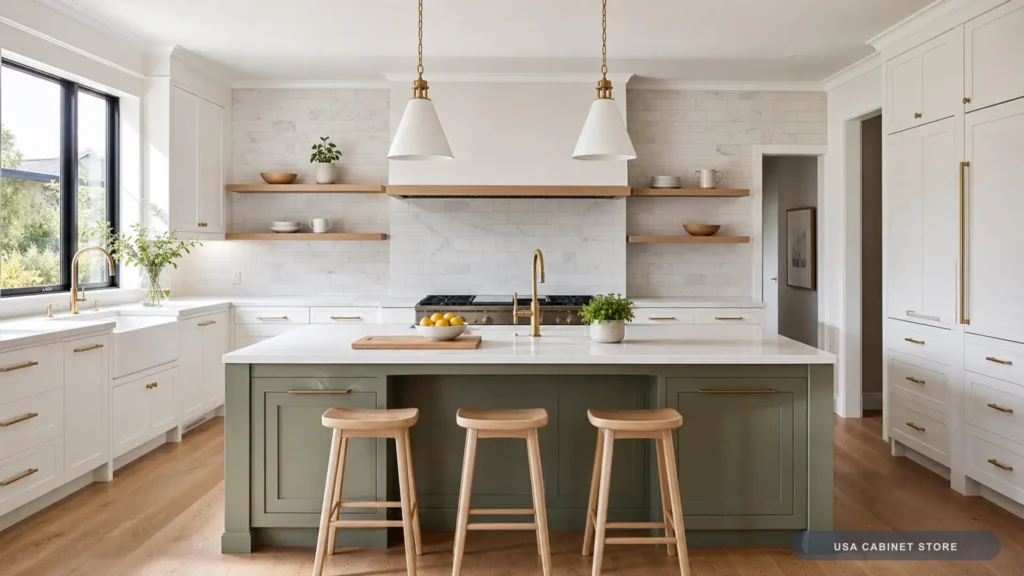


Cabinets are the single biggest line item in most kitchen remodels, and the one decision you live with longest. Get the box, the door style, and the construction right, and everything else in the room has something to lean on. Get them wrong, and no countertop or backsplash will save the look.
This guide walks you through every choice that matters: the four ways cabinets are sold, framed versus frameless construction, box and door materials, sizes, door styles, finishes, hardware, storage, and real 2026 pricing. We have sold kitchen cabinets since 2011 and run more than 14 showrooms across seven states, so the advice here is the same advice our designers give in person. By the end you will know exactly what to ask for before you ever set foot in a showroom.
- Tight budget or fast timeline: RTA or stock, framed, with a plywood box. Start here.
- Odd layout, or you want it to fit the room exactly: semi-custom.
- Modern and handleless, or a small kitchen you want to maximize: frameless.
- Inset doors or traditional detailing: framed, and budget a little more.
Full detail below, or jump to the buying checklist.
Kitchen Cabinets at a Glance
Not sure where to start? Bring your measurements to one of our showrooms and a designer will price your real kitchen across multiple lines in one sitting, free.
Book a Free Design Consultation →
The 4 Types of Kitchen Cabinets
Before you think about color or door style, decide how the cabinets are made and sold. There are four tiers, and they trade price against flexibility and lead time.
Ready-to-assemble (RTA) cabinets
RTA cabinets ship flat and get assembled on site or before delivery. The myth is that flat-pack means flimsy. It does not have to. Our own RTA line uses a plywood box, ¾-inch solid wood door frames, ⅝-inch dovetail drawer boxes, and soft-close hinges, then stocks it locally for days-not-weeks delivery. RTA is the lowest-cost route to a quality box, and it is the fastest. If you have a standard layout and a tight timeline, start here.
Stock cabinets
Stock cabinets come pre-built in fixed sizes, usually in 3-inch width increments. You get a strong menu of styles and finishes at a budget-friendly price, and short lead times. The catch is sizing. If your kitchen has an odd jog, a radiator in the way, or a run that does not divide cleanly into 3-inch steps, you fill the gaps with filler strips. For most rectangular kitchens, stock is the value sweet spot.
Semi-custom cabinets
Semi-custom is the middle ground most remodels land on. You start from a manufacturer's catalog but modify widths, heights, and depths in small increments, add inset doors or specialty inserts, and choose from a far wider finish range. You pay more than stock and wait a few weeks longer, but you can design a kitchen that actually fits the room instead of fitting the room to the cabinets.
Custom cabinets
Custom cabinets are built to order to any size, any configuration, any finish. This is the route for unusual layouts, statement pieces, and homeowners who want every interior fitting dialed in. It carries the highest price and the longest lead time, but nothing else gives you the same control. If you have a galley with three different ceiling heights or you want a true furniture-grade island, custom earns its cost.
| Type | Best for | Sizing flexibility | Lead time | Relative cost |
|---|---|---|---|---|
| RTA | Fast, standard layouts, value-focused | Low | Days | $ |
| Stock | Rectangular kitchens on a budget | Low (3″ steps) | ~2–4 weeks | $ |
| Semi-custom | Most remodels, real-room fit | Medium–high | ~5–8 weeks | $$ |
| Custom | Odd layouts, statement kitchens | Unlimited | ~6–14 weeks | $$$–$$$$ |
Framed or Frameless: The Single Biggest Decision
The first real question is not which brand. It is which box. Framed versus frameless construction drives drawer capacity, interior access, which door styles you can use, and how the doors sit on the cabinet. Get this right and the brand shortlist sorts itself out.
Framed cabinets
A framed cabinet has a face frame, a flat border of wood, attached to the front of the box. Doors mount to that frame. This is the most common construction in American kitchens. Interior access is slightly tighter because the frame narrows the opening by about an inch to an inch and a half per side. What you get in return is rock-solid door alignment over time and access to traditional door styles, including inset, where the door sits flush inside the frame. Most of our framed lines are Fabuwood, Mantra, 1951, Showplace, Legacy Crafted, and Bertch.
Frameless cabinets
A frameless cabinet, also called full-access or European style, has no face frame. Doors and drawer glides attach directly to the box, giving you a wider opening, more usable drawer space, and a clean, modern line. Frameless is the better choice for slab doors, handleless pulls, and squeezing maximum storage out of a small kitchen. Our frameless options are Showplace EVO, UltraCraft (a full-access, frameless maker since 1986), and Bauformat, the only true German-engineered frameless system in our catalog.
Want inset doors, a beaded face frame, or traditional detailing? Go framed. Want slab doors, handleless pulls, or the most drawer storage in a small kitchen? Go frameless. Almost everything else is noise.
Box and Drawer Materials: What Actually Lasts
The cabinet box you never see decides how long the kitchen lasts. The box and drawers can be built from any of these, running worst to best for a room that deals with steam and spills.
| Material | What it is | Holds up to kitchen moisture? |
|---|---|---|
| Particle board / furniture board | Recycled wood bonded with resin under heat and pressure | Weakest. Swells if water sits on it |
| MDF | Wood fibers compressed into a dense, smooth panel | Good. Stable, paints beautifully, heavier |
| HDF | Higher-density version of MDF | Stronger than MDF |
| Plywood | Thin wood veneers cross-glued at 90 degrees | Best all-around. Strong, light, screw-holding, water-tolerant |
| Solid wood | Kiln-dried lumber milled from timber | Excellent for doors and frames; can move with humidity in large panels |
Two specs do more than any others to separate a cabinet that lasts for decades from one that loosens early: a plywood box and dovetail drawer boxes. Dovetail joints interlock instead of relying on staples or glue alone, so heavily loaded drawers stay square. That said, durability is not only about the box material. Panel thickness, edge sealing, back-panel construction, the drawer-glide rating, and the quality of the install all matter too. Ask about the box and the drawers by name. On our value lines like RTA and 1951, dovetail drawers come standard, which is unusual at that price.
Wood Species for Doors and Fronts
Door fronts and face frames come in different hardwoods, and the species changes both the look and the durability. If you are staining rather than painting, this choice matters even more because the grain shows.
- Maple: Dense and smooth with a subtle grain. Takes paint and stain evenly, resists dents. The default for painted Shaker.
- Hickory: Very hard with dramatic grain and color variation. Great for rustic and farmhouse looks.
- Cherry: Rich, fine grain that deepens with age. A traditional, formal choice.
- Oak: Open, pronounced grain. White oak in particular is having a major moment for warm, natural kitchens.
- Birch and alder: Economical hardwoods that bring real-wood warmth at a friendlier price.
- MDF (for painted doors): Technically not a species, but a smooth painted MDF door avoids the grain telegraphing and seasonal movement you can get with solid painted wood.
Cabinet Sizes and Configurations
Cabinets fall into three families by where they live in the room. Knowing the standard dimensions helps you sanity-check any quote and plan your layout.
| Cabinet | Typical height | Typical depth | Typical width |
|---|---|---|---|
| Base | 34.5″ (36″ with countertop) | 24″ | 12″–48″ |
| Wall | 12″–42″ | 12″–24″ | 12″–36″ |
| Pantry / tall | 84″–96″ | 12″–24″ | 12″–36″ |
Within those families, watch for the specialty boxes that make or break a layout: sink base cabinets (false drawer front, open back for plumbing), corner cabinets (a blind corner hides space behind an adjoining cabinet, while a lazy Susan rotates to reach it), and pantry cabinets that turn vertical space into serious storage. Corners are where cheap layouts waste the most room, so plan them deliberately.
Door Overlay: Partial, Full, or Inset
Overlay describes how much of the cabinet face the door covers. It is a small word with a big effect on the final look and the price.
- Partial overlay: The most traditional and least expensive. The door leaves about an inch of face frame showing, and you can often skip hardware.
- Full overlay: The door covers nearly the entire face frame, leaving a slim reveal. It gives a custom look at a lower cost than inset and needs hardware to open.
- Inset: The door sits flush inside the frame, like fine furniture. It is the most refined and the most expensive, requires precise construction, and gives you slightly less interior space. Inset is only available on framed cabinets, which is one reason framed construction still matters.
Door Styles Carry the Look
The doors are the most visible part of any kitchen, so this is where personality lives. The main styles:
- Shaker: A flat recessed panel inside a square frame of rails and stiles. The most versatile style in America. Works painted or stained, traditional or modern.
- Slab / flat panel: A single flat surface with no detailing. A staple of modern and minimalist kitchens, and one of the most-requested looks heading into 2026.
- Raised panel: A center panel raised above the frame, often with beading. Reads traditional and substantial.
- Cathedral / arched: A raised or recessed panel with an arch at the top. Formal and classic, especially in stained wood.
- Beadboard: An inset panel of grooved vertical planks. Adds cottage and farmhouse texture.
- Glass front: A framed door with glass for display, sometimes lit from inside. Elegant, but it asks you to keep the interior tidy.
- Louvered: Angled horizontal slats. Less common in kitchens, useful where ventilation helps.
Thinking two-tone? Keep the door style identical on the uppers and lowers and change only the color. Mixing the style and the color at the same time is the number one reason a two-tone kitchen ends up looking busy instead of custom.
Colors, Finishes, and 2026 Trends
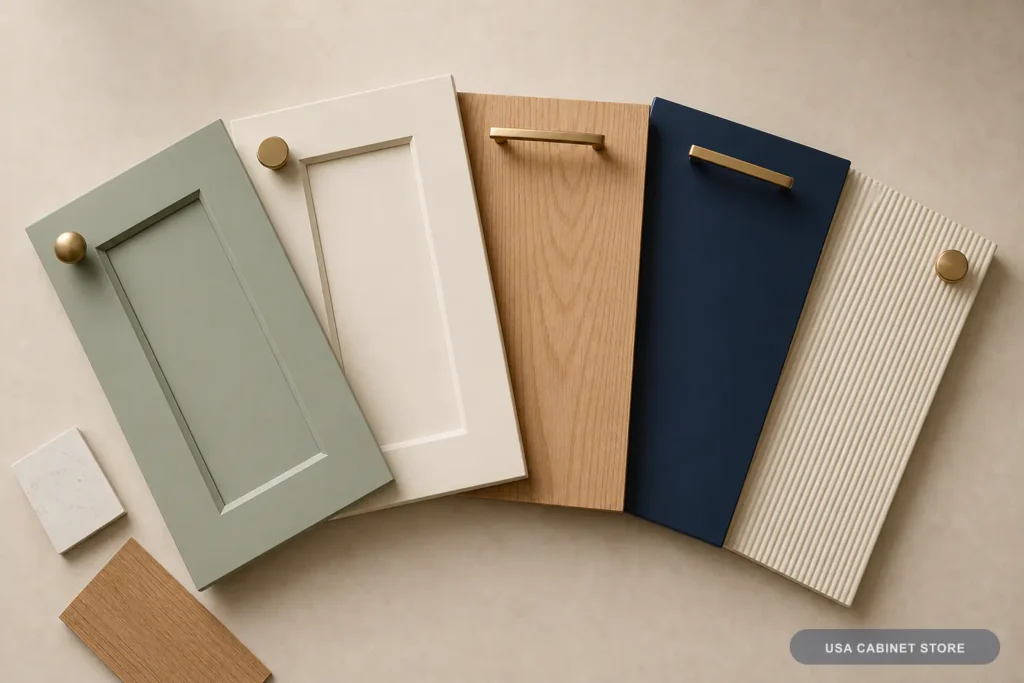
Finish is where cabinets stop being a product and start being your kitchen. Your core options are unfinished, stained (shows the grain), painted (the most popular, needs the most care), thermofoil (a vinyl layer over MDF, easy to clean), and glazed (an accent coat for an antiqued look). Paint sheen matters too: satin and semi-gloss clean up far easier than matte.
What people are actually choosing is shifting fast. The National Kitchen and Bath Association surveyed more than 600 design professionals for its 2026 Kitchen Trends Report, and the headline is the end of the cold all-white, all-grey kitchen. Four shifts stand out:
Color is back
Neutrals still lead (cited by 96% of NKBA pros), but green is the standout accent color at 86%, with blue close behind at 78%. Warm creams, taupe, and mushroom are replacing cold grey, and deep navy or burgundy islands are mainstream.
Wood grain over paint
Wood grain has passed painted cabinets in momentum: 59% of NKBA pros say it is growing, and white oak is the single most-requested look. Two-tone kitchens are normal now, and reeded or fluted fronts add a texture flat paint can't.
Warm minimalism
Contemporary and minimalist sits just behind transitional as a top style. That means slab fronts, matte low-sheen finishes, and handleless pulls, but warmed up with wood and color instead of stark white.
Bigger, harder-working kitchens
76% of NKBA pros expect kitchen footprints to grow, often at the expense of formal dining. Expect full cabinet walls, zoned coffee and baking stations, appliance garages, and furniture-style pieces.
The throughline across the NKBA report is timelessness. Transitional design tops the style list at 72%, which is a useful reminder: chase texture and warmth over trendy color you will regret. A green or navy island is easy to repaint later; a whole kitchen in a fad color is not.
See the 2026 finishes in person
Photos lie about color and texture. Our showrooms display working doors in the trending greens, warm woods, and reeded fronts so you can judge them in real light.
Find a Showroom → Book a Consultation →
Hardware: The Detail That Finishes the Room
Hardware is small but it sets the tone, and the mechanical parts you cannot see matter as much as the knobs you can.
- Pulls: Long, slim handles you grip with your hand. Sleek, modern, and easy on arthritic hands. The default for drawers.
- Knobs: The classic round opener, available in metal, wood, ceramic, and glass. Often paired with pulls (knobs on doors, pulls on drawers).
- Hinges: Insist on soft-close. It is standard on quality lines and stops the slam that loosens doors over years.
- Drawer glides: Look for full-extension, undermount, soft-close glides. They let you reach the back of the drawer and carry more weight than side-mount glides.
- Finishes: Brushed brass and gold are the current favorites, with matte black as a contrast. Unlacquered brass ages; lacquered stays put.
One 2026 note from the trend data: statement hardware is in. Oversized pulls and mixed metals are being used as jewelry for the kitchen rather than hidden away.
Bring a drawer from your current kitchen, or at least a photo of the inside, when you visit the showroom. Nine times out of ten the thing people actually hate is not the door color, it is that the drawers are shallow and stapled together. Deep dovetail drawers next to the stove fix more daily annoyance than any finish.
Storage and Accessibility Upgrades
The interior fittings decide whether a good kitchen becomes one you actually love using. Many of these can be added to semi-custom and custom orders, and a few to stock lines.
- Pull-out shelves, drawer organizers, and roll-out trays so nothing gets lost at the back.
- Lazy Susans and corner pull-outs to reclaim dead corner space.
- Tip-out trays at the sink, deep pot drawers, and built-in trash and recycling pull-outs.
- Appliance garages and zoned stations (coffee, baking) to clear the counters, a top 2026 request.
- Accessible features: pull-down shelves, elevated toe kicks for wheelchair clearance, varied counter heights, and raised dishwasher cabinets to reduce bending.
How Much Do Kitchen Cabinets Cost in 2026?
Cabinet pricing depends on the type, the box and door material, the size of the kitchen, and the complexity of the install. Independent industry cost guides generally put cabinets at roughly $100 to $300 per linear foot for stock and RTA, $150 to $650 for semi-custom, and $500 or more for custom, which lands most kitchens somewhere between about $5,000 and $25,000 for the cabinetry installed.
The table below is a different measurement, so read it carefully. These are complete installed projects from our own catalog, covering cabinetry, installation and the surrounding trades rather than cabinet list prices alone. That is why the numbers sit well above the per-linear-foot figures above.
| Tier | Lines | What you get | Typical installed project range |
|---|---|---|---|
| $ Value / stock | RTA, Fabuwood, Mantra, 1951 | Plywood box, dovetail drawers on RTA & 1951, strong painted Shaker menu, fast lead times | $15K–$27K |
| $$ Semi-custom | Showplace, Showplace EVO, Legacy Crafted | Modified widths and heights, broader catalog, inset available on select lines | $40K–$78K |
| $$$ Semi-custom to custom | Bertch, UltraCraft | Near-custom sizing, full finish palette, inset and beaded frames, upgraded drawer boxes | $78K–$155K |
| $$$$ German frameless | Bauformat | Engineered handleless system, integrated appliance panels, tightest factory tolerances | Quoted per project |
Want the cabinets-only number for your layout? Bring your measurements to a showroom and we will price the boxes and the installed project side by side.
A few honest notes from pricing real kitchens. Modifications add up: in our experience, changes like reduced-depth wall cabinets or custom fillers on stock lines often add roughly 10 to 20 percent and can stretch a two-week lead toward a month. For an irregular galley, the stock savings can vanish once the mods are priced in, which is the moment semi-custom starts to make sense. And on a standard 10-by-10 Shaker kitchen with no modifications, our locally stocked RTA line is usually the fastest to install, and in our showrooms it has held up as well as stock brands that cost more.
The 9 Cabinet Lines We Stock
Most stores sell one or two brands and bend your kitchen to fit them. We carry nine lines on purpose, so the cabinet fits the project instead of the other way around, from RTA value up to German-engineered frameless. The full lineup at a glance:
| Line | Construction | Level | Door styles | Lead time | Made in |
|---|---|---|---|---|---|
| RTA Cabinets | Framed | RTA value line | Shaker white, grey, blue | In-stock, days | Fabuwood-backed, locally stocked |
| Fabuwood | Framed | Stock / semi-custom | Shaker, raised-panel, slab | 2–3 weeks | Assembled in USA (NJ) |
| Mantra | Framed | Stock / semi-custom | Shaker, slab | 3–5 weeks | USA |
| 1951 Cabinetry | Framed | Stock / semi-custom | Shaker, slab | ~3–5 weeks | USA |
| Showplace | Framed | Semi-custom | Shaker, inset, raised-panel, slab, mullion | 5–7 weeks | USA (SD, employee-owned) |
| Showplace EVO | Frameless | Semi-custom | Shaker, slab, handleless | 5–7 weeks | USA (SD) |
| Legacy Crafted | Framed | Semi-custom | Shaker, raised-panel, glazed, inset | 4–6 weeks | USA (since 1998) |
| Bertch | Framed | Semi-custom / custom | Shaker, inset, beaded, raised-panel, slab | 6–8 weeks | USA (IA, since 1977) |
| UltraCraft | Frameless | Custom / built-to-order | Full catalog | 6–10 weeks | USA |
| Bauformat | Frameless | Modular / engineered | Slab, high-gloss, matte, wood-grain foils | 10–14 weeks | Germany |
Note: Showplace EVO is the frameless sub-line of Showplace, shown as its own row above for construction comparison but counted once, so the list totals our nine core lines. For current pricing and availability, see our kitchen cabinets product page.
And cabinets are not just for the kitchen. The same lines build bathroom vanities, laundry rooms, mudrooms, and home offices, so a whole-home project can stay coordinated from one factory. See the full breakdown on our kitchen cabinets and bathroom cabinets pages, or explore our cabinetry service.
How to Choose: A Simple Buying Checklist
Run through these in order and the decisions stop fighting each other.
- Set the budget tier ($ value, $$ semi-custom, $$$ custom). It rules most other choices in or out.
- Pick framed or frameless based on whether you want inset/traditional or slab/maximum storage.
- Confirm the box and drawer spec (plywood box, dovetail drawers, soft-close).
- Measure the room and flag corners, jogs, and anything odd that points toward semi-custom.
- Choose door style, overlay, and finish in that order.
- Check the lead time against your project timeline before you fall in love with a line.
- Get it priced as installed, with modifications included, so you compare apples to apples.
Measuring tip: sketch the room, mark every wall length, window, door, outlet, and the centerline of your sink plumbing. A designer can turn that into a real quote, and an accurate measure is what keeps a stock order from quietly turning into a semi-custom one.
Why Buy Cabinets From USA Cabinet Store
We have sold cabinets since 2011 and run more than 14 showrooms across Virginia, Maryland, North Carolina, Texas, New Jersey, Florida, and Tennessee. Because we carry nine lines, our designers can price your exact kitchen across value, semi-custom, and custom in a single visit instead of selling you the one brand they happen to stock. Design, measure, and installation are part of our service on most projects, and we handle warranty support directly for the lines we sell rather than leaving you to chase a manufacturer. That matters most on European, inset, and full-custom orders where the details are unforgiving.
“After 15 years and more than 14 showrooms, the pattern is clear. The homeowners who are happiest six months later are the ones who settled construction and box quality first, and chose the color last. Get the plywood box and the dovetail drawers right, and you will love the kitchen long after the trend color has moved on.”
Ready to design your kitchen?
Book a free consultation and we'll help you choose the right line, door style, and finish for your space and budget, with measure and installation included.
Book a Free Consultation → Find Your Showroom →Showrooms in Ashburn, Chantilly, Fairfax, Virginia Beach, Tysons Corner, Annapolis, Columbia, Cary, Houston, Cherry Hill, Tampa, Orlando & Nashville.
Straight Answers to What Homeowners Actually Ask
The concerns below are paraphrased and condensed from real kitchen-remodeling discussions on Reddit. They come up on nearly every thread about buying cabinets. Here are honest answers, not sales spin.
“The final price feels insanely high with high pressure sales tactics... If you have a ‘bad’ feeling, move on.” · r/AskChicago
High-pressure pricing and “today only” discounts are the most common complaint online. One homeowner was quoted $38,000, “discounted” to $24,000 for refacing, walked away, and finished a full remodel elsewhere for far less. Because we carry nine lines, a designer prices your real kitchen across value, semi-custom, and custom in one sitting, then lets you leave and think. If a quote only works when you sign now, slow down.
“It’s only face, not full cabinet replacement.” · r/AskChicago
Refacing keeps your existing boxes and swaps the doors, fronts, and veneer. It is cheaper and faster, and it is a smart move when the boxes are solid. But if the boxes are sagging particle board or the layout is wrong, new doors just dress up a failing frame. Reface when only the look is dated; replace when the box or the layout is the real problem.
“Start with small changes and live with them for a while. New lighting, countertops, backsplash, and pulls make the biggest visual difference.” · r/kitchenremodel
This is the best advice on the internet for anyone who just bought a house. You rarely need a full gut. New fronts and hardware, a fast RTA install, or a painted island against lighter perimeter cabinets can transform the room for a fraction of the cost. Start with what bothers you most and price the smallest change that fixes it.
“Add panels or false doors to the ends of all cabinets to make them match. Our local cabinet store sells eight brands.” · r/kitchenremodel
Matching an addition to what you already have is exactly where a multi-line store earns its keep. We carry nine lines, so we can match an existing finish or blend in new cabinets instead of forcing one brand to cover a job it does not fit. A single-brand store cannot always do that.
Kitchen Cabinet Buying Guide FAQs
What is the difference between framed and frameless cabinets?
Framed cabinets have a face frame on the front of the box that doors mount to, giving rock-solid alignment and access to inset and traditional styles. Frameless (European, full-access) cabinets have no face frame, so doors attach directly to the box for a wider opening, more drawer space, and a cleaner modern look. Choose framed for inset and traditional detailing, frameless for slab doors and maximum storage.
How much do kitchen cabinets cost in 2026?
For the cabinets alone, installed, a standard kitchen usually runs about $4,500 to $15,000 depending on material and tier. A complete kitchen project is a different number. Our value and stock lines (RTA, Fabuwood, Mantra, 1951) typically land at $15K–$27K, semi-custom lines (Showplace, Legacy Crafted) at $40K–$78K, and semi-custom to custom (Bertch, UltraCraft) at $78K–$155K. Those ranges cover cabinetry, installation and the surrounding trades, not cabinet list prices. German frameless (Bauformat) is quoted per project.
What is the average cost of kitchen cabinets per linear foot?
Installed, stock and RTA cabinets run about $100 to $300 per linear foot, semi-custom about $150 to $650, and fully custom $500 to $1,200 or more. For a standard kitchen that usually works out to roughly $4,500 to $15,000 for cabinets, depending on material and tier.
What is the most expensive part of a kitchen remodel?
Cabinetry, almost always. It typically takes up 30 to 40 percent of the total remodel budget, followed by labor at 20 to 25 percent and appliances at 10 to 20 percent. That is why getting the cabinet decision right matters so much to the overall cost.
What is the cheapest way to update kitchen cabinets?
If the boxes are solid, paint or reface them and swap the hardware for the biggest visual change at the lowest cost. If you are replacing, choose ready-to-assemble or stock lines instead of custom, and keep your existing layout so you are not paying to move plumbing or electrical.
When is the best time to buy kitchen cabinets?
Year-end, around December, is often the strongest time. Manufacturers clear inventory before the new year, so pricing tends to be more favorable and lead times can shorten. Off-peak ordering also means your project competes with fewer others for install slots.
What is the best material for a kitchen cabinet box?
For the box, plywood is the best all-around choice: strong, light, water-tolerant, and good at holding screws. MDF is excellent for painted doors because it is stable and smooth. Avoid particle board for anything near water. The two specs worth insisting on are a plywood box and dovetail drawer boxes.
What are the most popular kitchen cabinet colors for 2026?
Per the NKBA 2026 Kitchen Trends Report, neutrals still lead (cited by 96% of pros) but warm versions like cream, taupe, and mushroom are replacing cold grey. Green is the top accent color at 86%, with blue at 78%. Natural wood tones, especially white oak, and two-tone kitchens with deep navy or burgundy islands are all on the rise.
How long does it take to get new cabinets?
It depends on the line. Locally stocked RTA can be ready in days. Stock lines like Fabuwood run about 5-7 days, semi-custom lines 2–4 weeks, and full custom or German frameless 6–14 weeks. Lead times assume your design is finalized, your measure is locked, and your deposit has cleared.
Are RTA cabinets good quality?
They can be, if the spec is right. Our RTA line uses a plywood box, ¾-inch solid wood door frames, ⅝-inch dovetail drawer boxes, and soft-close hinges, and in our showrooms it has held up as well as lines that cost more. RTA is about how the cabinet ships, not how well it is built.
Helen works with homeowners on the showroom floor every week, helping them compare door styles, finishes, and box construction across our nine cabinet lines. The practical tips in this guide come from those conversations.
Emin founded USA Cabinet Store in 2011 and has grown it to more than 14 showrooms across seven states. He reviewed this guide for accuracy on construction, pricing, and product detail.
Sources: NKBA / KBIS 2026 Kitchen Trends Report (survey of 600+ design professionals); independent industry cost guides; homeowner discussions on r/AskChicago and r/kitchenremodel; USA Cabinet Store catalog and showroom pricing. Ideas contributed by Helen Yasar; reviewed by Emin Halac, CEO. Last updated July 2026.